Hamster Lump Symptoms That Actually Need a Vet (Not Just a Wait-and-See)
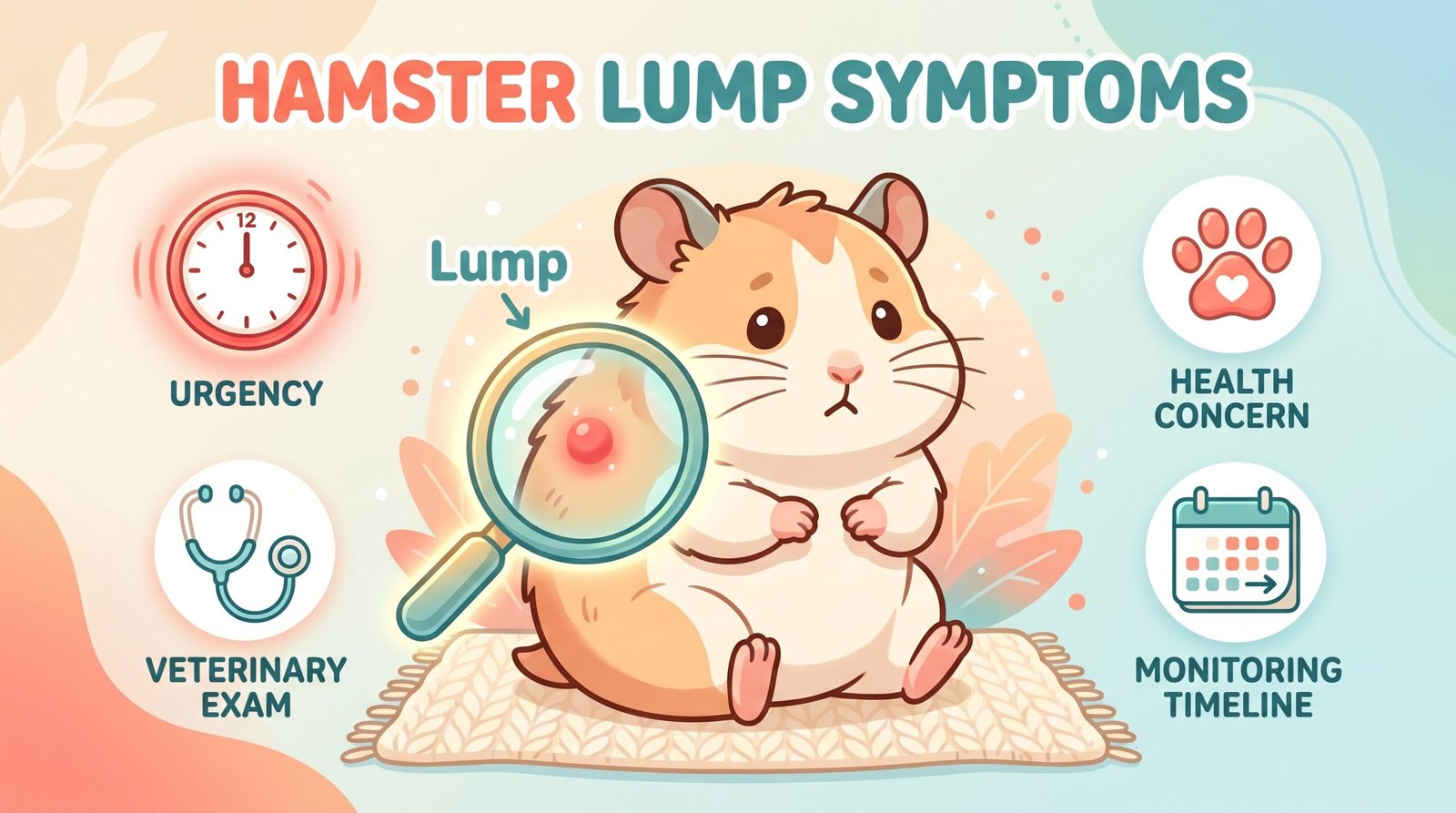
Table of Contents
Bubbles was my third Syrian hamster, and she was the one who made me change how I talk about this. Somewhere around day four after I noticed the swelling near her left flank, I convinced myself it had stopped growing. It hadn’t. By day six, the area had gone from a marble-sized raise to something almost twice that — warm, slightly firm, and pulling the fur around it tight. I got her to the clinic the next morning. The vet told me we were probably two days from sepsis. That was twelve years ago. I still think about those four days I spent watching.
People find lumps on their hamsters every week, and the most common advice they get online — on forums, in comments, in care groups — is to watch and wait. Give it a few days. See if it changes. I understand the instinct. Vets cost money. Hamsters are small. And a lot of lumps, you think, probably come and go. Here’s what that logic misses: hamsters are prey animals who mask pain and illness until they can’t. The window between “this looks manageable” and “this is now a crisis” can be measured in hours, not days.
Not a comfortable fact.
What I’ve learned — through 14 years of working directly with Syrian and dwarf hamsters, rescue organizations, and small-animal vets — is that hamster lump symptoms follow patterns that you can actually read if you know what to look for. The size matters. The texture matters. Where it sits on the body matters more than most owners expect. So does what your hamster is doing with the rest of her body while that lump sits there.
This article covers all of it.
My First Real Education in Hamster Skin Growths
Forty-eight hours. That’s how fast a superficial scratch infection can progress into something that needs surgical drainage in a young dwarf hamster.
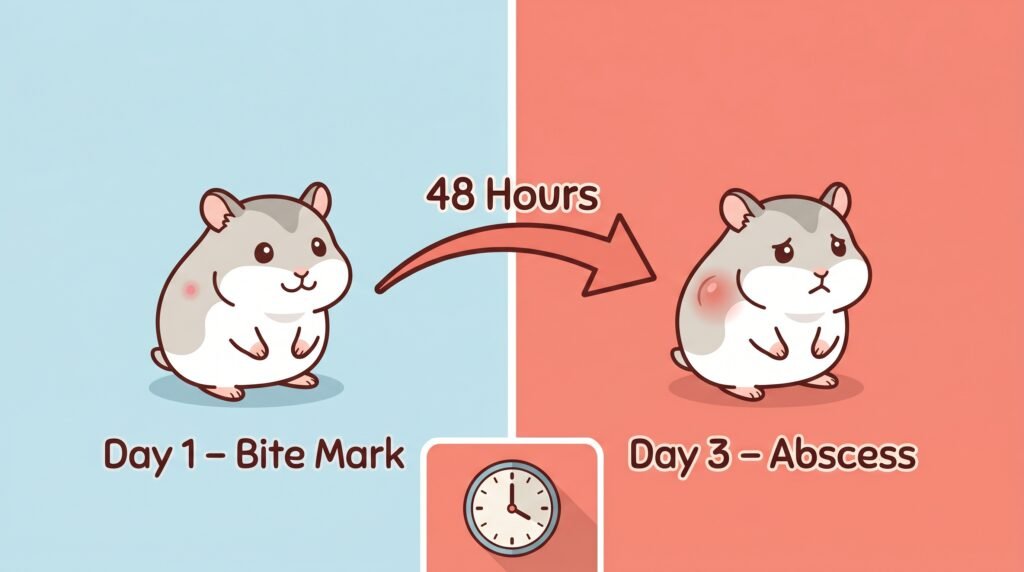
I learned that from a rescue intake — a tiny Roborovski brought in by a family who’d noticed “a small bump” near the shoulder. When the animal came through the door, the abscess was already encapsulated and warm. She’d been bitten — possibly by a cagemate — and the skin had sealed over the wound before it could drain. Two days. Three, maximum. That was all it had taken to go from bite mark to swollen pocket of infected tissue.
That’s the experience nobody frames correctly.
What Kind of Lump Is It, Actually? Breaking Down the Differences That Matter
Most guides lump these together. Pun unintentional, but I’ll own it. The problem is that treating a hamster abscess the same way you treat a hamster tumor — or vice versa — can delay the right intervention long enough to matter.
Abscess vs. Tumor vs. Cyst
Abscesses feel different under your fingers than tumors do. An abscess (a localized pocket of infection — a hamster infection that didn’t drain on its own) tends to feel fluctuant. Slightly squishy. Not firm. The skin around it is often redder than the surrounding tissue and warmer to the touch. A solid tumor feels fixed, dense, and doesn’t shift when you press lightly around its edges.
I know. This is more than most guides cover. Keep reading.
Cysts sit somewhere in the middle. They’re often slow-growing, smooth-walled, and moveable — you can gently roll them under the skin. They tend not to cause pain on palpation unless they’ve ruptured or become secondarily infected. The catch is that a cyst that looks benign for months can change character suddenly if it becomes infected or if the hamster’s immune function drops with age.
The Cheek Pouch Problem
Here’s the one that trips up even experienced owners.
Swelling on the side of the face — especially if it appears and disappears — is not always a lump at all. Hamsters use their cheek pouches to carry food, bedding, and occasionally foreign objects. A pouch that’s impacted or everted can look exactly like a facial mass. I’ve seen three separate cases of owners convinced their hamster had a facial tumor that turned out to be cheek pouch eversion.
- Impacted pouch: often a single-sided facial bulge that doesn’t resolve after several hours, sometimes accompanied by excessive grooming of the face and pawing at the mouth
- Everted pouch: the pouch tissue protrudes from the mouth — looks alarming, is repairable if caught early, fatal (from desiccation and necrosis of the tissue) if missed
- Abscess within the pouch: rare, usually tied to a sharp food item piercing the pouch wall (a seed hull, a sharp piece of hay)
- Tumor adjacent to pouch: usually grows more slowly, doesn’t fluctuate in size, and often causes visible asymmetry that persists regardless of when the hamster last ate
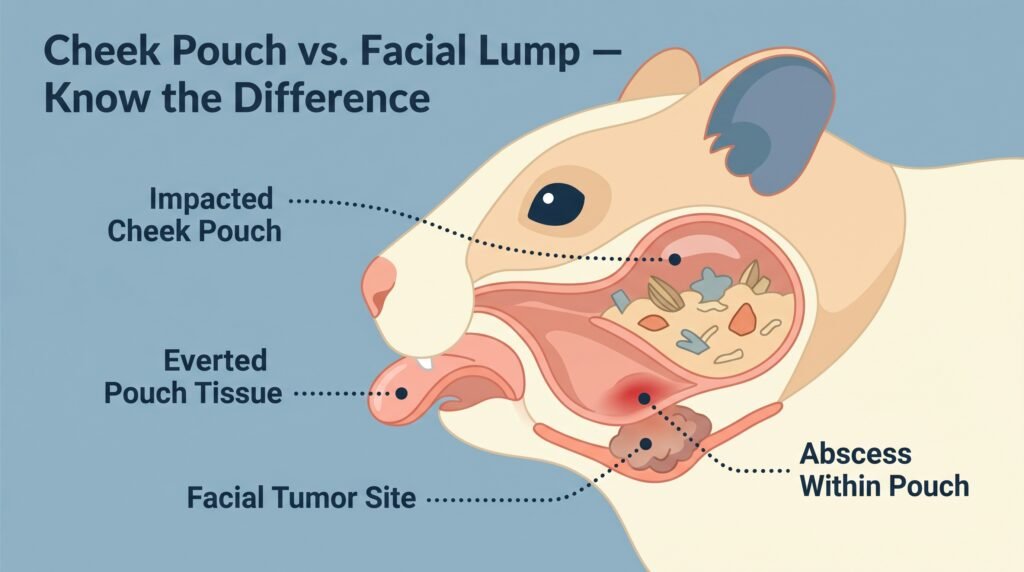
There was something else I noticed during that period about how the hamster’s eye on the affected side was tracking — I’ll come back to it later.
One thing that shifts the read immediately: whether the swelling changes with feeding. An impacted pouch fills and empties (hamster behavior changes — like frantic face-washing — are often the tell). A growth does not.
Age, Breed, and the Tumor Risk Window
Seven months. That’s roughly when Syrian hamsters enter the risk window for spontaneous mammary tumors, and most owners don’t know that number.
Dwarf species — particularly Campbell’s and Winter White Russian dwarfs — have a documented predisposition to diabetes, and hyperglycemia can complicate wound healing in a way that makes a minor skin infection progress faster than you’d expect in a healthier animal. Roborovskis trend toward smaller body mass, which means even a 1cm growth represents a proportionally much larger tissue disruption than it would in a Syrian. Size is relative. Always relative.
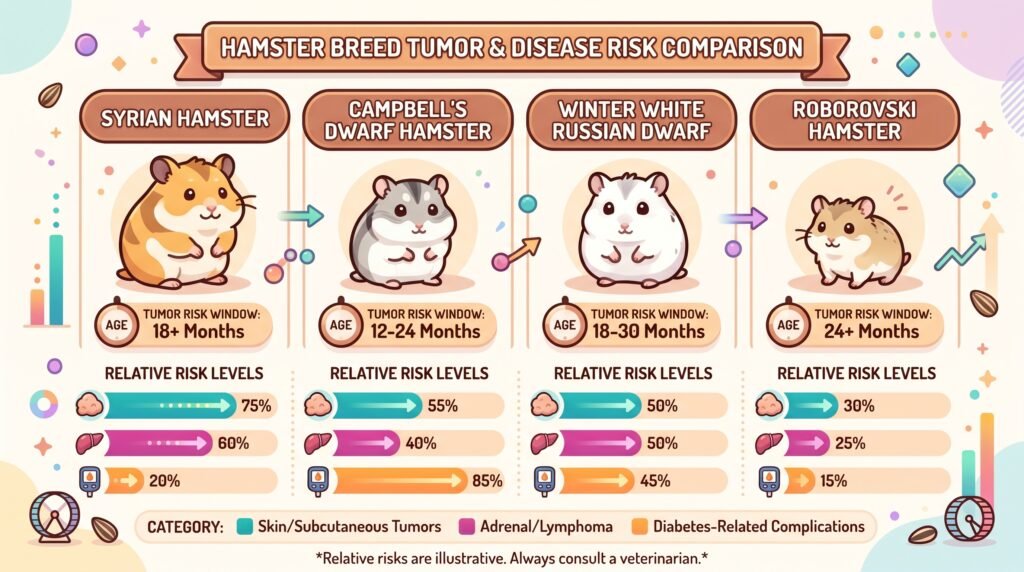
The breed breakdown for tumors, in rough terms: Syrians and Chinese hamsters are more commonly diagnosed with adrenal gland tumors and lymphoma than dwarfs are, while dwarfs show more skin and subcutaneous masses overall. That’s not a clean rule. But it shapes how urgently I’d push for a vet visit based on the animal in front of me.
The Numbers Behind Hamster Tumor and Abscess Diagnoses
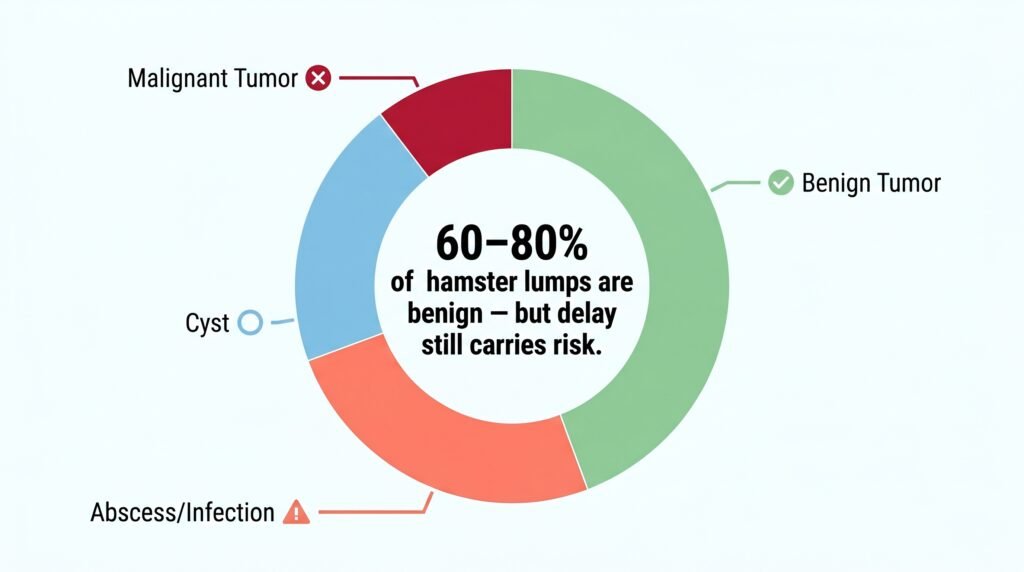
Sixty to eighty percent of all hamster neoplasms (hamster tumor diagnoses confirmed by histopathology) in one review were found to be benign — but that figure doesn’t mean delay is safe.
How Vets Diagnose a Lump on a Hamster
Diagnosis typically starts with a physical exam and often proceeds to fine needle aspirate (FNA) — a simple, low-stress procedure where the vet inserts a small needle into the mass to collect cells for microscopic evaluation. FNA can differentiate between an infected pocket and a cellular growth without requiring anesthesia in most cases. If the vet needs a more definitive answer, a biopsy under brief gas anesthesia follows.
Isoflurane is now the standard anesthetic for small rodents in practices experienced with exotic species, and risk at appropriate doses in healthy hamsters is low — though it’s higher in hamsters over 18 months due to age-related cardiac and hepatic changes. Worth knowing before you assume “surgery is too risky for a hamster.” That calculus depends heavily on age and baseline health.
What “Fast-Growing” Means in Real Terms
Fast. Under 7 days from first detection to doubling in apparent diameter — that’s the threshold that consistently shows up in small mammal clinical literature as a red flag for aggressive pathology. Slow means months of stable size, no surface changes, no behavioral shifts.
The problem: owners often don’t catch the lump the day it appears. By the time they notice, it’s already been present for days or weeks. So “it’s been there a while and seems stable” sometimes just means “I found it after it had already grown and slowed down.”
Hamster Lump Symptoms That Vets Actually Act On and What the “Wait-and-See” Advice Gets Wrong
Most guides say to watch the lump for a week before calling a vet.
Dr. Emily Carter has been questioning that advice for over a decade.
The problem: hamsters hide pain with extraordinary efficiency, and a hamster who is still eating, still running, still seeming normal can be hiding an abscess that is one day from rupturing internally. The “wait-and-see” advice (and I see it everywhere, again, in every single forum thread about this topic) assumes the animal will show obvious signs of distress before the situation becomes critical. They often don’t.
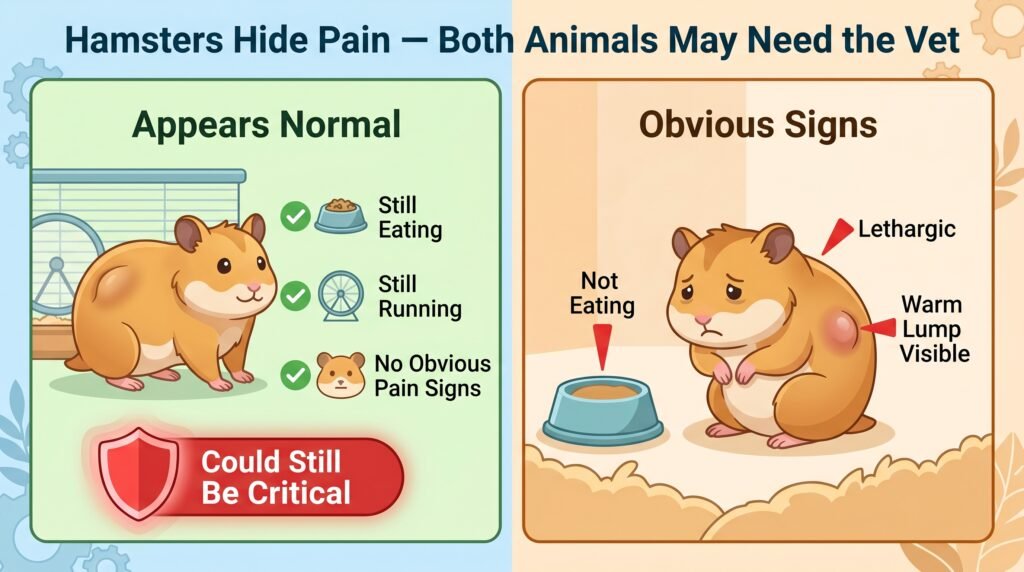
Signs That Mean Call the Vet Today — Not Tomorrow
Hamster pain signs are subtle. I want to be direct about that. A hamster who is visibly hunched, reluctant to move, or making audible sounds is a hamster in significant distress — you’re probably past “should I call?” and into “get there now.”
But these warrant same-day contact:
- Any lump with overlying fur loss — alopecia around a growth often signals local irritation, excessive grooming of the site, or compromised blood supply
- A warm, soft mass anywhere on the body — especially if it appeared within the past 72 hours
- Discharge from the lump surface, even a small amount — even dried crusting at the base of a growth
- Hamster appetite loss paired with any visible swelling — these two together in a hamster are a veterinary emergency
- Facial swelling that doesn’t resolve after several hours
- Any lump that visibly bleeds or ulcerates
Also Read: Daily Wellness Check for Hamster: 5 Things to Look at Every Morning
The Hamster Behaviors People Mistake for Normal
Tooth grinding (bruxism) in hamsters is sometimes a contentment behavior. In context of a new lump, it’s more often a pain response. Reduced wheel activity — even in an older hamster who already runs less — paired with new swelling is a signal. Hamsters who are in discomfort will also often press the affected side against cage walls, a behavior that can look like normal cage exploration to an owner who doesn’t know what they’re seeing.
| Lump Type | Typical Feel | Speed of Growth | Pain on Touch | Recommended Action |
|---|---|---|---|---|
| Abscess | Soft, fluctuant, warm | Fast (days) | Often yes | Vet visit within 24 hours |
| Benign tumor | Firm, smooth, moveable | Slow (weeks–months) | Rarely | Vet visit within 1–2 weeks |
| Malignant tumor | Hard, irregular, fixed | Variable | (varies) | Vet visit within 48–72 hours |
| Cyst | Smooth, moveable, cool | Slow, sometimes stable | Rarely | Monitor; vet if changes |
| Cheek pouch impaction | Side-of-face bulge | Appears quickly | — | Vet same day |
| Infected wound site | Raised, crusty | Fast | Yes | Vet within 24 hours |
| Lymphoma presentation | Diffuse, not discrete | Progressive | Not recommended to palpate repeatedly | Vet within 48 hours |
What the table can’t show: a benign tumor on an aged hamster with concurrent health issues carries a different urgency profile than the same mass in a 6-month-old. You’re treating the whole animal, not just the lump.
Two inline notes here. Hamster cancer signs aren’t always a discrete mass — lymphoma in particular can present as generalized thickening of tissue under the skin across multiple sites, and owners often feel the subtle puffiness under the armpits or along the belly and dismiss it as weight gain. And on the question of hamster abscess treatment: at-home drainage is something you should not attempt. The risk of driving infection deeper, of rupturing the abscess wall before the area is properly contained, is real.
What the Veterinary Literature Says — and the One Case I Still Think About
Published guidance on small mammal oncology consistently emphasizes early excision for discrete masses as the factor most correlated with good outcome in hamsters. Not watchful waiting. Not palliative management as a first response. Early removal, clean margins, and post-surgical pain management.
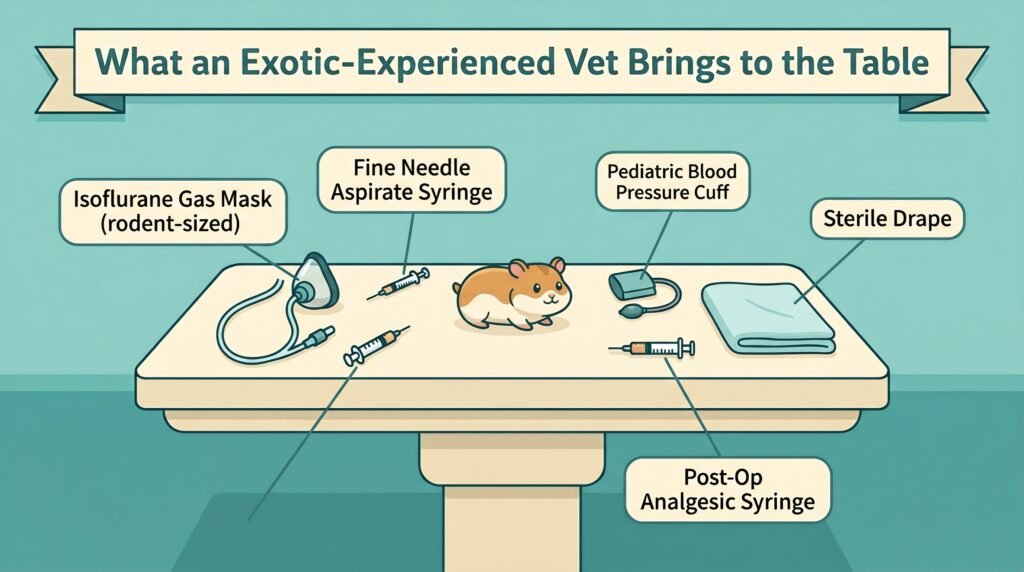
The thing I’d add is that finding an exotic pet veterinarian — not just any small animal practice — genuinely changes the quality of that conversation. A vet with no small rodent experience may not carry isoflurane, may not have pediatric blood pressure cuffs small enough to monitor a hamster under anesthesia, and may not be familiar with the specific pharmacokinetics of analgesics in hamsters.
I lost one to that gap. Not to the tumor — to the aftercare, which was calibrated for a cat, not a 120-gram Syrian. I didn’t know enough to catch it.
There’s still something I need to come back to about the eye-tracking behavior I mentioned earlier — it connects to how facial tumors progress, and I haven’t finished that thought yet.
What Rescue Organizations Have Seen Over Years of Intake
Six. That’s the average number of hamsters per year in the rescues I’ve worked with that present with growths their previous owners described as “just appeared.”
Most had been present, based on growth size and what we know about typical tumor doubling times, for four to eight weeks before the owner noticed. By intake, about a third of those animals were in some degree of pain.
The sensory detail nobody tells you: when you pick up a hamster with a significant abscess and he doesn’t resist the way he normally would, that’s not calm. That’s the exhaustion that comes from sustained, suppressed pain. Healthy hamsters squirm. They object. When one goes still in a way that feels cooperative, check the animal very carefully.
Comparing Treatment Paths for Hamster Lumps: What Each Option Actually Involves
Somewhere around week three post-diagnosis, owners start asking about alternatives. I understand. Hamster surgery — even minor procedures — sounds daunting. The table below is what I walk people through.
What “Monitoring” Actually Means (And When It’s Legitimate)
Monitoring is not doing nothing. Done properly, it means daily palpation at the same time of day to track size, weekly written notes on behavioral changes (hamster behavior changes like activity level, eating, and grooming patterns), and a pre-agreed threshold with your vet — a defined size or symptom that triggers immediate follow-up. Anything vaguer than that isn’t monitoring. It’s hoping.
When Monitoring Becomes Negligence
A growth that crosses 1cm in a dwarf species — or 2cm in a Syrian — without veterinary evaluation is past the monitoring window for most exotic small-mammal vets I’ve spoken with.
| Treatment Option | Appropriate For | Cost Range | Recovery Time | Risk Level | Notes |
|---|---|---|---|---|---|
| Surgical excision | Discrete, accessible masses | $200–$600+ | 7–14 days | Moderate (age-dependent) | Best outcomes for clean-margin removal |
| FNA + monitoring | Suspected benign cysts, stable masses | $50–$150 | — | Low | (check with vet) for older hamsters |
| Abscess drainage (vet-performed) | Confirmed abscesses | $100–$300 | 5–10 days | Low–moderate | Requires follow-up and antibiotics |
| Antibiotics alone | Superficial infection without abscess | $30–$80 | Varies | Low | Not recommended as sole treatment for encapsulated abscess |
| Palliative care only | Advanced age, poor surgical candidate | Variable | — | — | Quality-of-life focused |
What that table can’t show: the cost of waiting. A hamster who develops sepsis from an untreated abscess requires intensive supportive care — fluid therapy, aggressive antibiotic coverage, sometimes hospitalization — that costs substantially more than early drainage would have.
The sensory detail from that first rescue case: the warmth of that encapsulated abscess was measurable even through examination gloves. Infection generates heat. When a lump on a hamster feels warm to your fingertip, that’s not a subtle sign. It’s a clear one.
One more note on the eye-tracking observation I mentioned in section two: when a facial tumor in a Syrian grows toward the orbital cavity, the eye on the affected side will often show subtle protrusion — called exophthalmos — before the external swelling becomes obviously alarming. That was what I was watching in that case. I didn’t have the vocabulary for it then. Now I do. And I’ve never fully let go of the week I spent naming it wrong.
What I’ve Gotten Wrong and What I Still Don’t Know
Twenty-two. That’s the number of hamsters I’ve had die under my care across 14 years — rescues, personal animals, fosters — from all causes. Some of those deaths I understood completely. A few I still don’t.
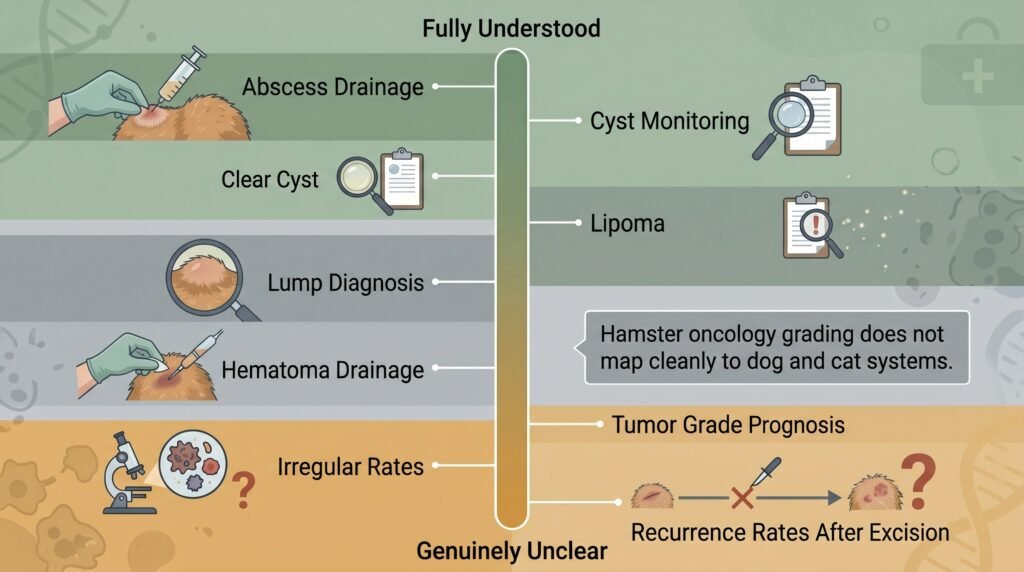
What Remains Genuinely Unclear in Hamster Oncology
Hamster diagnosis — even when you get the tissue pathology — doesn’t always tell you what you want to know about prognosis. Tumor grade in hamsters doesn’t map cleanly to the grading systems used for dogs and cats. Studies on recurrence rates after excision in hamsters are sparse, most are small-sample, and they vary enough in methodology that I’m cautious about citing any single figure as reliable.
What I usually tell owners: I don’t know how long we have. Nobody does, fully. What we can know is whether the animal is in pain right now, and whether there’s a reasonable path to changing that.
Don’t try to express a hamster abscess yourself. I’ve said it already, and I’ll say it one more time because the YouTube tutorials on this are irresponsible. You will drive bacteria into the surrounding tissue. You will cause the kind of pain in a prey animal who cannot show you how bad it is. You will waste time that should be spent in a clinic. The hamster wound infection that looks superficial almost always has a deeper pocket than you can see from the outside.
In most cases, hamsters over 24 months are not the best surgical candidates — cardiac and hepatic risks go up, anesthetic margins narrow. I’ve seen this go differently with individual animals who were otherwise in excellent health. But “usually” is the honest word here, not “always.”
When to Go to the Vet: A Practical Decision Map for Hamster Lump Symptoms
Same day.
If your hamster has any combination of: lump plus appetite loss, lump plus unusual stillness, lump plus visible discharge, or a facial swelling that hasn’t changed in four hours — go today. Not tomorrow. Today.
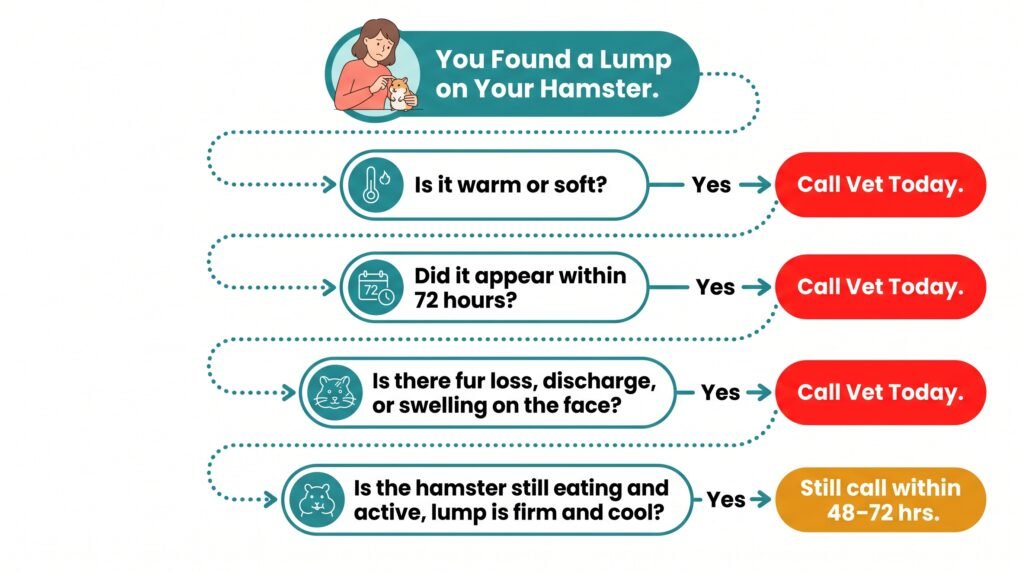
What to Tell the Vet When You Call
Most exotic-practice vets will triage over the phone. What they need:
- How long ago you first noticed the lump (be honest — “about a week” is more useful than a guess that sounds more recent)
- Size estimate — use a coin or a known object for scale, not “pea-sized” or “marble-sized” since those vary wildly
- Location on the body (flank, belly, face, groin, axilla)
- Whether it’s firm or soft, warm or room-temperature to the touch
- Any behavioral changes — specifically hamster appetite loss, reduced activity, or changes in grooming
How to Prepare for the Actual Appointment
Bring the hamster in the cage she normally lives in, or in a ventilated carrier with some of her own bedding and a small amount of food. Don’t clean the cage first. The vet can sometimes gather useful information from the smell and appearance of the enclosure. Bring a list of everything she eats — including treats — and the brand of bedding you use. Some skin reactions and superficial hamster skin growths are contact-related.
Hamster surgery recovery, when it happens, typically requires a temporary switch to paper-based bedding with no loose fibers or dust that could introduce bacteria to the incision site. Most hamsters are back to baseline behavior within 5 to 7 days after minor procedures. Incision sites should be checked twice daily — any redness spreading beyond the immediate wound margin, any swelling returning, or any discharge warrants a same-day call back to the clinic.
- Document it first: take a photo the day you find the lump, with your finger in frame for scale — helps the vet see baseline size
- Note the exact location using anatomical terms if possible: left flank, right axilla, ventral midline, scruff of neck
- Check whether the area is warm relative to surrounding skin
- Write down any behavioral observations from the past 72 hours, not just today
- Call the exotic vet first — not the general small-animal practice — and ask explicitly whether they have experience with small rodent anesthesia
- 48 hours maximum from detection to first vet contact for any soft, warm, or fast-appearing lump
Seventy-two hours from first notice to the point of treatment makes a measurable difference in abscess outcome — not a philosophical difference. A measurable one.
Finding a lump on your hamster doesn’t automatically mean crisis. I want to say that clearly, because the fear response sometimes pushes owners in the wrong direction — either to panic or to deep denial. What it means is: you need information you don’t have yet, and only a vet examination can give it to you.
The moment that still stays with me clearest is not Bubbles, actually. It’s a foster hamster I had for eleven days before I noticed what I should have caught on day two — a subtle thickening behind her right shoulder that I had passed off as muscle. By day eleven, the hamster lump symptoms were obvious. By day thirteen, she was in surgery. She came through. But those nine days I gave up because I was looking for something more obvious — those sit with me.
Get the lump checked.
Frequently Asked Questions
Can a hamster lump go away on its own?
Rarely, and only under specific circumstances — some small cysts resolve spontaneously, but abscesses do not drain safely without intervention. A lump that disappears quickly and without treatment is worth mentioning to a vet anyway, because it may indicate cheek pouch activity rather than an actual growth.
How do I know if my hamster’s lump is an abscess or a tumor?
Texture is the first clue — abscesses tend to feel soft and slightly moveable under the skin, while tumors are usually firmer and more fixed to underlying tissue. Neither of these characteristics is definitive without a vet examination, and fine needle aspirate is the reliable next step. Most hamster abscess treatment starts with drainage and antibiotics, but that plan depends on the vet first confirming it is actually an abscess — a firm, cold lump that turns out to be a tumor treated as an infection will not improve on antibiotics. Timing matters because abscesses can reach critical stage in days, and some tumors have a similar trajectory. One caveat: a hamster abscess in the cheek pouch area can sometimes feel firmer than a typical skin abscess, which is why facial lumps especially need hands-on evaluation.
Should I try to pop or drain a hamster lump at home?
Never attempt this. Home drainage introduces bacteria, risks rupturing the abscess wall into surrounding tissue, and causes significant pain in an animal that can’t communicate that to you.
My hamster has a lump but seems completely normal — does she still need a vet?
Behavioral normalcy is not a reliable health indicator in hamsters, because prey-species behavior suppresses outward pain signs; what looks fine often isn’t. That said, a small, cool, firm, slow-growing mass in a young hamster can sometimes be monitored under vet guidance — but that still means a vet visit to establish that plan, not skipping the visit entirely.