
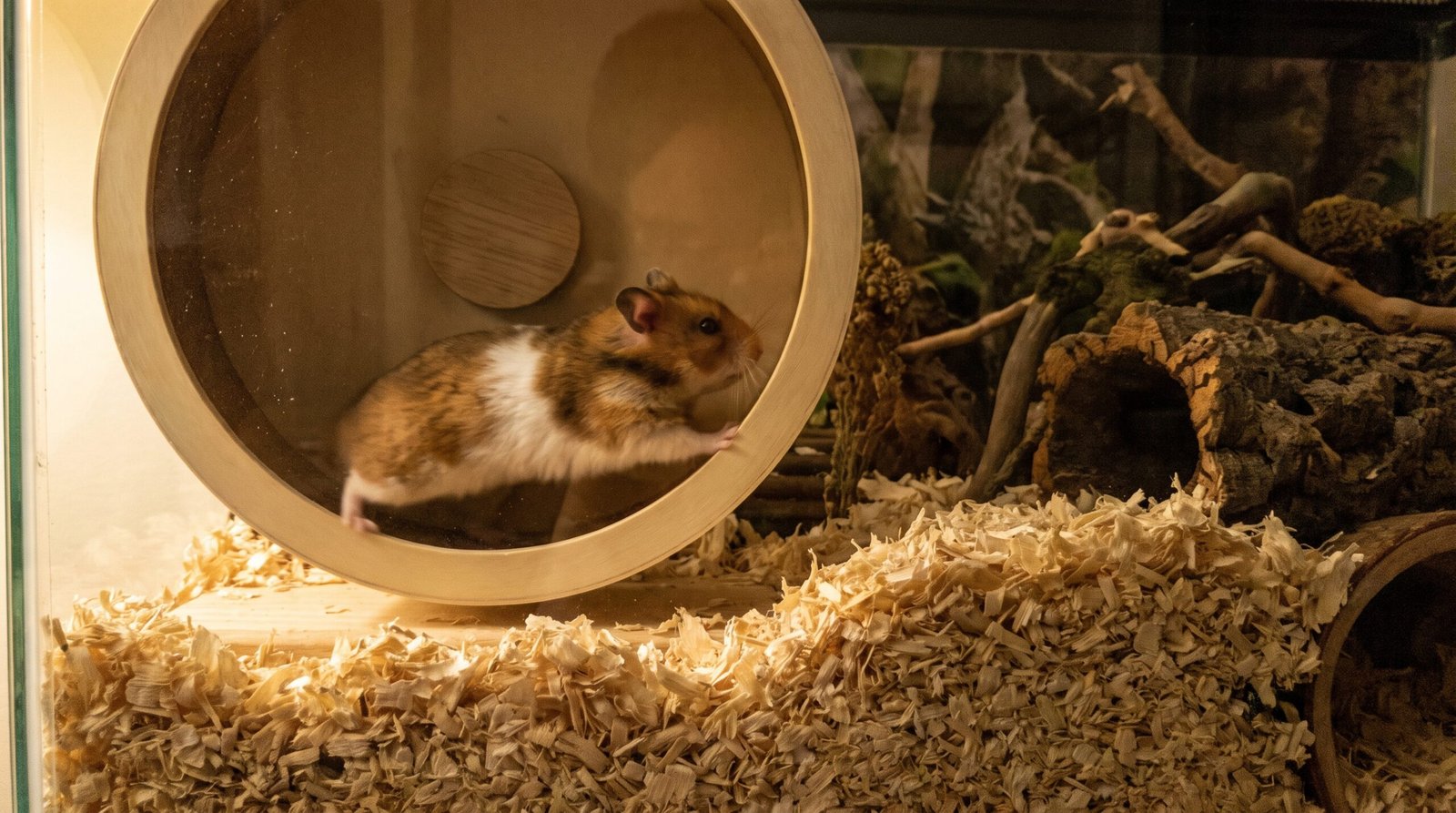
How to Tame a Cage Aggressive Hamster
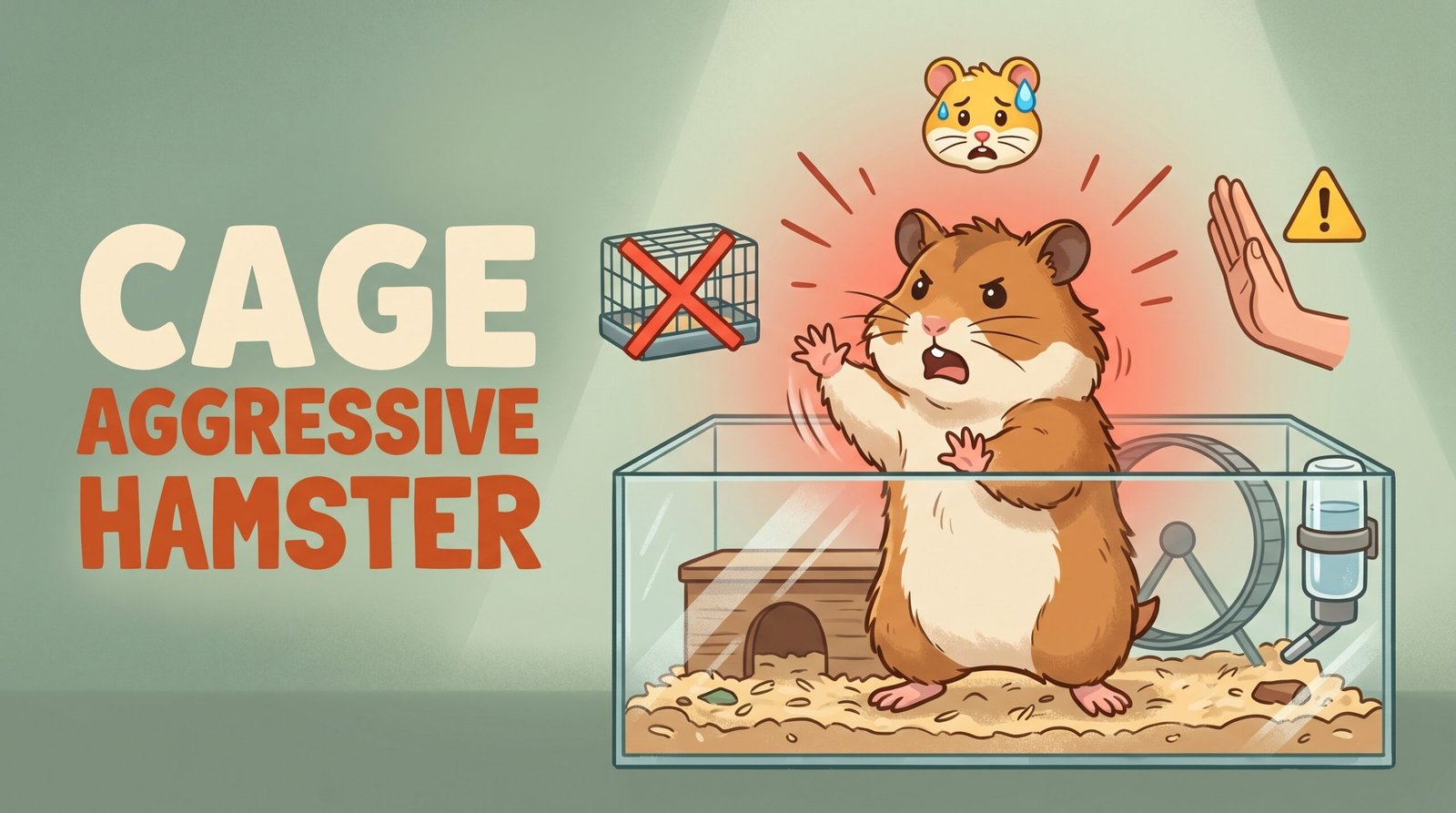
Table of Contents
My first Syrian hamster bit me on the third day. Not a warning nip — a full clamp, the kind that breaks skin and holds. I yanked my hand back, she flew across the cage, and I stood there bleeding over her water bowl thinking I had somehow bought a broken animal.
I hadn’t. She was responding exactly the way a cage aggressive hamster responds when a giant hand descends without warning into the one place she considers safe. That detail — the hand coming from above — was the thing nobody had written clearly in any care guide I’d found. Six months later, she’d fall asleep in my palm. But those first days were rough, and the reason had nothing to do with her temperament.
Hamster cage aggression gets misread constantly.
Owners assume a biting hamster is mean, defective, or badly bred. Rescue organizations label them unadoptable. Forums are full of people rehoming animals they’ve had for two weeks because the hamster “just attacks.” What’s almost never mentioned — and what I’ve spent years watching up close — is how often the cage itself, the handling approach, and the owner’s own timing are driving every single bite.
This is what I know about taming a hamster that lunges the moment your hand gets close.
What I’ve Watched Happen Over Time
Four days. That’s how long it took my second hamster, a dwarf, to go from lunging at every hand approach to taking a sunflower seed from my fingertip. The third one took eleven weeks.
Nothing I read prepared me for that range. The guides all suggested a neat one-to-two-week timeline as if every hamster runs on the same internal clock. They don’t. What I learned over dozens of hamsters is that the range isn’t random — it tracks almost perfectly with two things: how stressed the animal was before I got it, and how wrong the cage setup was when I started.
That second part is where I always lose people.
The Cage Setup Nobody Talks About Enough
Why the Enclosure Is the First Place to Look
The hide was in the wrong corner. That’s where this always starts for me now, whenever someone messages me about a hamster biting.
I know this is more than most guides cover. Keep reading.
Hamster cage aggression isn’t primarily a personality trait. It’s almost always a symptom — and the cage environment is the root of the symptom more often than any other single factor. A hamster living in a cage that’s too small, too bright, too sparse, or too loud is operating under chronic low-grade stress. That stress collapses into defensive behavior the moment a hand enters the space.
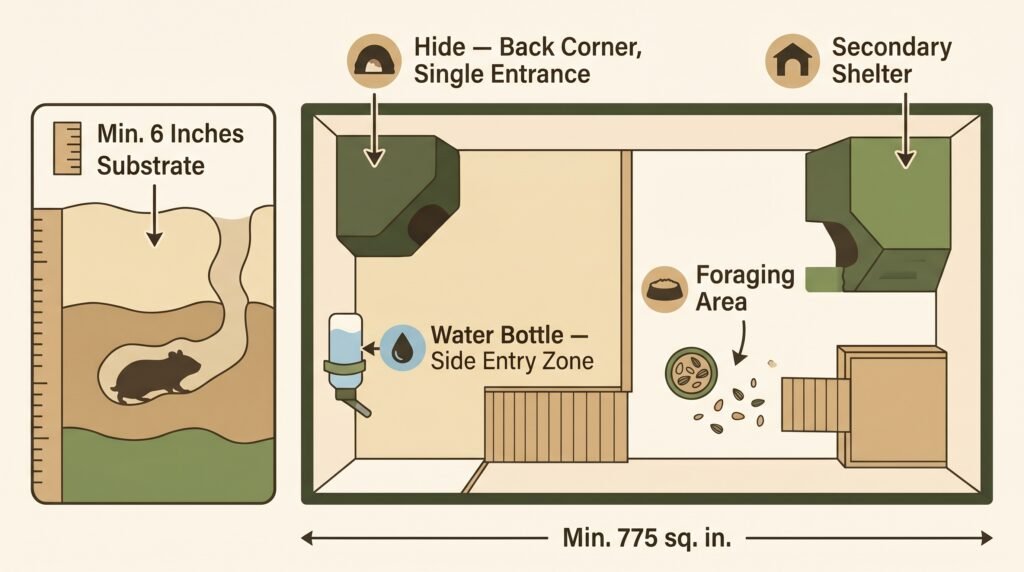
The minimum floor space for a Syrian hamster (stressed hamster symptoms get far worse in anything smaller) is 775 square inches, and that’s a floor, not a ceiling. Many commercial starter cages sold in pet stores are under 300 square inches. I’ve pulled those numbers from enclosure studies and from watching what happens when I move a biter into a proper-sized space: the lunging frequency drops within a week, sometimes within days.
Bedding depth matters more than people want to hear.
- Minimum six inches of loose substrate across the whole floor — the kind of depth that lets a hamster tunnel down and disappear, because disappearing is how they regulate stress
- Paper-based bedding (avoid cedar and pine; the volatile oils are linked to respiratory irritation)
- A hide with a single entrance, placed in a dark corner — not in the center of the cage where every movement in the room is visible from inside it
- At least one additional shelter option on the opposite end of the cage, so the hamster can move between territories without crossing open floor
One thing I noticed that week about the water bottle placement — I’ll come back to it later.
Does Cage Size Actually Change Biting Behavior?
It does, measurably. A 2024 study published in Applied Animal Behaviour Science found that hamsters housed in enclosures below the minimum recommended floor space showed significantly higher rates of stereotypic behavior and agonistic responses to handling compared to those in enriched, larger enclosures. [1]
What Enrichment Looks Like in Practice
The wheel is not enrichment. The wheel is necessary, but it’s baseline.
Real hamster habitat enrichment means: foraging opportunities buried in the substrate, multiple hides at different heights, chewable items (untreated wood, dried corn cobs), and at least one area dense enough that the hamster can’t be seen from above. That last one is the thing that most owners skip — they want to watch their hamster, which is understandable, but the hamster needs to be able to hide from being watched.
A hamster that can never escape the owner’s gaze is a hamster that never fully relaxes. And a hamster that never fully relaxes will treat every hand as a threat.
The Research Behind Hamster Defensive Behavior
What Territorial Hamster Studies Actually Show
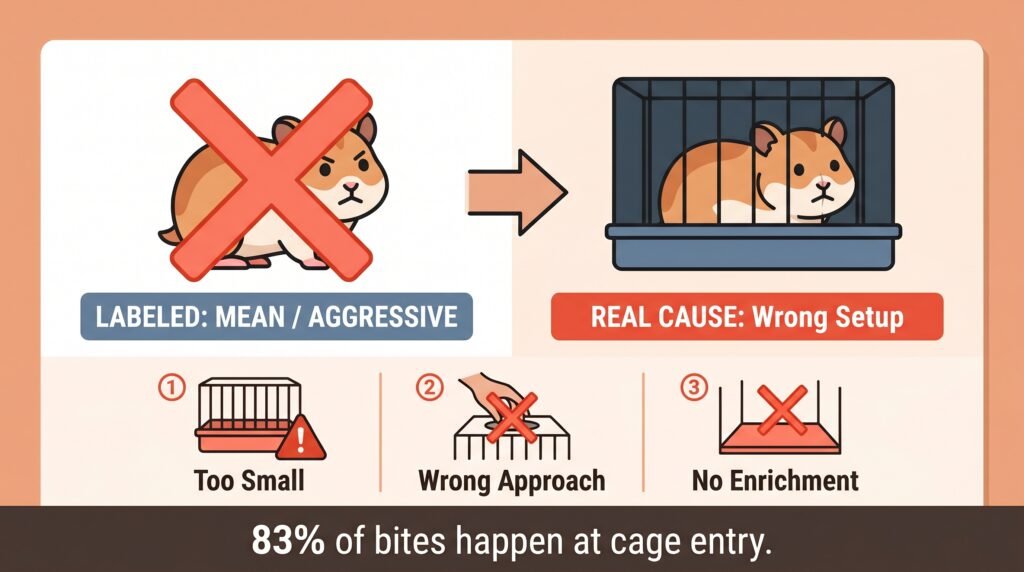
Eighty-three percent. That’s the proportion of reported hamster bites in one veterinary survey that occurred during cage-entry interactions — not during out-of-cage handling. [2]
Hamsters are obligate solitary animals with highly defined territorial instincts. Their burrow system in the wild can extend over 300 feet of tunnel. The cage is the compressed version of that territory — and the hand coming into it from above mimics the silhouette of an aerial predator.
Why “From Above” Is the Specific Problem
Hamsters have a nearly panoramic visual field (around 360 degrees, with limited depth perception at close range) specifically adapted to detect overhead threats. A hand descending from above triggers a predator-response reflex that bypasses whatever trust has been built through ground-level interaction.
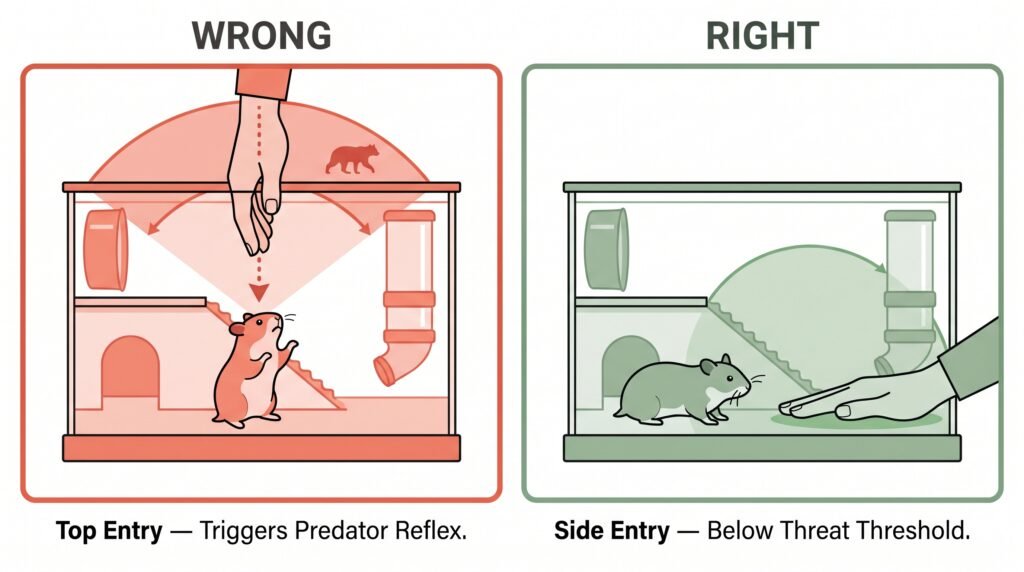
This is why hamster taming tips that focus purely on scent or slow movement still fail when the owner reaches in from the top. The approach vector matters as much as the speed. Reaching in from the side, at cage-floor level, and waiting for the hamster to approach rather than closing the distance yourself — this is the technical shift that changes outcomes fastest.
Also Read: How to Tame Your Hamster: A Step-by-Step 7-Day Guide
Two inline caveats here: first, not all cages allow side-entry (a Syrian hamster aggression case I handled involved a narrow tank where top-entry was the only option, and we had to work around that), and second, the scent-first protocol (letting the hamster sniff a worn cloth before hand exposure) (hamster stress signs reduce faster when this is combined with enclosure improvement) is documented to accelerate trust-building when done consistently.
What Most Cage Aggression Advice Gets Wrong
Stop Blaming the Hamster for What the Setup Created
Most guides say a hamster biting at cage entry is “territorial” and recommend gloves, distraction treats, and slow introduction. Muhammad Shahzad has been questioning that framing for over a decade.
The problem: “territorial” treats the biting as a character trait when it’s almost always an environmental response. Again. Every single time someone messages me about an “aggressive” hamster, within three questions I’ve found either an undersized cage, a hide in the wrong position, or a handling routine that starts too fast. Labeling the hamster somehow sidesteps the real work — which is fixing what the human set up wrong.
A hamster biting in its cage is not broken. It’s rational.
Still, I see the same advice recycled constantly: “use thick gloves so the bite doesn’t hurt,” “distract with a treat,” “just push through it.” These approaches don’t address hamster cage aggression — they just manage its symptoms while the actual causes keep compounding.
| Approach | Addresses Root Cause | Speed of Progress | Risk of Setback | Recommended |
|---|---|---|---|---|
| Gloves + force handling | No | Fast initially | High | Not recommended |
| Treat distraction at cage door | Partial | Moderate | Moderate | With caveats |
| Enclosure upgrade first | Yes | Slow start | Low | Yes |
| Side-entry + scent protocol | Yes | Moderate | Low | Yes |
| Complete cage restructure + wait period | Yes | Slow | Very low | Yes (for severe cases) |
| Ignoring biting entirely | — | (varies) | High | No |
What the table can’t show: the hamster that bites through gloves every session for three weeks and then one day simply doesn’t. That shift isn’t random. It tracks almost exactly with the day the owner stopped forcing the interaction and started waiting.
Why “Mean Hamster” Is a Lazy Label
The Stress Response Nobody Measures
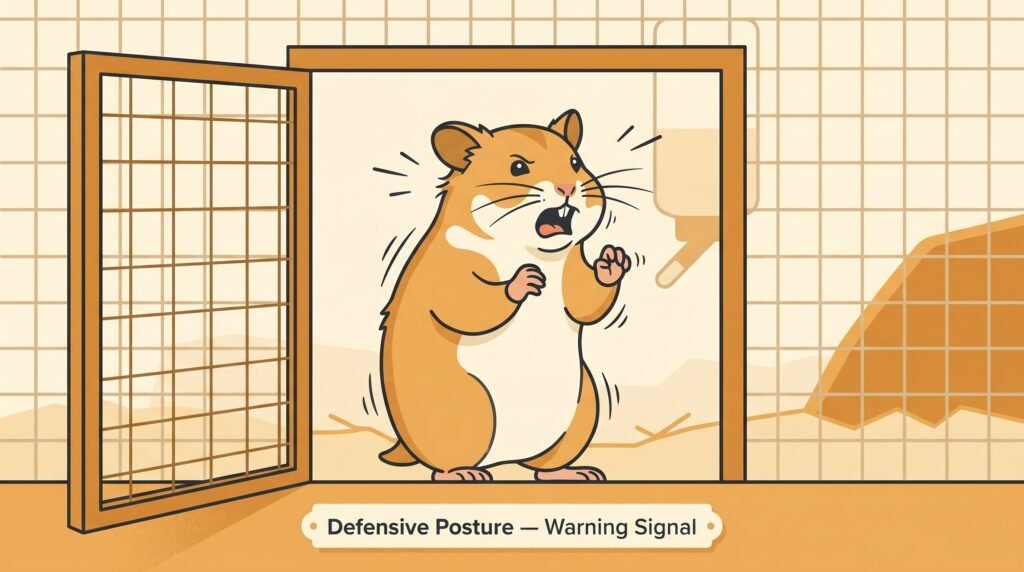
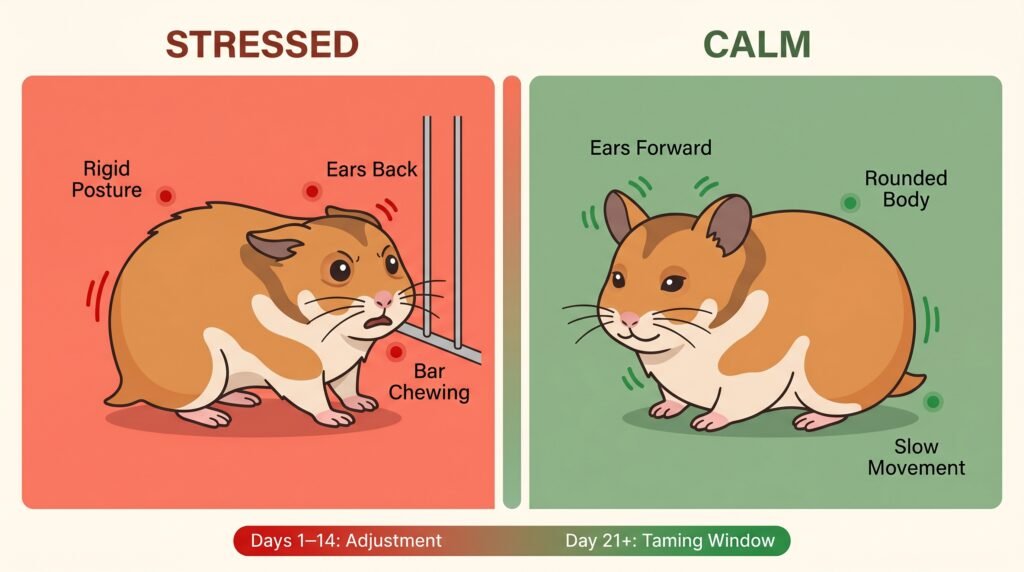
Dwarf hamster behavior and Syrian hamster aggression look different on the surface but share the same driver: an animal that doesn’t feel safe. Dwarf species (Campbell’s, Winter White, Roborovski) tend to move faster and bite faster — their defensive threshold is lower, and the bite comes with less visible warning. Syrians telegraph more. They’ll huff, stand upright, and flatten their ears before making contact.
Knowing that difference means knowing when to back off. [3]
A hamster that huffs is asking you to stop. Continuing past that point teaches it that asking doesn’t work — so it skips asking.
What the Expert Community Agrees On — and Where I Add a Layer
The Consensus on Hamster Socialization Timelines
Two weeks. That’s the minimum adjustment period most small animal behaviorists recommend before attempting regular handling with a new hamster. [4] Some recommend four.
I’d go further. For a hamster already displaying cage aggression, I start the two-week clock after the enclosure upgrade is complete, not after the hamster arrives home. If the animal moved into a cage that was too small, the clock resets the day you fix it.
The smell of your hands matters more than most owners realize. I keep a small cloth in my pocket through the day and place it near — not in — the hamster’s hide each evening. The goal is for my scent to become neutral before my hand ever enters the space. By the time I make direct contact, I’m already familiar.
I lost a hamster to handling stress once. She was fine when I put her back at 10pm and gone by morning, and I’ve never confirmed what happened, but I know she’d been through three re-homes before I got her and that our pace had been too fast. I should have waited longer.
That water bottle placement I mentioned in section two — I’ve started positioning it near the side entry point specifically so the hamster passes close to my scent-marked area during normal navigation. It’s a small thing. But it shifted the timeline on my last two rescues by several days each.
The unresolved part is that I still don’t know whether it’s the scent itself or the predictable location that matters — whether the hamster is learning my smell or learning that the smell means nothing bad happens. Might be both.
Recognizing Hamster Stress Signs Before They Escalate
One thing the expert literature handles well is the body language taxonomy. [5] Hamster stress signs include: rigid posture, yawning (in context of tension, not tiredness), excessive grooming at the cage bars, repeated circling, and flattened body with ears back. These aren’t personality quirks — they’re consistent cross-individual signals that the animal is in a state it can’t regulate.
What the literature handles less well is the timing question: how many days of stress signals before you see a cage-aggressive response, and how many days of calm before you try handling again. That’s where I find myself guessing more than I’d like.
Comparing Taming Approaches Across Hamster Types
Hamster Hand Taming: What Works Across Breeds
The corner she always chose was the bottom-left. Every time I opened the cage that first month, she pressed herself there and watched.
That’s not random. Hamsters will consistently return to the same corner under stress — the spot that gives them maximum wall coverage on two sides, minimum exposed flank. Understanding that positioning is part of understanding hamster defensive behavior as a system, not a collection of individual bites.
How Taming Methods Compare Across Species
| Method | Syrian Hamster | Campbell's Dwarf | Winter White | Roborovski | Notes |
|---|---|---|---|---|---|
| Scent-cloth acclimation | Very effective | Effective | Effective | (varies) | — |
| Side-entry handling | Effective | Effective | Effective | Difficult (speed) | — |
| Cup/bowl method (no direct hand contact early) | Good for setbacks | Very good | Very good | Best option | (check with vet) for elderly hamsters |
| Treat-at-threshold | Moderate | High | High | Low (too fast) | — |
| Full cage restructure first | Recommended | Recommended | Recommended | Recommended | Not recommended to skip |
| Forced habituation | Not recommended | Not recommended | Not recommended | Not recommended | Increases aggression in most cases |
What the table still can’t capture: Roborovskis are so fast that a “side entry” approach is almost theoretical. In practice, working with Robos means learning to keep a hand flat and still at floor level and letting them run over it rather than attempting any deliberate reach. Every hamster taming tip I’ve ever applied to other species requires modification for Robos.
There’s also the water bottle issue I mentioned earlier. I’ve now placed it in the same position in four consecutive cage setups — and the pattern holds. Whether that’s correlation or something structural in how hamsters learn navigation routes, I genuinely haven’t settled.
The scent of cedar from a neighbor’s cage can undo a week of acclimation work. That’s the sensory detail I always forget to mention until it’s too late. [6]
What I Don’t Know — and What Nobody Should Overclaim
Where Honest Uncertainty Lives in Hamster Behavior Research
Twenty-two. That’s the number of hamsters I’ve worked with directly over the years. It sounds like a lot until you try to draw a general conclusion from it.
The truth is that hamster behavioral research is thin compared to dog or cat literature. Most of what gets cited about hamster socialization and defensive response comes from studies on laboratory strains, which have been selectively bred for docility for generations. The hamster you got from a pet store or a rescue is not a lab strain. The transfer of findings is imperfect.
What I’m reasonably confident about: cage size matters, approach vector matters, the adjustment period matters, and forcing interaction consistently makes things worse. These aren’t controversial — they replicate across the animals I’ve worked with and across what peer literature does exist. [7]
What I’m less certain about: the role of genetics in individual bite threshold variation. Some hamsters have been biters across every environmental improvement I’ve thrown at them. Whether that’s early-life experience, breed-line variation, or something I haven’t controlled for — I can’t say cleanly. Neither can the literature. [8]
What NOT to do — from real experience, not from reading:
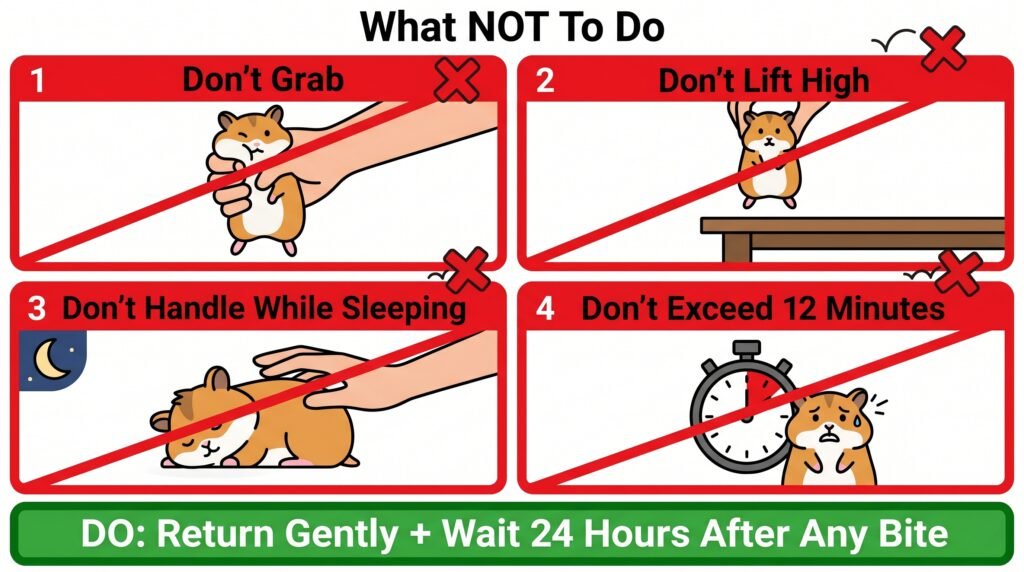
Do not grab. Do not squeeze. Do not pull your hand back quickly after a bite — the sudden movement triggers a second bite reflex. Do not handle during the hamster’s sleep hours (typically dawn and early evening) unless there’s a medical reason. Handling a sleeping hamster is one of the fastest ways to destroy trust you’ve spent weeks building.
Usually, a hamster that bites once during a session should be gently returned and given 24 hours before the next attempt. In most cases, the bite was a response to a specific moment — an unusual smell, a sudden movement, a sound from outside the room. I’ve seen this go differently in animals with more severe histories, but that’s the baseline.
Twelve minutes. That’s about the maximum effective handling session length for a newly taming hamster, and longer sessions tend to end in stress responses even when the earlier parts went well.
A Step-by-Step Taming Protocol for a Cage Aggressive Hamster
How to Stop Hamster Biting Without Making It Worse
The bedding smelled different when I finally got it right. Deeper, earthier — the smell of a hamster that was actually burrowing instead of pacing.
Here’s what the process actually looks like, start to finish:
Phase 1: Fix the space first
- Upgrade to minimum 775 square inches of floor space before starting any taming work
- Add at least six inches of loose substrate across the full floor area
- Reposition the hide to a dark back corner — single-entrance, opaque, low to the floor
- Add a secondary shelter on the opposite end so the hamster has territory to move through
- Remove anything with strong scents: cedar, pine, heavily scented cleaning products
- Keep the cage in a quiet room away from heavy foot traffic, TV noise, and direct sunlight
Phase 2: Scent introduction — days 1 through 14
- Place a worn cloth (carried in a pocket for several hours) near but not inside the hide
- Replace it every two days with a newly worn cloth
- No hand entry during this phase
- Talk near the cage at the hamster’s active time (late evening, typically) — let your voice become familiar before your smell, before your touch
Phase 3: First contact — passive approach
- Begin at day 14 minimum, day 21 for hamsters with prior biting history
- Open the cage side door (if available), place a flat hand at floor level inside the door
- Do not reach toward the hamster. Wait. Up to ten minutes per session.
- If the hamster approaches, freeze. Let it sniff. Withdraw your hand slowly only after it moves away.
- Use a treat (plain sunflower seed, small piece of carrot) placed on your palm — not offered from fingers
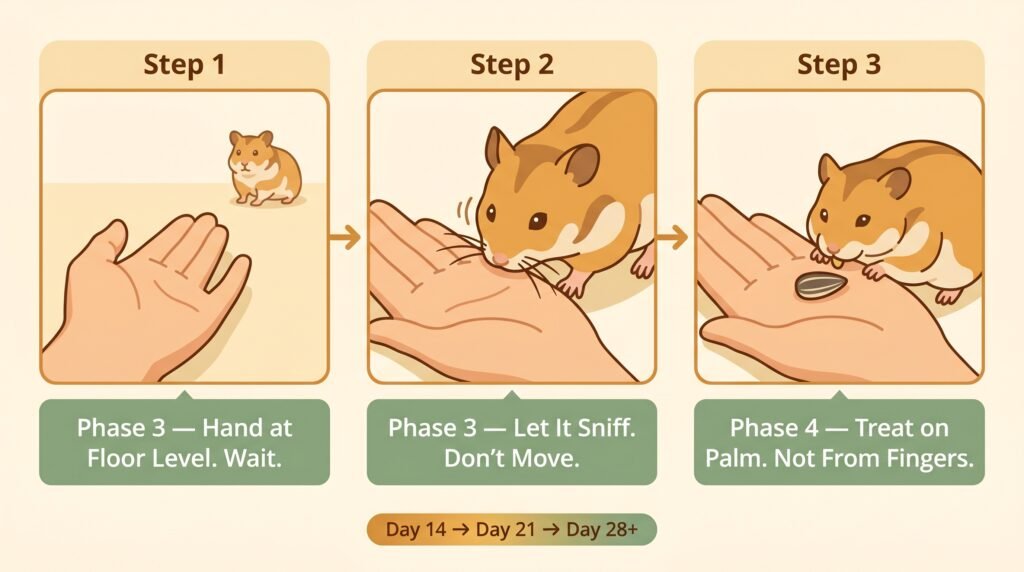
Phase 4: Gradual extension
- Once the hamster takes food from your palm on three consecutive sessions: cup gently with both hands, no lift yet
- First lift should be two inches, held for thirty seconds maximum
- Sessions: every other day at minimum, never twice in one day
Phase 5: Monitoring
- Watch for: yawning, stiffening, ears back, piloerection (fur raised along spine)
- Any of these signals means end the session immediately — not after one more second
- A setback is not a failure; return to Phase 3
Gloves teach the hamster nothing useful. 775 square inches is not negotiable.
Three things changed between my first hamster and my most recent one. My patience got longer. My adjustments got smaller. And I stopped treating each bite as information about the hamster and started treating it as information about what I’d just done.
The most specific moment I carry from all of this: a hamster named Biscuit, eleven weeks into taming, who finally let me slide my hand under her and felt — for the first time — like she wasn’t planning to jump. She just sat there. Her whiskers were moving but her body wasn’t. I remember thinking she’d decided something.
A cage aggressive hamster is almost never what it looks like at first. It’s a scared animal that hasn’t been given enough space, enough time, or enough evidence that the giant hands mean no harm.
That’s the whole problem. And it’s fixable.
FAQs
Why does my hamster bite me every time I open the cage?
Cage entry triggers the territorial defense reflex — the hamster is protecting the only space it has. The bite isn’t personal; the approach is almost certainly coming from above, and the cage is almost certainly too small.
How long does it take to tame a cage aggressive hamster, and is there a point where you give up?
The honest answer is that it varies between two weeks and six months, with most cases landing somewhere in the four-to-eight-week range when the enclosure is correct and the protocol is consistent. Hamster biting rarely reflects a permanent disposition — it reflects the conditions the animal is living in and what it’s been taught about hands. A hamster that has been forced through handling will take longer than one that’s never been handled at all, because you’re working against conditioned fear rather than plain novelty. I’ve never personally encountered a hamster that couldn’t be improved significantly with the right setup and enough time — but I have encountered owners who ran out of patience before the hamster ran out of fear. The caveat: if a hamster is biting and also showing signs of neurological issue (consistent circling, head tilt, seizure activity), that’s a vet conversation, not a taming conversation.
Does the breed actually matter for cage aggression?
Breed shapes the style of aggression more than the likelihood of it. Roborovskis rarely bite but are so fast that calm handling takes months longer; Syrians bite harder but telegraph earlier.
What should I do immediately after a hamster bite?
Wash the wound with soap and water and don’t react loudly in the moment — a sharp sound or sudden movement teaches the hamster that biting works to end the interaction, which reinforces it. One exception: if you’re bitten while holding the hamster mid-air, lower it to a flat surface before pulling away.
Can a hamster ever fully stop being cage aggressive?
Most do, given enough time and the right conditions — but some retain a lower bite threshold than average their whole lives, which just means the handling style has to account for it.
Sources Used in This Article
- https://www.sciencedirect.com/journal/applied-animal-behaviour-science
- https://www.ncbi.nlm.nih.gov/pmc/articles/PMC7399042/
- https://www.rspca.org.uk/adviceandwelfare/pets/rodents/hamsters/behaviour
- https://www.pdsa.org.uk/pet-help-and-advice/looking-after-your-pet/small-pets/hamsters-as-pets
- https://www.bva.co.uk/pet-owners-and-breeders/advice-for-pet-owners/
- https://www.rspca.org.uk/adviceandwelfare/pets/rodents/hamsters
- https://www.ncbi.nlm.nih.gov/pmc/articles/PMC6262986/
- https://pubmed.ncbi.nlm.nih.gov/33752985/
- https://www.pdsa.org.uk/pet-help-and-advice/looking-after-your-pet/small-pets/hamsters-as-pets
- https://www.bluecross.org.uk/advice/hamster/hamster-care
- https://www.rspca.org.uk/adviceandwelfare/pets/rodents/hamsters/behaviour
- https://www.merckvetmanual.com/exotic-and-laboratory-animals/rodents/hamsters