Why Wire Cages Make Hamsters Bite the Bars (And What Actually Stops It)
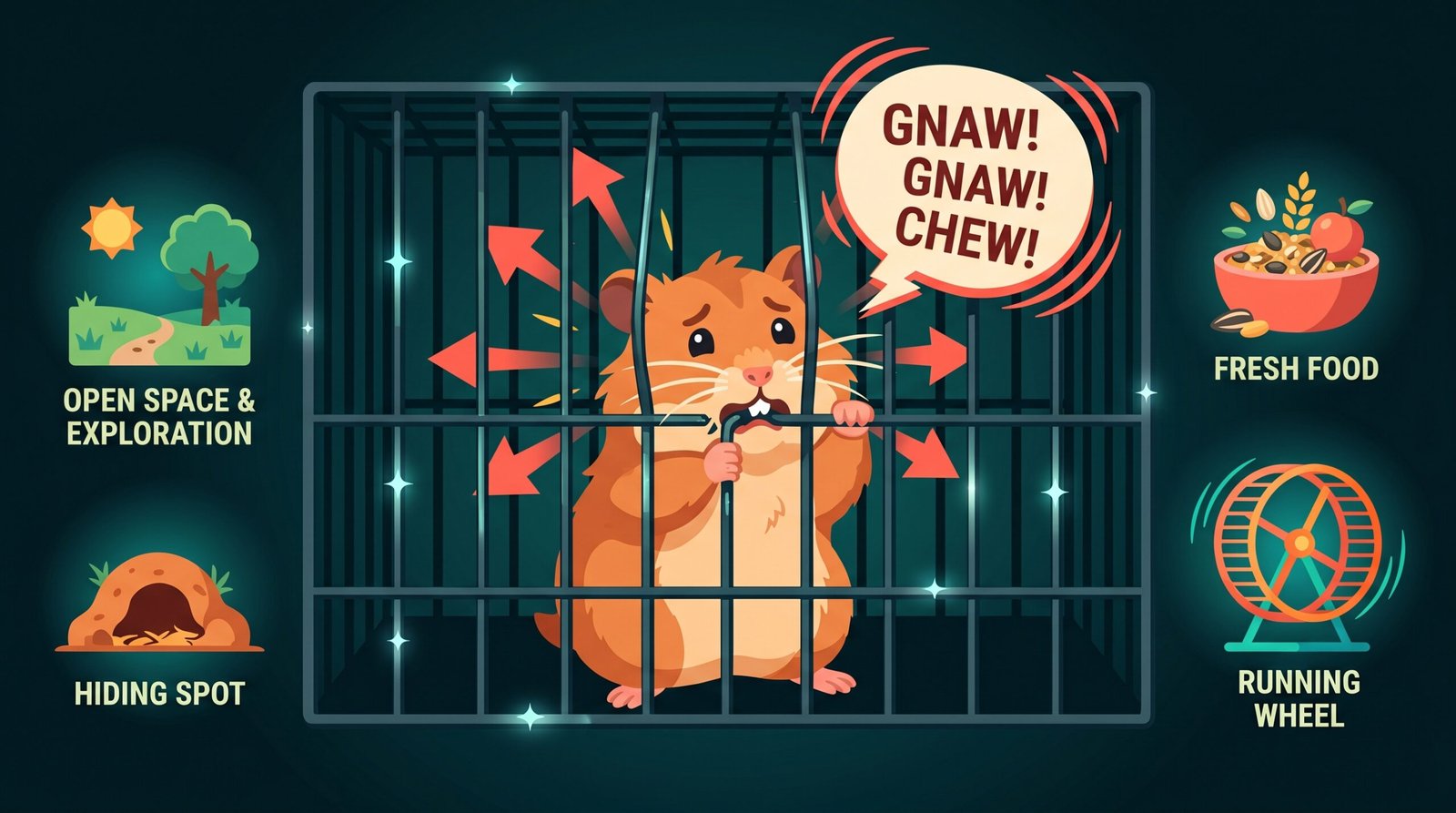
Table of Contents
Hamsters bite the bars of its cage and gnawing at them isn’t being naughty. It isn’t “just something hamsters do,” either. Hamster bar biting is one of the clearest stress signals a small rodent can give you — and wire cages are, by a wide margin, the setup most likely to cause it.
Not a quirk of temperament. A predictable response to a specific kind of enclosure.
Once you understand why it happens, the fix is usually straightforward — even if it’s not the fix most pet store employees will suggest.
It’s also a more common problem than the marketing around wire cages would have you believe. Search any hamster forum and you’ll find dozens of threads asking some version of the same thing: why does my hamster keep biting the bars, and how do I get it to stop? The answers range from genuinely useful to actively counterproductive. Sprays. Distraction. Scolding. Half of it treats the symptom and never once asks what the cage itself is doing to produce it.
What Bar Biting Actually Is
Bar biting falls into a category animal behaviorists call stereotypic behavior — repetitive, seemingly purposeless actions that show up almost exclusively in captive animals living in conditions that don’t meet their needs. You won’t see a wild hamster do this. There’s nothing to bite.
The behavior usually looks the same across individuals. Grip two bars with the front paws. Gnaw rapidly. Pull back, do it again, same spot. It’s not random exploration — it’s targeted, repetitive, and often happens at the same time every day, frequently right as the hamster wakes up and wants out.
Also Read: 10 Things Every Hamster Habitat Needs
Researchers who’ve studied captive rodents in barren or undersized housing have linked this kind of repetitive bar-directed behavior to frustration specifically, the frustration of wanting to perform a natural behavior (escape, exploration) and being physically blocked from doing it. A 2007 study on golden hamsters housed in different cage sizes found that animals in smaller enclosures showed measurably more stereotypic behavior than those given more space, which lines up with what most experienced keepers will tell you anecdotally.
None of that means your hamster hates you. It means the cage is telling on itself.
Why Wire Specifically Triggers It
Plenty of small cages cause stress. Wire cages have a particular feature that makes bar biting worse, though: visibility.
A hamster in a wire cage can see straight through to the room beyond — furniture, foot traffic, you walking past. It can smell the world outside. It just can’t get to any of it. Full sensory access, zero physical access. That combination is close to a perfect recipe for redirected, frustrated chewing aimed at the one barrier standing between the hamster and everything it can sense but never reach.
A few more wire-specific issues stack on top of that:
- Bar spacing. Welfare guidelines generally call for bar spacing no wider than about half an inch (roughly 1.27 cm); anything looser and a Syrian hamster can wedge its head through and injure itself trying.
- Cold metal. Bars conduct heat away from a small body fast, which is uncomfortable in a way solid-walled enclosures simply aren’t.
- Limited bedding depth. Most wire-topped cages have shallow plastic bases, which brings us to a separate but related problem — burrowing.
- Tooth damage. Hamster incisors grow continuously, and they’re built for gnawing wood and fibrous material, not chewing on metal. Repeated bar gnawing can chip or fracture teeth.
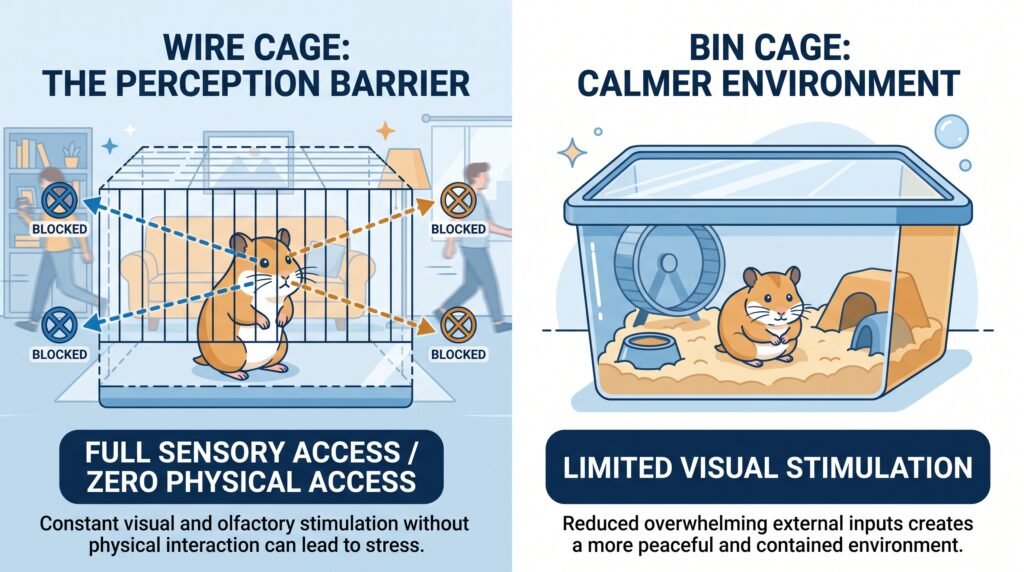
Swap wire for solid plastic, glass, or acrylic, and bar biting frequently drops off within days. Not because the hamster has “calmed down.” Because there’s nothing left to bite at.
There’s a reason this pattern shows up so reliably across species, not just hamsters. Zoo and lab animal researchers have documented similar bar-directed stereotypies in everything from big cats to mice housed in barren, see-through enclosures, and the proposed mechanism is consistent across all of them: an animal that can perceive a goal — open space, the outside world, another animal — but can’t act on that perception tends to redirect the resulting frustration onto whatever’s physically closest to the goal. For a hamster, that’s almost always the bars.
The Space Problem Nobody Mentions on the Box
775 square inches. That’s the figure the Veterinary Association for Animal Welfare (TVT) — a German veterinary body whose hamster housing standards get cited by welfare groups well beyond Germany — sets as the minimum footprint for any hamster, dwarf or Syrian, working out to roughly 100 cm × 50 cm of unbroken floor space. Other organizations set the bare minimum somewhat lower, closer to 450 square inches, while treating 600–800 square inches as the real target for a Syrian hamster’s long-term welfare.
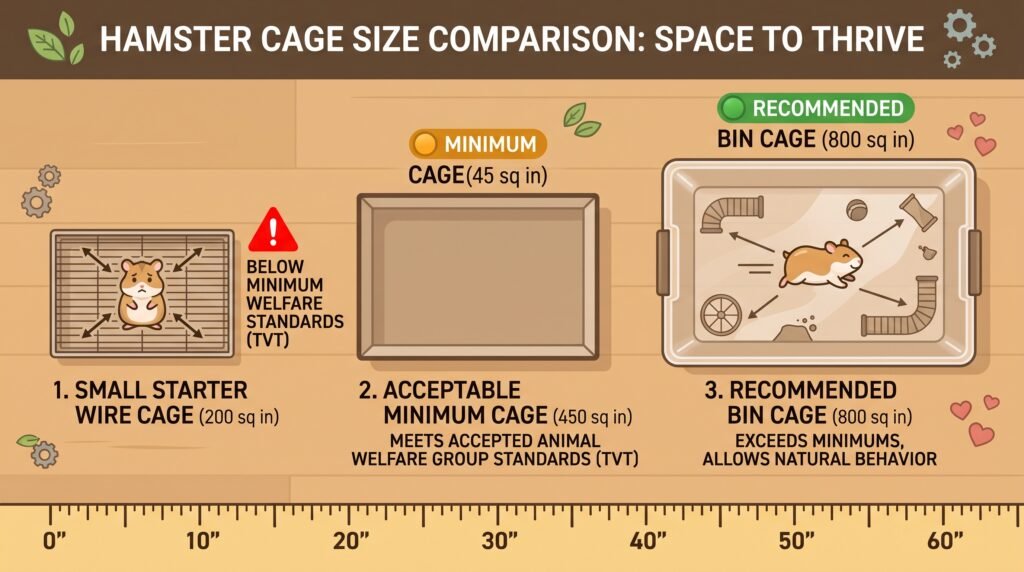
Pet store cage packaging is, frankly, not a reliable guide to any of this. Most “starter” wire cages on shelves fall well under what welfare organizations consider acceptable, and the marketing rarely says so.
What matters more than the exact figure is the pattern: almost every source agrees the cages sold as “hamster starter kits” don’t meet it. A hamster squeezed into 200 or 300 square inches, with nowhere to dig and nothing to do, runs out of outlets for normal behavior fast. Biting the one moving part of the environment becomes one of the only things left to do.
Floor space matters more than height, too. A cage that’s tall but narrow is far less useful than one that’s low and wide — hamsters are ground-dwelling burrowers, not climbers.
Comparing Common Cage Types
| Cage Type | Typical Floor Space | Bedding Depth Possible | Bar-Biting Risk |
|---|---|---|---|
| Standard pet-store wire cage | 150–300 sq in | 2–3 in | High |
| Large wire “mansion” style | 350–450 sq in | 3–4 in | Moderate |
| Glass or acrylic tank (40 gal) | 600+ sq in | 8–12 in | Low |
| DIY bin cage | 600–800 sq in | 8–12 in | Low — no bars at all |
| Modular/cube cages | (varies) | (varies) | Not recommended for bar biters — gaps and connectors often replicate the wire problem |
A table like this can’t tell you what your own hamster will actually do once moved — some hamsters settle in days, others take weeks, and a hamster with months of habitual bar biting behind it may keep gesturing toward old corners of a removed wire cage out of pure routine for a little while.
Bedding Depth and the Burrowing Instinct
Here’s the part most cage setups get badly wrong, and it compounds the bar-biting problem instead of sitting separately from it.
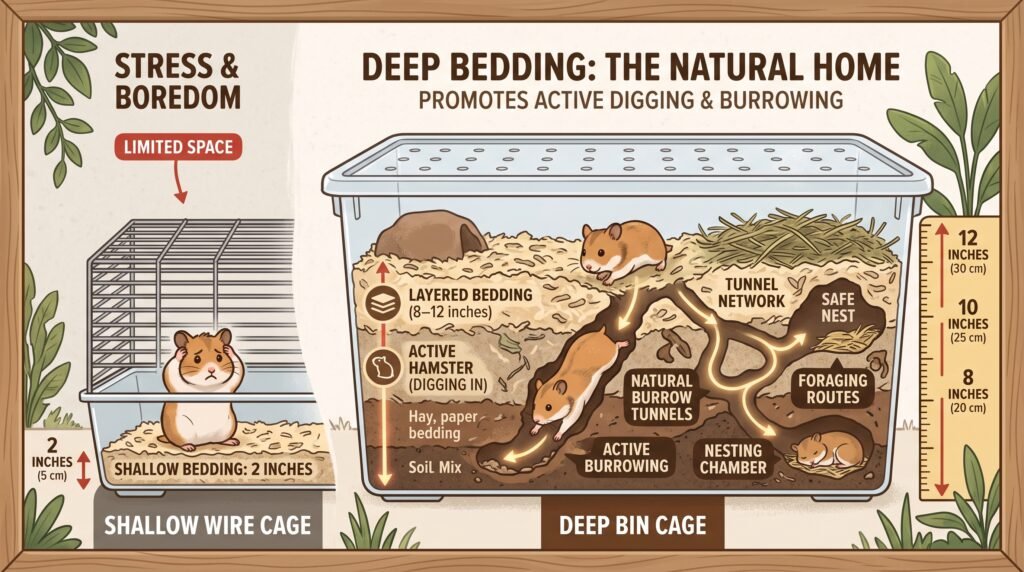
Wild hamsters dig burrow systems that can run several feet underground, with separate chambers for sleeping, food storage, and waste. Not a luxury behavior. Core to how the species manages temperature, safety, and stress. A hamster that can’t dig is running on a frustration deficit before it’s even touched the bars.
Two to three inches. That’s the bedding capacity most commercial cages ship with. Welfare-focused guides put the actual minimum closer to six or seven inches, with eight to twelve inches considered genuinely sufficient for a Syrian hamster to build real burrows instead of shallow scrapes.
Deep bedding does double duty. It satisfies the digging drive directly, and it gives the hamster something physical to interact with instead of the bars. Owners who switch from a shallow wire cage to a deep-bedding bin setup often report that bar biting — or what used to be bar biting — turns into burrowing within the first week. The behavior didn’t disappear. It found somewhere legitimate to go.
Other Stress Signs That Often Show Up Alongside It
Bar biting rarely travels alone. Spot a wire cage that’s the underlying problem and you’ll usually find a cluster of related behaviors, not one isolated habit.
Pacing back and forth along the same stretch of wall is one of the most common companions — another repetitive, fixed-route behavior with no real destination. Excessive grooming to the point of bald patches is another, particularly around the flanks. Some hamsters go reactive when handled during the exact window they’d normally be bar biting, snapping or freezing instead of exploring a hand the way they might at other times of day.
None of these signs proves anything in isolation. A hamster might over-groom because of mites, or pace because it’s just hungry and waiting on food. But two or three of them showing up together, in a hamster housed in under 300 square inches of wire-bar space? That pattern points pretty clearly in one direction.
Bar Biting vs. Normal Chewing — They’re Not the Same Thing
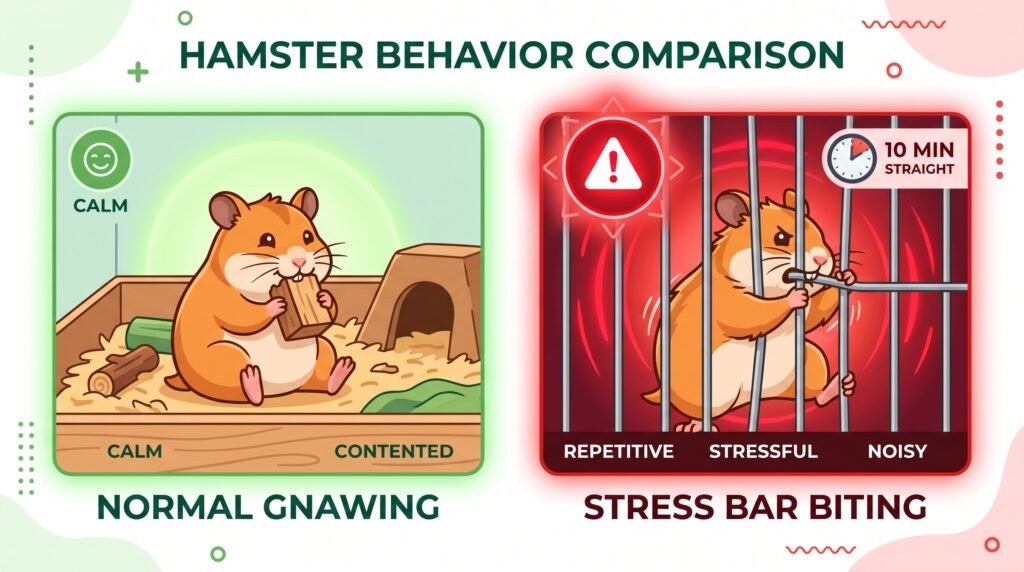
It’s worth separating two behaviors that get lumped together. Hamsters need to gnaw — their incisors grow continuously, and chewing on safe wood, cardboard, or mineral chews keeps them worn down. Healthy. Occasional. Usually quiet.
Bar biting is different. Rapid, repetitive, often paired with the hamster climbing the bars and rattling the whole structure, and it tends to cluster at specific times — often right when the hamster’s active period starts and it wants out. A hamster gnawing a wooden chew toy for thirty seconds before wandering off is doing maintenance. A hamster locked onto the same two bars for ten straight minutes, every single evening, is communicating something else entirely.
Not sure which you’re seeing? Normal gnawing is intermittent, and the hamster disengages on its own. Stress-driven bar biting tends to need an external interruption — you picking the hamster up, a loud noise, food appearing — before it stops.
What Doesn’t Actually Work
A handful of “fixes” circulate in hamster forums and pet store advice that don’t address the actual cause:
- Bitter spray on the bars. Might reduce the specific behavior of mouth-on-metal, but it doesn’t touch the underlying frustration — the hamster’s still trapped in the same undersized, visually-open enclosure. The stress usually just resurfaces somewhere else: over-grooming, aggression at cage-cleaning time.
- Moving the cage to a quieter room. Sometimes helps a little, since less visual stimulation means less to be frustrated about reaching. Still just treating a symptom of the visibility problem, not the floor-space problem underneath it.
- More toys inside the same small cage. Enrichment items genuinely help. They can’t substitute for square footage, though. A wheel and a few tubes crammed into 200 square inches doesn’t fix what 200 square inches is.
- Scolding or removing the hamster from the bars repeatedly. Interrupts the behavior in the moment. Does nothing about why it started — and handling a hamster at the exact moment it’s already frustrated can make it warier of hands generally, not less.
- Covering the cage with a blanket during the day. Can help with light sensitivity, since hamsters are nocturnal, but it gets misapplied constantly as a fix for bar biting that happens during active hours — when the hamster can still see straight through the mesh weave anyway.
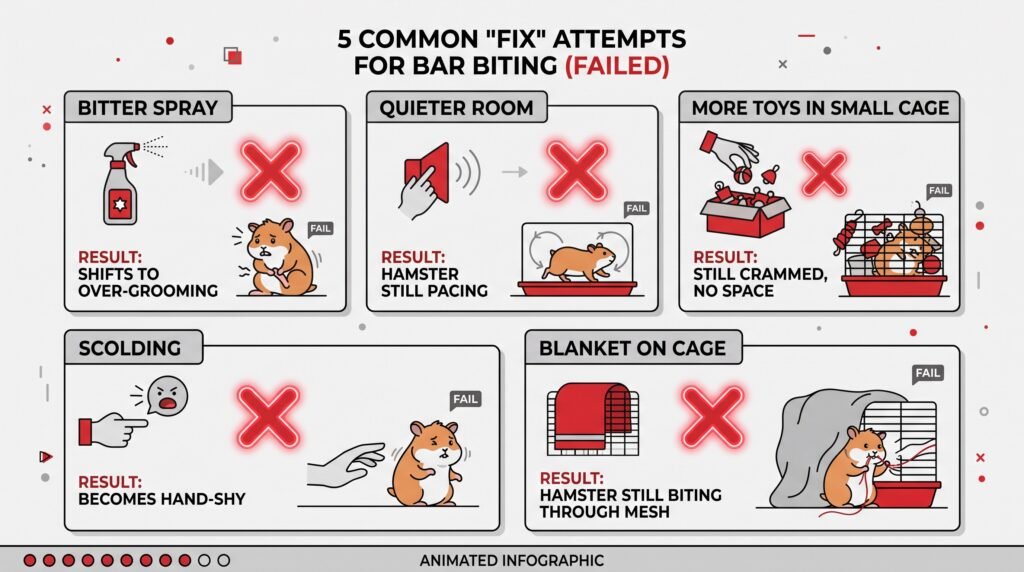
None of these are wrong to try, exactly. Some are even reasonable supporting steps. They’re just incomplete on their own, and leaning on any single one of them tends to leave the underlying frustration untouched.
The Actual Fix: Change the Enclosure, Not Just the Behavior
The most consistently effective approach is also the most obvious one. Remove the wire.
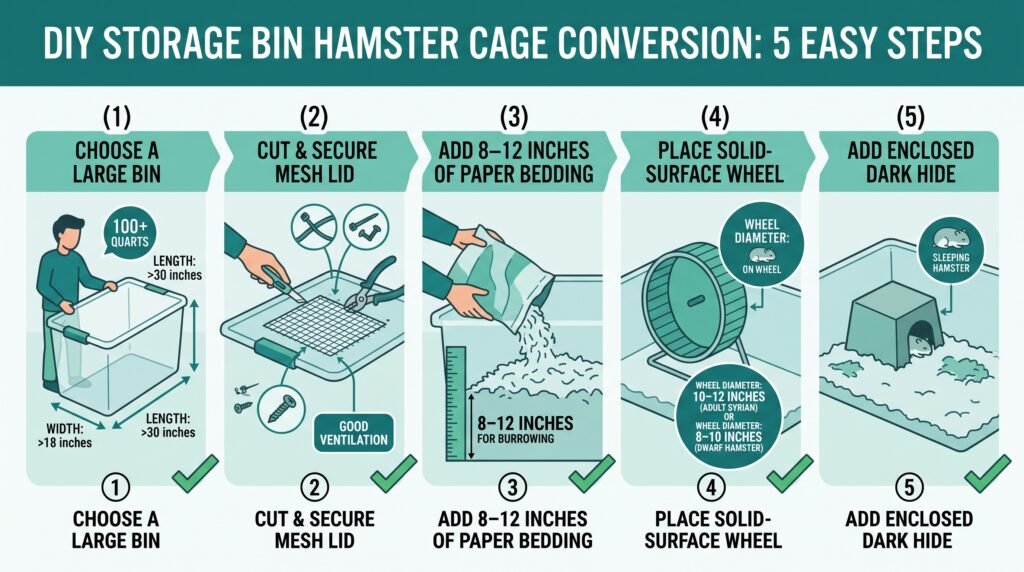
A solid-walled enclosure — a large glass or acrylic tank, or a converted plastic storage bin with a secure mesh lid for ventilation — eliminates the see-through, can’t-reach barrier driving most of the frustration in the first place. Bin cages specifically have caught on in the hamster welfare community for exactly this reason: affordable, deep-bedding-friendly, and available in floor dimensions that clear the 450–800 square inch range without costing what a comparably sized commercial tank would.
A reasonable conversion checklist:
- Pick a bin with 600+ square inches of floor space for a Syrian, 300+ for a dwarf species — bigger if your space allows.
- Cut and secure a ventilated lid — typically hardware cloth or mesh, attached so it can’t be pushed up from underneath.
- Add 8–12 inches of paper-based or aspen bedding. Skip pine or cedar; the aromatic oils irritate a hamster’s respiratory tract.
- Install a solid-surface wheel. Wire or mesh wheels can injure feet, and undersized wheels cause spinal curvature over time. Diameter guidelines run roughly 8 inches minimum for dwarf species and 11–12 inches for Syrians, with the rule of thumb being that the hamster’s back should stay flat while running, not arched.
- Add at least one enclosed hide — somewhere fully dark, since hamsters are nocturnal and need a true daytime retreat, not just a half-open dish.
- Give the bedding time. A hamster moved into a new, larger setup sometimes digs constantly for the first few days. That’s not distress. That’s a hamster finally able to do what it’s built to do.
If a full conversion isn’t realistic right now, even partial changes help: covering the wire with solid panels on the inside, deepening the bedding as far as the existing base allows, and adding a wheel of the correct size. It won’t fully solve a floor-space problem, but it reduces the visual-frustration piece considerably.
Enrichment That Actually Replaces the Bar-Biting Outlet
Once the enclosure itself is sorted, what goes inside it matters more than most starter kits suggest. A few additions consistently make a difference for hamsters coming out of a bar-biting pattern:
- Untreated wood chews (apple, hazel, or willow branches) for legitimate gnawing, replaced as they get worn down
- Digging boxes filled with a separate substrate, like coco fiber, layered on top of the main bedding for a dedicated burrow zone
- Scatter feeding instead of a single food bowl, which gives foraging behavior somewhere to go
- Rotating one or two tunnel pieces every couple of weeks rather than leaving the same layout in place indefinitely, since novelty itself has measurable enrichment value
- A sand bath for species that benefit from one, which doubles as both grooming and an activity outlet
None of these substitute for adequate floor space. They’re additive, not corrective — the cage size has to be right first, or the enrichment is being layered onto a problem it can’t fix on its own.
When Bar Biting Isn’t (Just) About Stress
Most of the time, bar biting traces back to space, enrichment, and a wire cage’s visibility problem. Worth knowing what it isn’t, too.
Overgrown or maloccluded teeth can drive a hamster to chew at anything hard and available, bars included, trying to relieve the discomfort. Drooling, weight loss, visible tooth misalignment, trouble eating, alongside the bar biting? That’s a dental issue, not a behavioral one — it needs a vet who treats small exotics, not a bigger cage.
A few other, less common possibilities are worth ruling out if a housing change doesn’t resolve things: pain from an untreated injury that leaves the hamster restless and unable to settle, or simply an old hamster dealing with reduced mobility and disorientation, which can superficially resemble agitation at the cage edges. Exceptions, not the rule. Real enough, though, that “just buy a bigger cage” shouldn’t be the end of the conversation if other symptoms are present.
It’s worth saying plainly: changing the enclosure usually helps, but “usually” isn’t “always.” Some individual hamsters bar-bite less from space frustration and more from general anxiety, and in those cases handling routine and a predictable schedule matter as much as square footage. Bar biting that persists more than two or three weeks past a full setup change — bigger enclosure, deep bedding, correct wheel, enclosed hide — is a reasonable point to start ruling out dental or health causes instead of assuming it’s purely environmental.
A Practical Starting Point
Three things, if that’s all you change this week: swap the wire for a solid-walled enclosure if you can, get bedding depth up to at least six inches, and put in a wheel sized correctly for your hamster’s species. Those three address the visibility problem, the burrowing deficit, and the exercise outlet all at once — the three things stereotypic bar biting tends to be compensating for.
A hamster that stops biting the bars isn’t a hamster that’s been trained out of a bad habit. It’s a hamster that no longer needs to.
Frequently Asked Questions
Will my hamster grow out of bar biting on its own?
No. Left in the same undersized wire enclosure, bar biting typically continues or worsens rather than resolving by itself.
How long does it take for bar biting to stop after switching cages?
This varies a lot by individual hamster, but many owners see a noticeable drop within the first one to two weeks of moving to a larger, solid-walled enclosure with deep bedding. Some hamsters stop almost immediately once the visible escape route is gone; others take longer if they’ve been bar biting for months and the behavior has become more habitual than purely reactive. If you don’t see any change after three to four weeks, it’s worth checking the hamster’s teeth and overall health rather than assuming the cage change simply hasn’t worked yet, since persistent biting can occasionally point to a dental problem unrelated to space.
Is it normal for a hamster to chew on its cage occasionally?
Light, occasional gnawing — a few seconds here and there — is closer to normal dental maintenance than a stress signal. Persistent, repetitive bar biting is the behavior worth addressing.
Can a wire cage ever be acceptable for a hamster?
Some keepers modify wire cages by lining the lower portion with solid panels and using only the upper wire section for ventilation, which can reduce the visibility problem somewhat. It’s a workable compromise if a full bin or tank conversion isn’t possible, though most welfare-focused sources still consider a solid-walled enclosure the better default.
Does bar biting damage a hamster’s teeth?
Yes, it can. Repeated contact between incisors and metal bars can chip, crack, or misalign teeth over time, which is one more reason to treat the behavior as something to resolve rather than tolerate.
Is it cruel to keep a hamster in a wire cage at all?
Not automatically, but it’s a setup that requires more compensation than most owners realize — bar spacing under half an inch, generous floor space well above the bare legal or industry minimums, and ideally solid panels lining the lower portion to cut down on visibility. A wire cage that meets every one of those conditions can work. Most don’t, which is why wire cages show up so consistently in bar-biting cases.
Can two hamsters share a larger enclosure to reduce stress?
No, and this is worth being direct about: Syrian hamsters are solitary by nature and will fight, sometimes fatally, if housed together as adults. Even some dwarf species that are occasionally kept in pairs require careful, expert-guided introductions and constant monitoring. A second hamster is not a substitute for adequate space, and housing two together to “keep each other company” is more likely to create a new welfare problem than solve this one.
What’s the single most cost-effective change to make first?
Bedding depth, if you’re not ready for a full cage swap yet. Going from two or three inches to six or more inches in an existing enclosure is usually the cheapest single change, and it gives the hamster something to actively dig into rather than just observe through the bars. It’s not a complete fix on its own, but among the partial measures, it tends to produce the most visible shift in behavior for the least cost and effort.