How Often Should You Change Hamster Water?
Table of Contents
By Dr. Muhammad Shahzad
The first time someone asked me How Often Should You Change Hamster Water? , my answer was short: every day. The follow-up question was always the same. Even if the bottle’s still full? Yes. Especially then.
That surprises people. A water bottle that still has plenty of water left in it doesn’t look like a problem. It looks fine. The water’s clear, the level hasn’t dropped much, nothing seems wrong.
It’s not about how much water is left. It’s about what’s happened to it since you filled it.
A lot of pet-care guides default to a once-a-week schedule because it’s tidy and easy to remember. It also ignores three things that matter a lot more than the calendar: how warm the room is, how close the bottle sits to a window, and how much your hamster’s saliva, bedding, and stray seeds have gotten into the spout since yesterday. Hamster hydration isn’t a weekly chore. It’s a daily one, with a deeper clean layered on top.
What a Week-Old Bottle Actually Looks Like
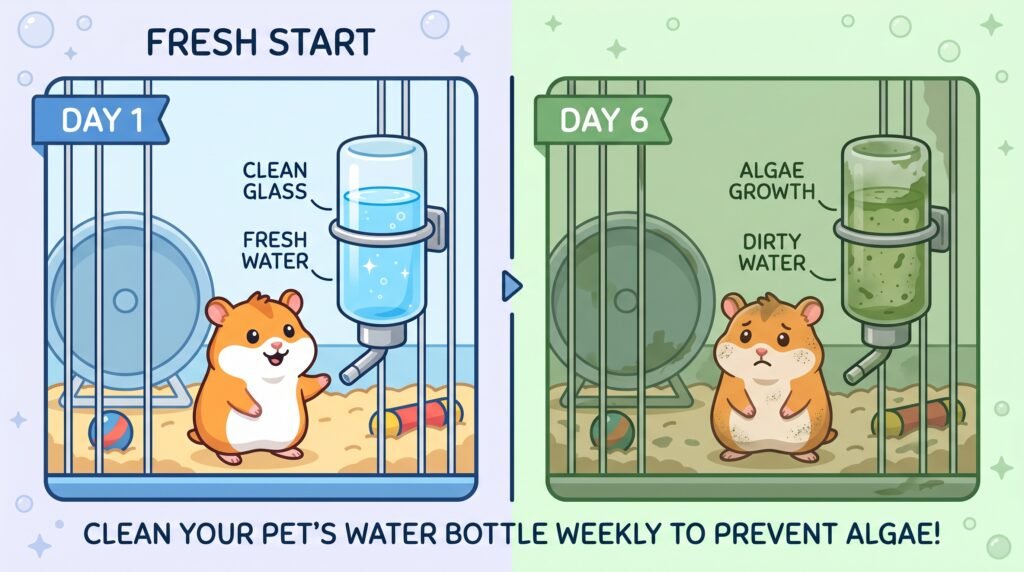
Six days. That’s roughly how long it takes for a sunlit bottle to go from clear to faintly green at the bottom.
I noticed it first on a bottle I’d mounted near a bedroom window, more for the light than anything practical. By day four there was a thin film along the inside curve of the plastic. By day six, algae — not a lot, but enough that I wouldn’t have wanted to drink from it, and I didn’t see any reason my hamster should either.
Light and warmth are the two ingredients algae needs, and most hamster cages provide both without anyone trying.
Why I Go Further Than Most Care Guides on This
I know this is more than most guides cover on hamster water bottle maintenance. Bear with me, because the spout matters more than the bottle itself.
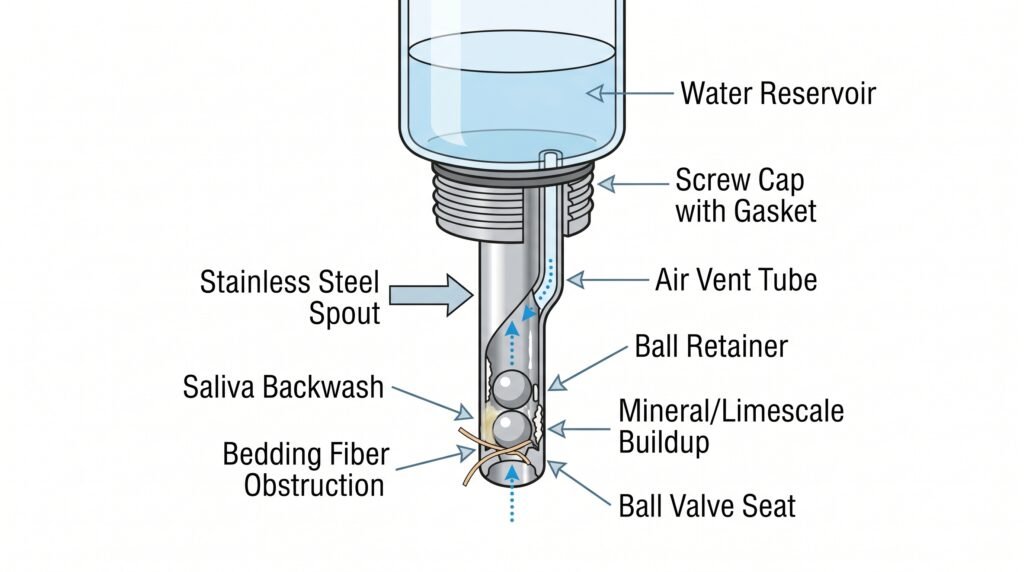
Hamsters drink through a small steel tube with a ball-valve at the tip. Every time they lick it, a tiny amount of saliva gets pulled back up into that tube before gravity sends fresh water back down. It’s a closed loop, which sounds hygienic, except saliva carries bacteria, and bacteria left in a warm, dark, wet tube for days does what bacteria does.
There was something else I noticed about bottle placement that week — the angle of the spout relative to the hamster’s reach changes how much backwash happens. I’ll come back to that.
A few things compound the problem fast:
- Food particles — sunflower seeds, pellet dust, the occasional hoarded vegetable scrap, all of it ends up near the spout sooner or later
- Bedding fibers that work their way up and lodge in the ball-valve, sometimes blocking it entirely without you noticing for a day or two
- Mineral buildup from hard tap water, which leaves a chalky residue that’s easy to miss until it’s thick enough to feel under a fingernail
- Direct light exposure, which on its own can turn a perfectly clean bottle into an algae farm within a week, even without anything else going wrong
Daily water changes don’t eliminate all of this. But checked daily, you catch a clog before it becomes a blockage, and you catch buildup before it becomes a coating (Acepet, 2025; RSPCA, n.d.).
That’s the part nobody mentions in the five-minute pet-store pamphlet.
The Actual Numbers Behind Hamster Hydration
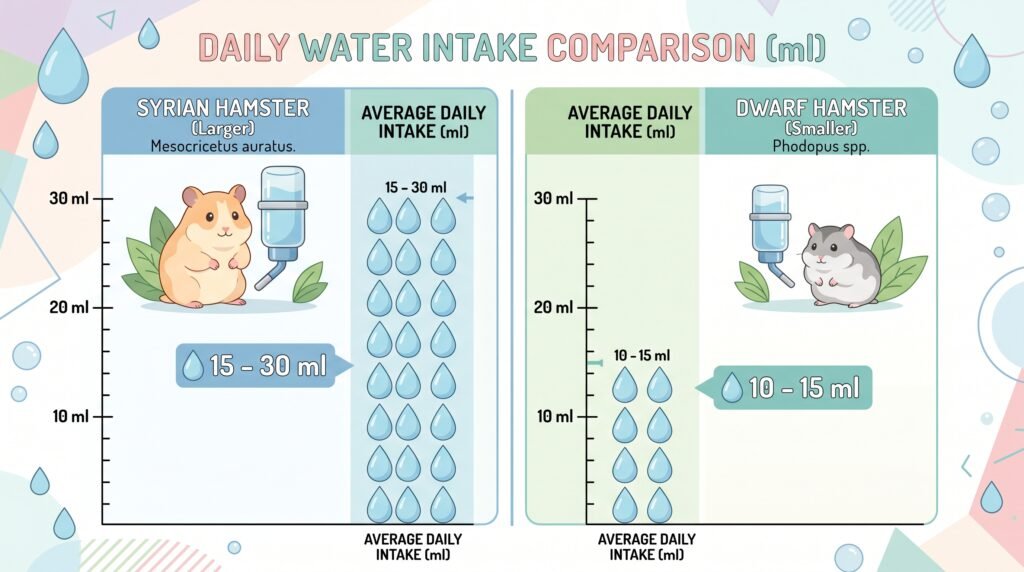
Ten to thirty milliliters. That’s the typical daily water intake for an adult hamster, give or take, depending on body size, room temperature, and how much moisture they’re already getting from fresh vegetables (Hamster Care Wiki, citing NIH nutrient-requirement data, 2025). A Merck Veterinary Manual reference puts a golden hamster’s average closer to 30 mL a day, which lines up with what most owners observe in practice — a level that barely seems to drop day to day, which is exactly why people assume the water’s still fine.
Also Read: The Complete Hamster Nutrition Pyramid: What They Actually Need
It isn’t a lot of water. A standard hamster bottle holds 80 to 150 mL, so even daily drinking only moves the level down a few millimeters.
That small intake is exactly why freshness gets overlooked. The bottle looks almost full after 24 hours, so it’s tempting to leave it. But low consumption volume has nothing to do with contamination rate — bacteria multiply on a clock, not in proportion to how much your hamster happens to drink.
A hamster that’s drinking noticeably more than usual (often a sign the room’s too warm, or in some cases an early indicator of diabetes) or noticeably less — to the point of going a full day or two without touching the bottle — is a reason to call a vet, not wait it out (RSPCA Surrey East, n.d.).
Signs of Dehydration Worth Watching For Change Hamster Water
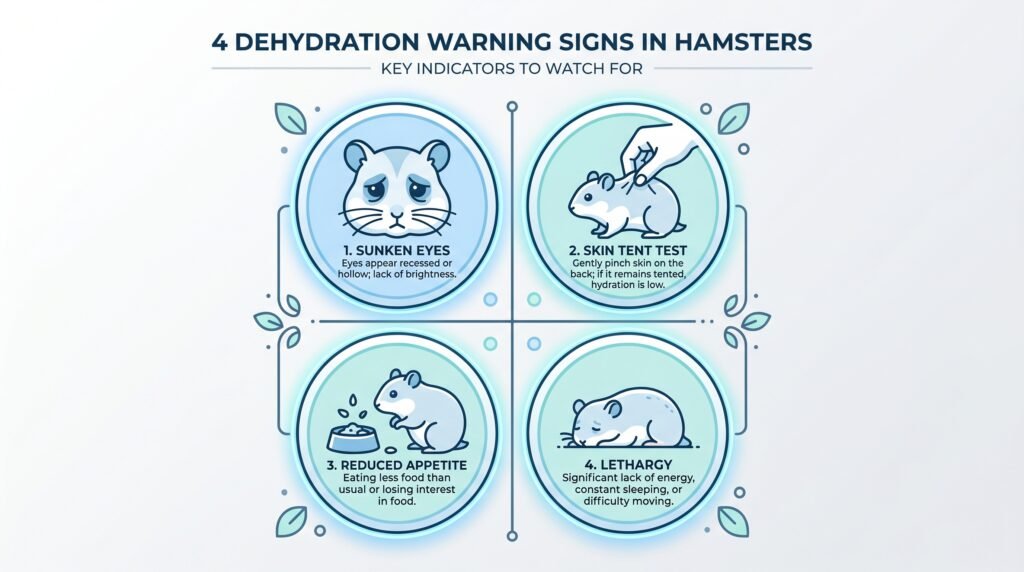
Sunken eyes. Loose, tented skin that doesn’t snap back when gently pinched. Reduced appetite. Lethargy that goes beyond a hamster’s normal daytime sleepiness. Any one of these on its own might mean nothing — hamsters sleep most of the day regardless. Two or more together, especially paired with a hamster avoiding its water bottle, is worth acting on quickly.
Most Guides Say Weekly. I’ve Been Disagreeing With That for Years.
Most pet-care articles still recommend changing hamster water once a week, with a separate weekly bottle-cleaning step tacked on for good measure.
I’ve been questioning that advice for years now, and not quietly.
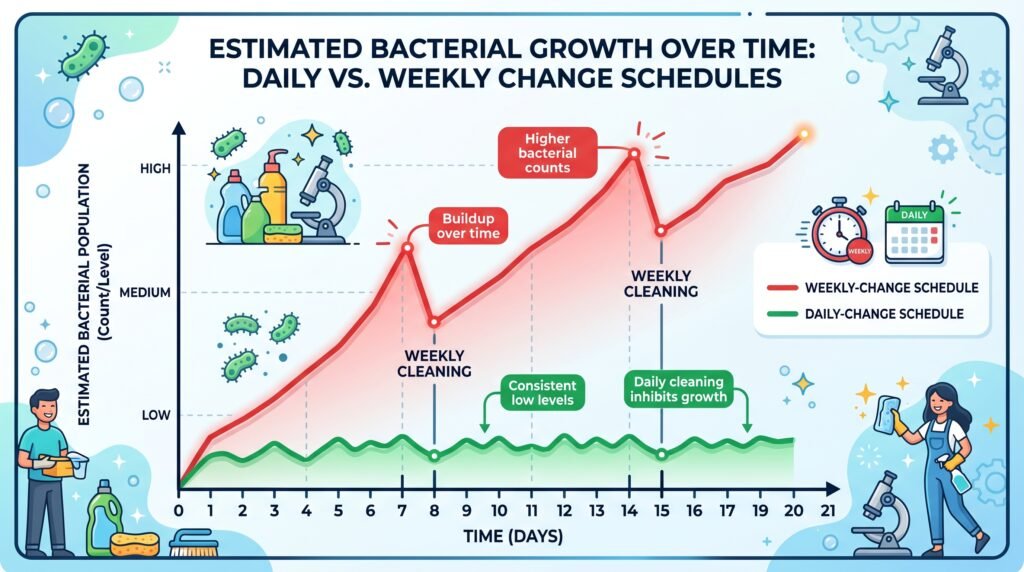
The problem: a once-a-week schedule treats water freshness like a maintenance task on a fixed interval, the same way you’d schedule an oil change. Water doesn’t degrade on a fixed interval. It degrades based on light, warmth, and contact with food and bedding — variables that shift from one cage setup to the next, sometimes from one day to the next in the same cage.
A bottle sitting in a cool, dim corner of a room might genuinely go several days without much bacterial growth. A bottle hanging six inches from a south-facing window in July is a different situation entirely, and treating both the same way — because a guide somewhere said “weekly” — is how hamsters end up drinking water they shouldn’t.
| Approach | Bacterial risk | Effort required | Best suited for |
|---|---|---|---|
| Change weekly only | High — significant buildup likely | Low | Not recommended |
| Change every 2–3 days | Moderate (varies by room temp/light) | Moderate | Cooler rooms, low sun exposure |
| Change daily, deep-clean weekly | Low | Higher | Most setups — the default I recommend |
| Change daily + rotate two bottles | Lowest | Higher (but faster per swap) | — |
A table can show you the relative risk levels. What it can’t show you is how fast a clogged spout turns into a hamster that’s quietly gone a day without drinking, because nothing about a blocked bottle looks urgent from the outside until you actually check it.
What the Veterinary and Welfare Community Actually Recommends
The RSPCA’s guidance is direct on this: hamsters need a constant supply of fresh, clean water, and owners should check the bottle every day for leaks or blockages, changing the water regularly rather than on a fixed weekly cycle (RSPCA, n.d.; RSPCA NextGen, n.d.).
Most veterinary-adjacent sources land in a similar place once you read past the headline number — daily checks, daily or near-daily changes, and a more thorough scrub of the bottle and spout once a week to deal with the buildup daily rinsing doesn’t fully remove.
I still think “once a week” undersells the spout problem specifically. The bottle itself can look completely clean while the spout is already developing a film, and a quick glance at water clarity won’t catch that.
There was a stretch early on, before I started flushing the spout daily, where I assumed a clear-looking bottle meant a clean one. It didn’t.
A bottle that visibly leaks, drips constantly, or stops dispensing water when tapped needs to be addressed immediately — not at the next scheduled change, regardless of how many days are left until the weekly clean.
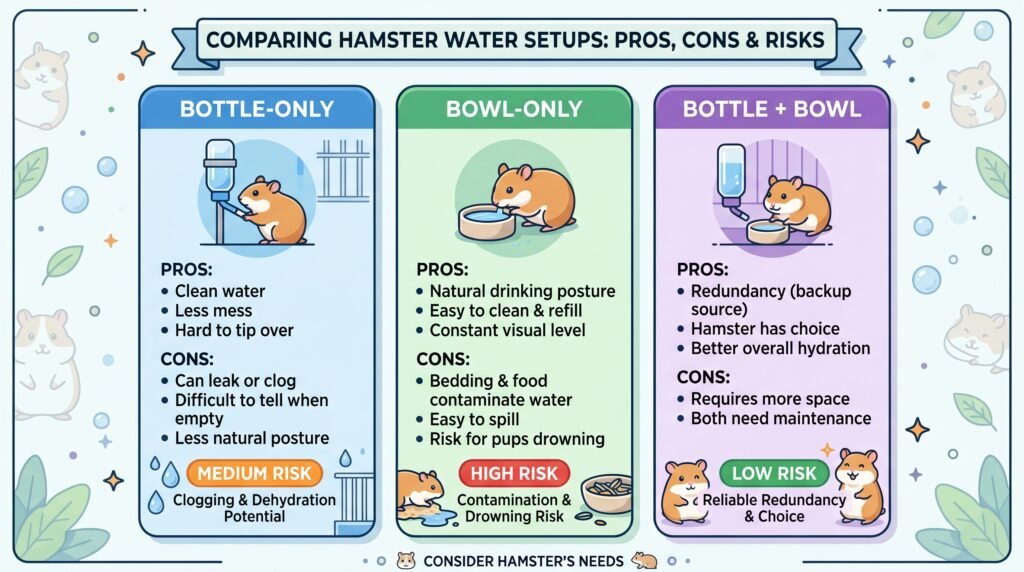
Bottle vs. Bowl vs. Both
| Option | Contamination risk | Monitoring ease | Leak risk | Best for |
|---|---|---|---|---|
| Bottle only | Low–moderate (spout buildup) | Harder to gauge intake | Low | Most standard setups |
| Bowl only | High — bedding, food, waste all reach it easily | Easy to see remaining water | — | Not recommended alone |
| Bottle + bowl | Low (varies by cage layout) | Easiest — bowl shows visible drop | Moderate | Hamsters recovering from illness, very young/old hamsters |
| Two rotating bottles | Lowest | Easy | Low | Owners who can't check the cage daily at the same time |
Neither option fully replaces daily attention. A bowl just makes the evidence of a problem more visible, not the problem itself less likely.
What I Genuinely Don’t Know — and What Not to Do
I don’t have a precise answer for exactly how many hours it takes bacteria in a hamster’s water bottle to reach a level that would actually make a healthy adult hamster sick. The honest answer is that it varies — water source, ambient temperature, how clean the bottle was at the last fill, and the individual hamster’s health all factor in, and nobody’s run a controlled study narrow enough to give you a number.
What’s clear enough to act on: don’t wait until the bottle is empty before refilling it. In most cases that means weeks of standing water by the time it’s gone, since hamsters drink so little at a time — and by then you’re not dealing with slightly stale water, you’re dealing with a genuine contamination risk.
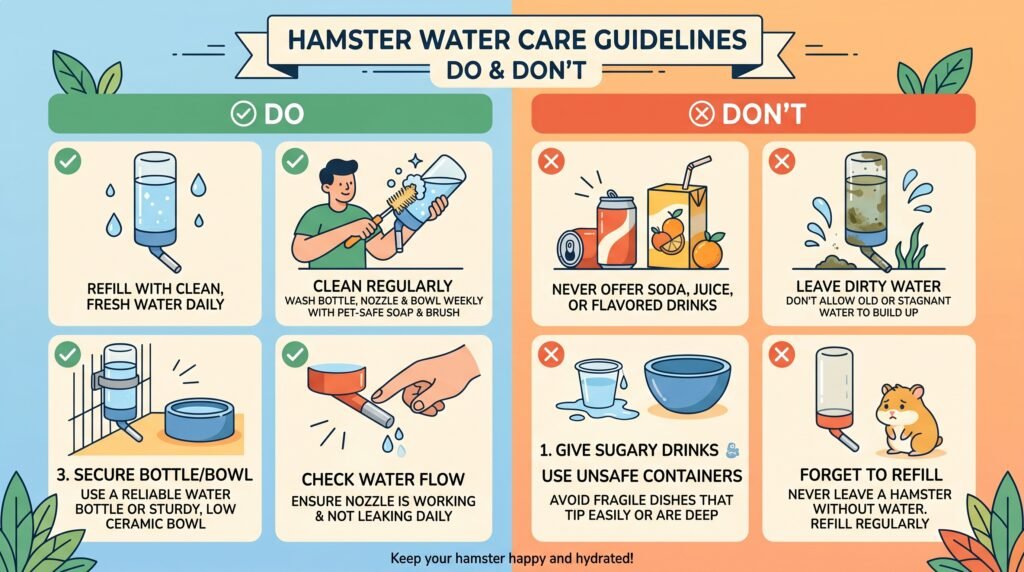
Don’t use flavored water, electrolyte additives, or anything beyond plain (ideally filtered or previously-boiled-and-cooled) water, in most cases — sugars and artificial sweeteners in those products aren’t built for a hamster’s system (Environmental Literacy Council, n.d.).
And don’t assume a full bottle means a working bottle. I’ve seen this go differently than expected more than once — a bottle that’s visually full but has a clogged spout, with the hamster going a day or more without realizing water isn’t actually coming out.
A weekly deep clean — full disassembly, hot soapy water, a bottle brush worked into the spout itself — handles what daily rinsing leaves behind.
A Routine That Actually Works
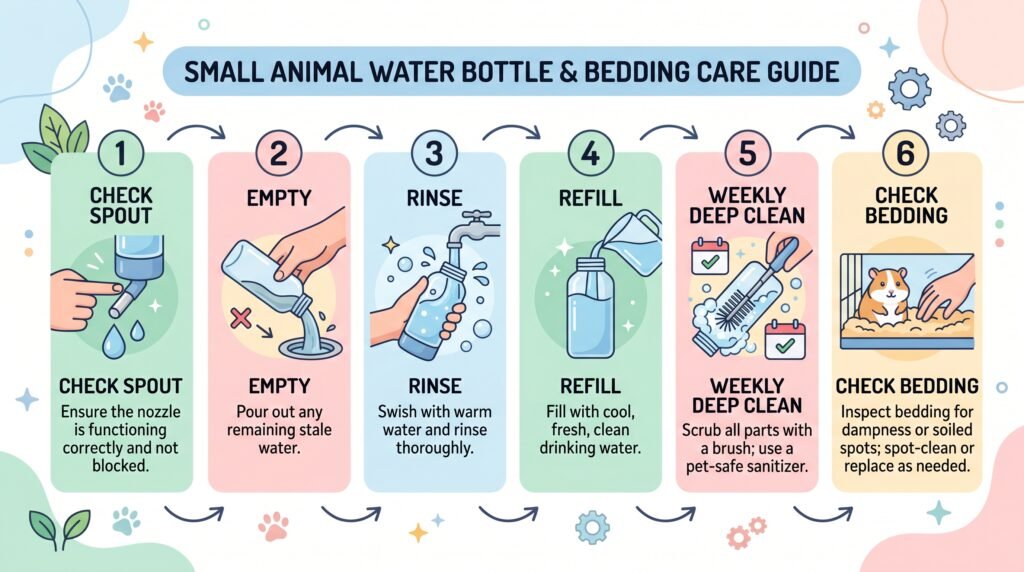
Here’s what daily water care looks like in practice, broken down:
- Check the spout first — tap the ball-valve gently; a drop should appear within a second or two
- Empty
- Rinse with warm water — no soap needed for the daily rinse, just thorough rinsing
- Refill to roughly 80% capacity, leaving room for the valve to seal properly without overflowing
- Once weekly, fully disassemble the bottle and scrub the interior and spout with a bottle brush and warm soapy water, rinsing until no residue remains
- Check that the bedding directly beneath the bottle isn’t damp, since a slow drip going unnoticed for days is a common, quietly persistent leak source
A hamster drinking 10–30 mL a day doesn’t need a large bottle. It needs a clean one. (Acepet, 2025)
Conclusion
What strikes me now, after years of this same conversation with new owners, is how much the “weekly is fine” advice depends on nothing ever going wrong — no warm spell, no sunny windowsill, no stray seed lodged in the spout.
I think about the bottle I left near that window longer than I should have, watching a faint green film creep up the inside over six days while the water level barely moved at all. Nothing about it looked urgent from across the room. That’s exactly the problem.
Change the water daily. Deep-clean weekly. Check the spout every single time.
FAQs
Do I really need to change my hamster’s water every day?
Yes — even if the bottle still looks mostly full.
How often should you change a hamster’s water bottle versus just topping it up?
Topping up isn’t the same as changing it. A bottle that’s been refilled on top of older water without a full empty-and-rinse still carries whatever buildup was already on the spout and the lower portion of the bottle, so the daily routine should always include emptying it completely, not just adding more on top — and the water itself should be replaced even on days the bottle still has plenty left, since the issue is contamination, not volume. A full weekly clean with a bottle brush handles what daily rinsing alone won’t fully remove.
Can a hamster get sick from a dirty water bottle?
Yes, and a clogged spout that goes unnoticed is often the bigger risk than the water itself looking dirty.
Is tap water safe for hamsters, or should I filter it?
In most cases tap water is fine, but it depends heavily on local water hardness and chlorine content; filtered or previously-boiled-and-cooled water is the safer default if you’re unsure, and hard water in particular speeds up mineral buildup in the spout.
What if my hamster won’t drink at all?
Call a vet the same day, especially past 24 hours.
Sources
- RSPCA — What to Feed a Pet Hamster
- RSPCA Surrey East Branch — Caring for Hamsters
- RSPCA NextGen — Hamster Advice
- RSPCA Worcester — Hamster Care Information
- SpectrumCare — Can Hamsters Drink Water? (citing Merck Veterinary Manual data)
- Hamster Care Wiki — Water (citing NIH “Nutrient Requirements of the Hamster”)
- Acepet — Correct Use of a Hamster Water Bottle
- Environmental Literacy Council — How Often Do You Change Hamster Water?