
Why Hamster is Obsessively Running on Their Wheel
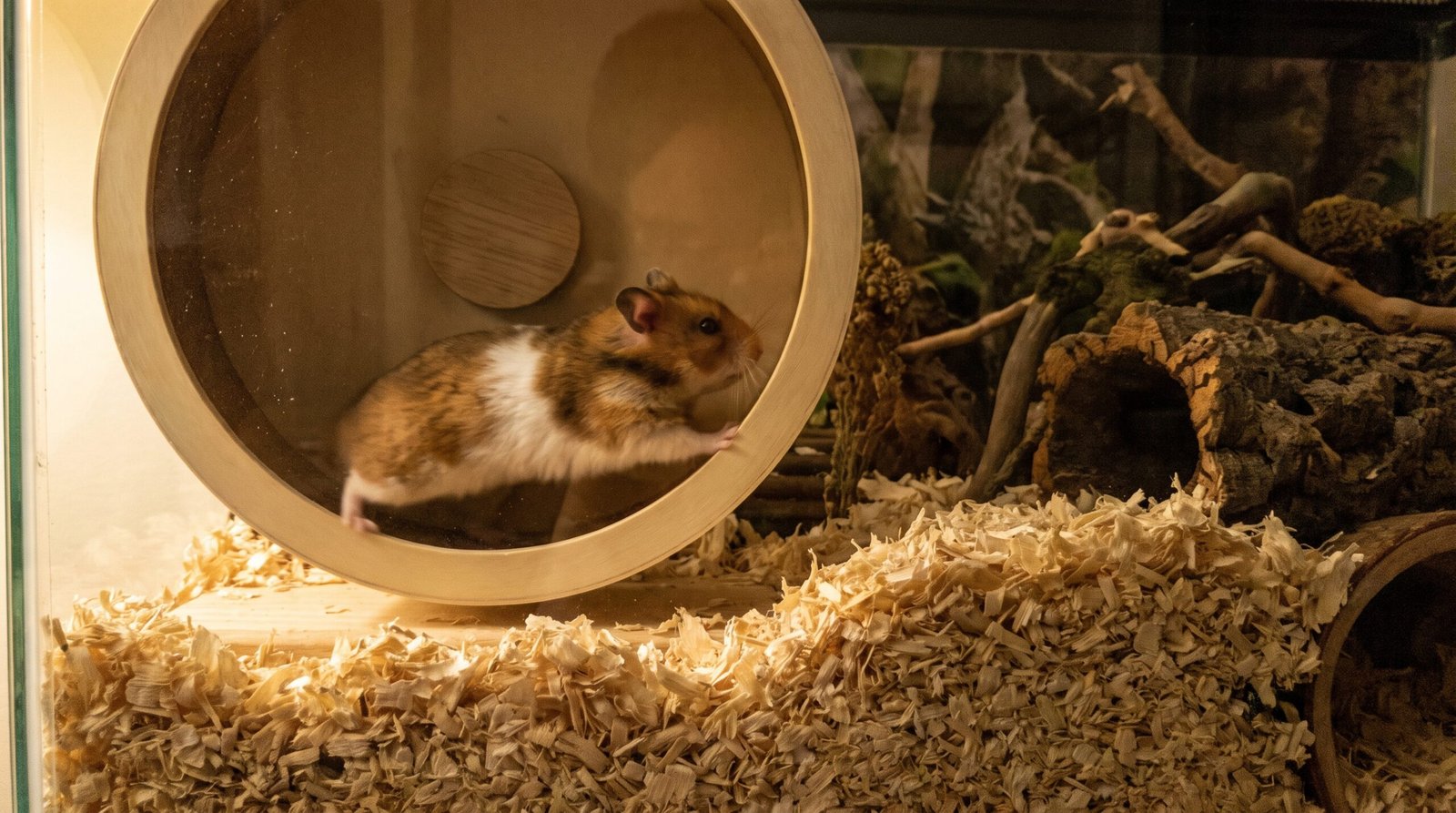
Table of Contents
Two in the morning, and the cage in the corner sounds like a tiny freight train. That’s how it started with Clover, a Winter White I bred back in 2016, and it’s the same complaint I get from new owners almost every week now: “Why is my hamster obsessively running on their wheel?” Fourteen hours. That’s roughly how long some of my Syrians have logged on a wheel odometer in a single night, and no, I didn’t believe the number either the first time I saw it. If your hamster is obsessively running on their wheel, it can look alarming at first, but hamster wheel behavior often appears obsessive because, biologically, a huge part of it actually is—just not in the way most people assume.
I want to be upfront about something.
Most of what you’ll read below comes from ten years of breeding Syrian and dwarf hamsters and consulting on habitat setups for two small-animal rescues, not from a textbook I skimmed last week. That matters here because the internet is full of confident answers about “hamster wheel obsession” that don’t match what I’ve actually watched happen in hundreds of cages. Some of it agrees with the official welfare guidance. Some of it, honestly, doesn’t.
So here’s the pivot before we go further: running is normal, expected, and even necessary for a hamster’s wellbeing — right up until it isn’t, and the line between the two is thinner than most cage-setup guides admit.
This isn’t about whether your hamster loves the wheel. It’s about whether the wheel has become the only thing they do.
By the end of this, you’ll know exactly which numbers to check tonight, which ones to ignore, and which single piece of equipment is responsible for most of the “obsessive” running stories I hear.
Hamster is Obsessively Running on Their Wheel. Why?
Three times in one week — that’s how often I got the same panicked message from a first-time owner last spring, always about the same hamster, always at 1 a.m. She was convinced her Roborovski was sick. He wasn’t.
He was a nocturnal rodent doing exactly what nocturnal rodents do once the lights go out and the house goes quiet, and the wheel was simply the most visible part of it. I checked his food intake, his weight, his fur condition, and his cage size before I said anything reassuring, because “it’s probably fine” isn’t advice — it’s a guess dressed up as one.
His fur was glossy. His weight hadn’t shifted a gram from the week before. That combination told me more than the wheel odometer ever could.
Where My Own Bias Kicks In (And Why I Can’t Help It)
Ten inches. That’s usually where this conversation with me starts, because the wheel itself is the first thing I check and almost always the first thing that’s wrong.
I know this is more than you needed. Bear with me — bedding depth and wheel sizing are the two things I will talk your ear off about, and running behavior sits directly downstream of both.
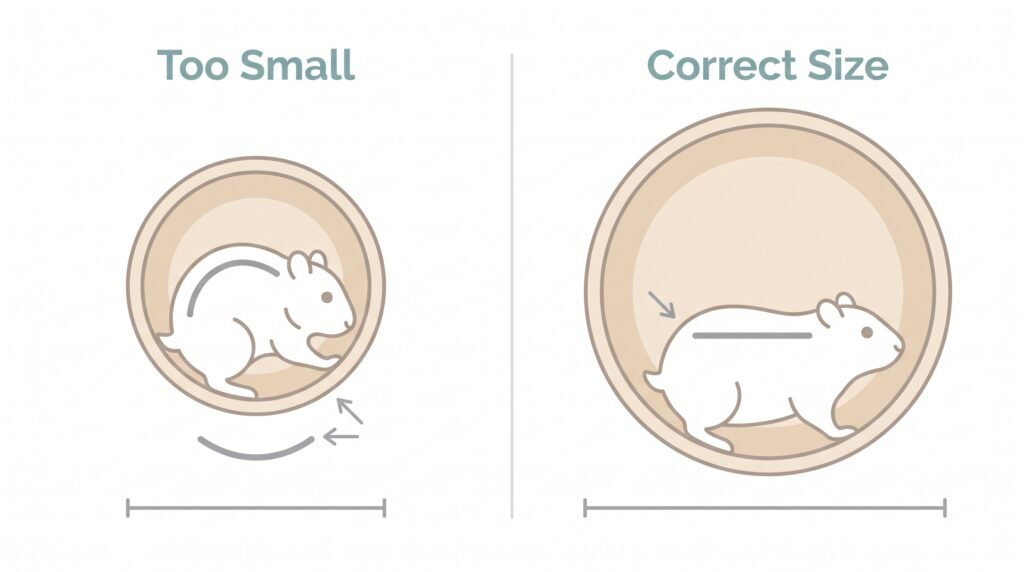
A wheel that’s too small forces a hamster’s spine into a curve while it runs, and that arched-spine posture is exactly what the Tierärztliche Vereinigung für Tierschutz has flagged as a driver of permanent spinal curvature in young hamsters, particularly Syrians squeezed onto wheels smaller than 28cm. Dwarf species need less — a minimum around 20cm according to the same welfare body — but “less” doesn’t mean “small enough to fit in a pet-store starter cage,” which is where most of these problems begin.
There was something else about the bearing noise I noticed that first week with Clover — a faint, irregular click every few rotations that I couldn’t place. I’ll come back to it.
I know this reads like a spec sheet instead of an answer to “why won’t my hamster stop running,” but stay with me, because every item below has shown up in a real cage I’ve personally walked into and fixed.
Here’s where the over-explaining really starts, and I’d apologize except I don’t think I should:
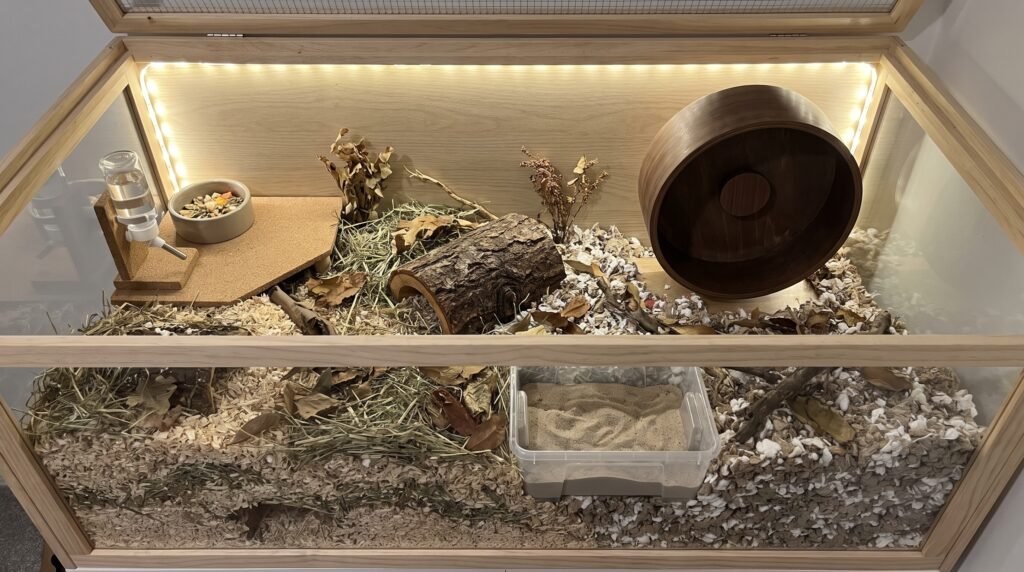
- Wheel diameter has to let the spine stay flat, not curved, at full stride — this is non-negotiable and not really up for debate the way cage size still is
- Solid running surfaces beat wire mesh every time, because mesh rungs are a documented cause of bumblefoot and sole injuries
- The wheel needs to sit low enough, or have a low enough entry lip, that a hamster isn’t leaping onto it
- Bearing noise matters more than people think — a squeaky wheel can suppress nighttime activity almost as much as a too-small one
- Placement inside the cage affects use; a wheel crammed against a food bowl gets avoided more than one with clear approach space
- Weight capacity varies by material, and a Syrian on a dwarf-rated wheel will eventually crack the axle
- Depth of the running track prevents a hamster’s back feet from slipping off mid-stride, which is its own injury risk
- Cleaning frequency affects use too — hamsters are fastidious, and a wheel caked in old bedding gets ignored
- The wheel should be replaceable without redesigning the whole enclosure, because sizing up is common as a hamster matures
- And finally, the stand or bracket has to be stable — a wobbling wheel changes running rhythm in ways owners rarely connect back to the actual cause
I’ve had owners fix three of these at once and watch total nightly wheel time drop by nearly half, not because the hamster stopped needing to run, but because it finally could, comfortably, without fighting the equipment. A 2004 running-wheel and bedding-depth study on golden hamsters found something that surprised me the first time I read it: animals kept with shallow bedding didn’t just wire-gnaw more, they also logged noticeably higher wheel activity than hamsters given deep, natural burrowing material — as if the wheel was partly substituting for something the environment wasn’t providing.
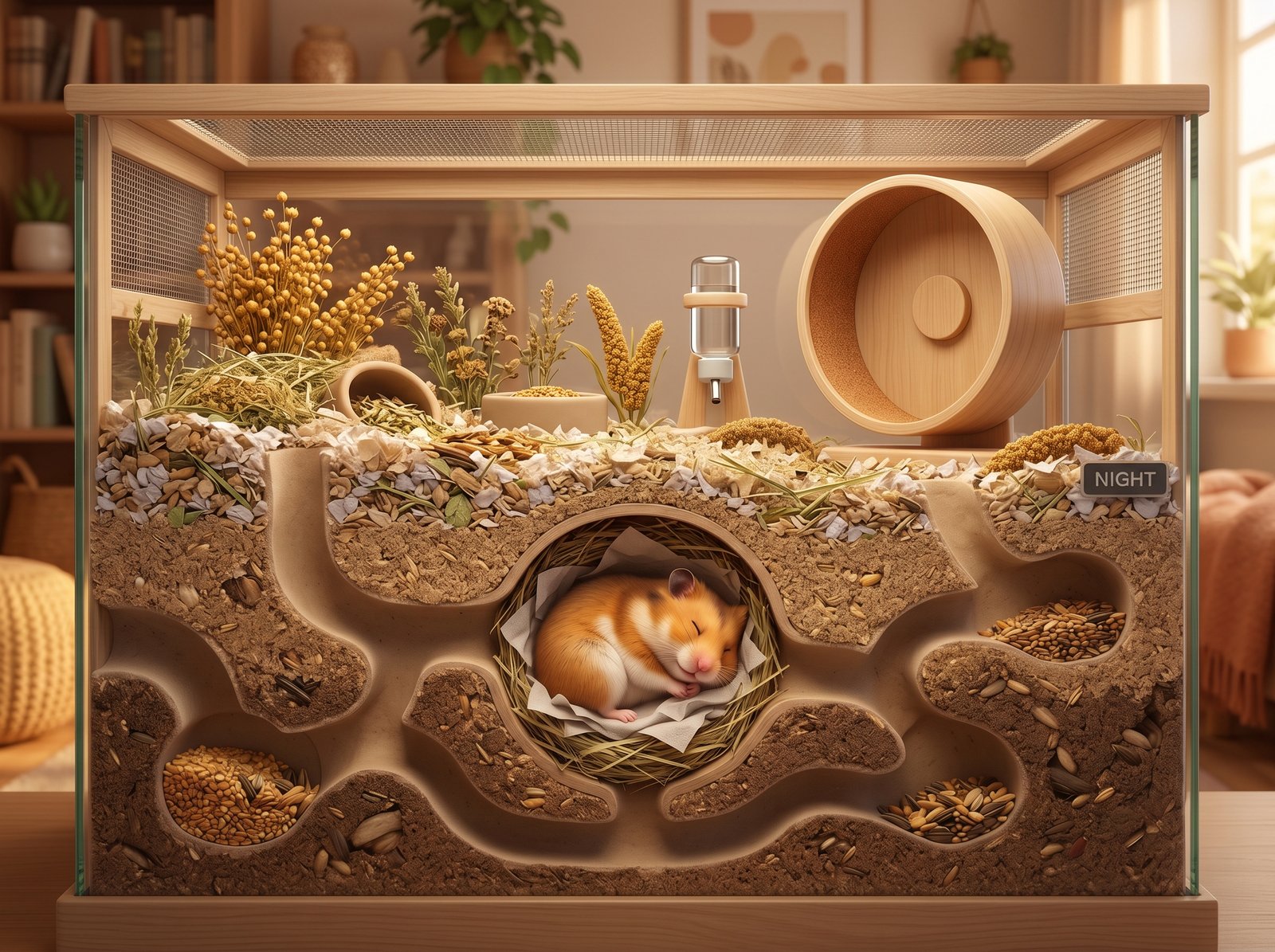
Twenty-five centimeters. That’s roughly the depth of substrate researchers used in the “enriched” group of that same study, and it’s a long way from the inch or two of shavings that ships with most starter cages. I’ve swapped owners from two inches to ten and watched wheel obsession — their word, not mine — fade within a week, simply because the hamster suddenly had somewhere else to put that nighttime energy besides the wheel (hamster cage enrichment).
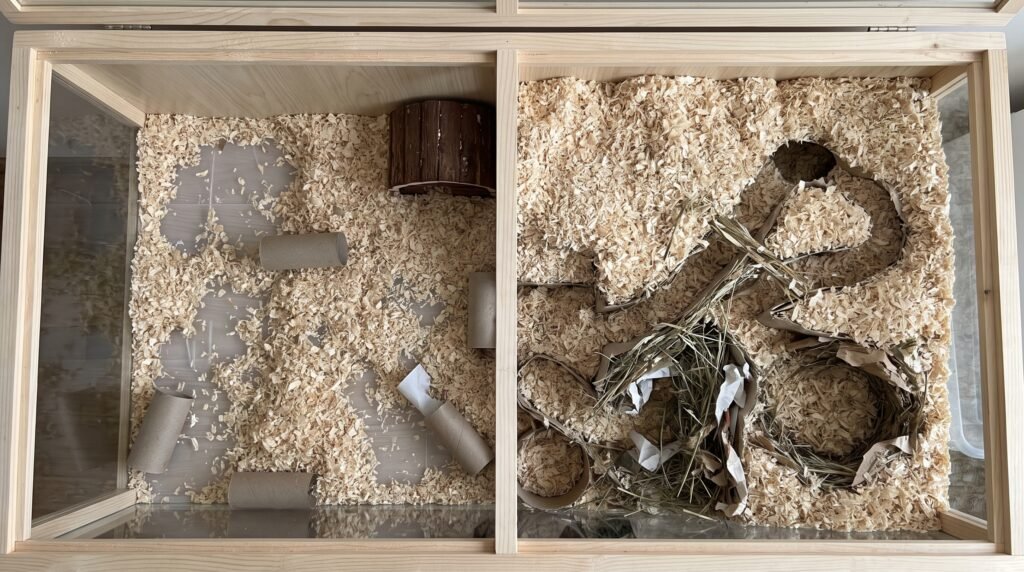
Hide placement is the other half of this equation, and it’s the part I genuinely can’t shut up about. A hide positioned too close to the wheel gets used as a launch pad, which changes running posture in ways that look identical to genuine spinal strain until you actually watch closely. Move it to the opposite corner, angle the entrance away from the wheel’s rotation, and that odd stutter-step some owners describe — the one that looks like limping — often disappears within days. It isn’t always injury. Sometimes it’s just bad furniture arrangement.
None of this is glamorous advice. It’s measuring tape and bedding bags, not supplements or gadgets, and that’s exactly why it gets skipped.
The Numbers Behind “Excessive” Wheel Running
Nine kilometers. Some behavioral researchers estimate wild golden hamsters travel roughly that distance foraging across a single night, which reframes the entire question of what counts as too much wheel running for a hamster with nowhere else to burn that instinct.
A pet hamster confined to a cage still carries that same nocturnal drive, and the exercise wheel becomes the one legal outlet for it. Circadian research on Syrian and Siberian hamsters shows wheel-running activity clustering tightly around the dark phase of the light cycle, tracked in lab studies as a direct behavioral readout of the animal’s internal clock — researchers studying the suprachiasmatic nucleus have used nocturnal wheel activity itself as the marker of circadian rhythm strength, because it’s that reliable an indicator. That’s not obsession. That’s a clock running on schedule.
Where it tips into genuinely excessive territory is harder to pin down than most articles admit, and the honest answer involves duration relative to rest, not raw hours. A hamster running steadily for four or five hours after lights-out, then eating, drinking, and settling into a nest for the day, is inside a completely normal range (hamster nighttime activity). One that never stops moving even after food and water are gone, that runs frantically the instant it’s placed back in the cage, or that shows repetitive circling off the wheel too — that’s a different animal, and that pattern edges toward stereotypic behavior rather than healthy nocturnal exercise.
Body weight matters here too, more than most owners expect. A Roborovski weighing barely 20 grams can log what looks like an alarming number of wheel rotations and still be burning proportionally less energy than a heavier Syrian running half as long, simply because of stride length and rotational mass. Comparing raw hours across species — the way a lot of forum advice does — misses this almost entirely, and it’s part of why “how much wheel time is too much” resists a single clean answer (hamster energy levels).
Temperature plays a role researchers have documented but owners rarely consider. Hamsters kept in rooms above roughly 26°C tend to reduce voluntary activity, wheel included, as a heat-avoidance response, which means a sudden drop in running can sometimes point to an overheated room rather than illness. The reverse also holds: a cooler room, within safe limits, can produce longer, more sustained wheel sessions without anything being wrong at all.
Measuring Wheel Time Without Guessing
Twelve seconds. That’s roughly how long it takes to fit a cheap odometer sensor to most solid wheels, and it turns a vague “he’s been on there forever” into an actual number you can track week over week. I don’t think every owner needs one, but anyone genuinely worried about excessive wheel running should stop relying on memory and start relying on data, because human perception of “constant” running is notoriously unreliable once you’re sleep-deprived yourself.
What I Think Most Cage Guides Get Backwards
Most pet-store advice and even some casual online guides treat wheel running as something to manage — as if the goal is limiting it, the way you’d limit screen time.
Muhammad Shahzad has been questioning that framing for ten years.
The problem: treating a nocturnal rodent’s primary exercise outlet as a behavior to restrict almost always traces back to a cage that’s too small to offer anything else. Take the wheel away, or ration it, and you haven’t solved boredom — you’ve removed the one enrichment tool the animal actually chose for itself. I’ve watched this go wrong the same way, over and over, every single time: an owner “solves” excessive running by removing the wheel overnight, and within days the hamster is bar-chewing, pacing the same corner, or over-grooming instead. Still surprises people. It shouldn’t.

| Wheel Type | Spine Safety | Noise Level | Cleaning | Typical Cost |
|---|---|---|---|---|
| Solid-surface plastic (11–12") | Good if sized correctly | Low to moderate | Easy — wipes clean | $15–35 |
| Wire-mesh wheel | Not recommended | Low | Moderate | $8–15 |
| Flying-saucer style | (varies) — depends on species and size | — | Moderate to hard | $12–30 |
| Silent/ball-bearing solid wheel | Good | — | Easy | $25–55 |
No table shows you what a hamster actually does when the wheel is right but the cage still isn’t: it runs less, not more, because it finally has somewhere else to go.
Pet-store staff, in my experience, are trained to sell the cage in front of them, not to explain why a bundled wheel might already be wrong for the animal going home in it. I don’t say that to be harsh. It’s just the reality of a retail floor where turnover matters more than a spinal x-ray six months down the line.
Again — and I do mean again, because I’ve had this exact conversation more times than I can count — the fix isn’t a stricter running schedule. It’s a bigger box with more in it. Enrichment isn’t a bonus feature. It’s the thing that makes the wheel one option among several instead of the only option there is.
I’ve written before about how a startled, under-stimulated hamster can withdraw entirely rather than run at all — the “ghost hamster” pattern is the mirror image of the wheel-obsession complaint, and both usually trace back to the same root cause: an environment that doesn’t give the animal enough legitimate choices. Daily supervised out-of-cage time factors in here too, since hamsters given regular structured interaction and taming sessions tend to settle into calmer, more predictable wheel patterns than hamsters left entirely to their own devices around the clock.
What the Wider Research Actually Says
A 2005 study on golden hamsters found that running-wheel access significantly reduced stereotypic bar-mouthing compared to hamsters housed without one, which lines up with a broader pattern researchers have noted across species — exercise deprivation, not exercise itself, tends to precede repetitive stereotypies.
Bar-mouthing dropped. Wheel use didn’t spike into anything abnormal.
That distinction — wheel access reducing stress behaviors rather than causing them — runs against the instinct a lot of new owners have, which is to see nonstop movement and assume something’s wrong. I lost a young dwarf once to what I initially wrote off as “just an active one.” She wasn’t running out of joy by the end. She was running because the cage gave her nothing else, and by the time I understood the difference, the damage to her feet was already done.
Cortisol regulation is the piece people skip past fastest, and it’s the piece that matters most. Hamsters denied a wheel don’t necessarily become calmer; deprivation studies point the opposite direction, toward elevated stress markers rather than reduced ones (hamster stress symptoms). None of this means unlimited running is automatically fine — it means the wheel itself is rarely the villain in these stories.
Exotic-mammal veterinarians I’ve consulted with tend to describe the same triage order when an owner reports “excessive” running: rule out pain first, then check the equipment, then look at the cage as a whole, and only then consider whether the behavior itself needs addressing. Running toward pain — favoring a hind leg, an odd gait, stopping abruptly mid-stride — looks nothing like the smooth, sustained wheel use that worries owners for the wrong reasons. The two get confused constantly, and it’s usually the smooth, healthy runner who gets misdiagnosed as “obsessive” by someone comparing it to a much less active pet from a previous household.
Research on wheel-running and stress physiology in rodents more broadly backs this triage order up: voluntary exercise has repeatedly been shown to blunt stress-hormone responses rather than amplify them, which is part of why yanking the wheel the moment a hamster looks “too into it” so often backfires. The animal isn’t running because it’s stressed. Often enough, it’s running instead of becoming stressed, and removing that outlet is what tips the balance the wrong way.
I still haven’t explained that bearing click from Clover’s wheel, by the way. Turned out to be a hairline crack in the axle mount, invisible until it wasn’t.
Comparing Species: Wheel Needs Aren’t One-Size-Fits-All
Syrian hamsters, Winter Whites, Campbell’s dwarfs, Roborovskis, and Chinese hamsters don’t share identical wheel requirements, and treating them as interchangeable is where a lot of “my hamster runs too much” confusion actually starts. A wheel that’s perfectly adequate for a Winter White can be genuinely dangerous for a Syrian twice its size, and a pet-store multi-pack of “universal” wheels rarely accounts for any of this.
| Species | Min. Wheel Diameter | Typical Nightly Pattern | Escape Risk (small gaps) | Bar-Chewing Correlation |
|---|---|---|---|---|
| Syrian | 11–12" (28–30cm) | Long, steady bouts | — | High if wheel undersized |
| Winter White | 8–9" | Frequent short bursts | (check with vet if squeezing occurs) | Moderate |
| Campbell's dwarf | 8" | Very high nightly volume | Not recommended below 8" | Moderate to high |
| Roborovski | 6.5–8" | Near-constant, fast, erratic | High with metal-rung wheels | — |
| Chinese hamster | 8–9" | Long bouts, tail-clearance needed | (check with vet re: tail injury) | Low |
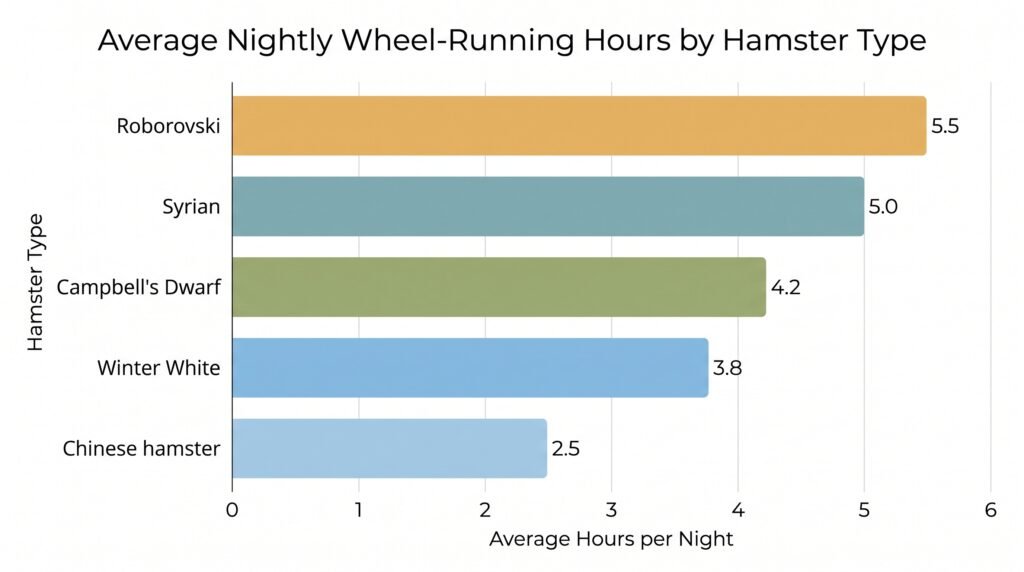
A single long sentence to sit with here: none of that table tells you why a Roborovski who runs almost every waking minute of the dark phase can be completely healthy while a Syrian doing a third of that volume on an undersized wheel is already developing the early signs of a curved spine, and the only way to know which situation you’re in is to look at the equipment and the animal together, not the clock.
Why Species Comparisons Mislead Owners
Cross-species comparison is where I see the most owner anxiety get manufactured, usually from a well-meaning forum post. Someone with a Roborovski reads that Syrians “only” need a certain number of hours and panics that their own hamster, running nearly nonstop, must be unwell — without realizing Roborovskis are simply built to run more, for longer, at a faster natural pace than a Syrian ever will. The species baseline matters as much as the raw number, and most articles quoting a single “normal amount of running” for all hamsters are quietly wrong for at least three of the five species people actually keep.
Dwarf species, as a rule, run more per gram of body weight than Syrians do — a pattern that shows up consistently enough in owner-reported logs and breeder observation that it’s treated as near-universal among rescue organizations I’ve consulted with, even without one single definitive citation nailing the exact multiplier.
Chinese hamsters get left out of most wheel-size guides entirely, which is a genuine gap, because their longer tail changes the clearance math slightly compared to the tailless-looking dwarf species most articles default to. A wheel that’s technically the right diameter can still catch a Chinese hamster’s tail against the back wall if the running track is shallow, something I only learned after a rescue intake came in with a partially degloved tail tip years ago.
Winter Whites and Campbell’s dwarfs get lumped together constantly, and while their wheel needs overlap closely, Campbell’s tend to run in shorter, more frequent bursts through the night rather than the longer continuous stretches more typical of Winter Whites — a distinction that matters when an owner is trying to decide whether a pattern change is meaningful or just normal variation between individuals.
What Nobody Can Promise You
I don’t know, precisely, how many hours of wheel running crosses from “healthy nocturnal exercise” into “stereotypic behavior” for any individual hamster, and anyone who gives you an exact number without meeting your animal is guessing.
What I can tell you clearly is what not to do: don’t remove the wheel as a first response to worry, and don’t assume a quiet hamster who isn’t running is automatically the calmer one — some of the most stressed animals I’ve handled in rescue work barely moved at all. Usually, a sudden change in running pattern — much more, much less, or newly frantic — matters more than the absolute amount ever does.
The RSPCA and PDSA’s current housing guidance both point in the same direction on this: bigger, more complex enclosures reduce reliance on any single enrichment item, wheel included, and that’s really the whole answer compressed into one sentence. In most cases, a hamster with a properly sized wheel, adequate bedding depth, and a few scattered enrichment options will self-regulate its own running without anyone stepping in at all.
Six weeks. That’s roughly how long it can take a newly upgraded hamster to settle into a new baseline running pattern after a cage change, so don’t judge the wheel by week one.
I’ve seen this go differently more times than the tidy version of this advice suggests. One rescue Syrian I fostered never fully normalized her running pattern even after every equipment fix I could think of, and the honest answer was that I never found out why. She lived a long, apparently comfortable life anyway. Not every question gets an answer, and pretending otherwise does owners a disservice.
Age-specific caution matters here too. Very young hamsters, still growing into adult bone density, are more vulnerable to wheel-size injuries than a fully grown adult on the same equipment, which is part of why “the wheel it came with” is rarely still the right wheel by three months in.
Obesity and arthritis complicate this picture from the opposite direction, and I don’t want to gloss over that. An older or overweight hamster running noticeably less isn’t automatically “finally calm” — reduced wheel use in an aging animal deserves the same scrutiny as increased use in a young one, and owners tend to worry about only one direction of change while ignoring the other entirely.
What to Actually Do Tonight
Start here, in this order:
- Measure the wheel. Under 8″ for a dwarf or under 11″ for a Syrian means replace it before anything else.
- Solid surface only — no wire rungs, ever, regardless of what the packaging claims.
- Check for an arched back mid-stride; that single posture tells you more than an hour of watching total run time.
- Add deeper bedding, since the shallow-bedding studies above tie thin substrate directly to higher wheel reliance.
- Listen for bearing noise. A squeak most humans barely notice can be loud enough to a hamster to change behavior.
- Log three nights of running pattern before making any decision — one bad night isn’t a trend.
- Check food and water intake alongside the wheel, not instead of it.
- Introduce at least one non-wheel enrichment item — a dig box, a chew, a tunnel — the same week you fix the wheel.
- Watch for off-wheel repetitive movement, like corner-circling or bar-chewing, which points toward stress rather than healthy exercise.
- If the pattern changes suddenly and stays changed for more than a week, that’s the point to call an exotic-animal vet, not before.
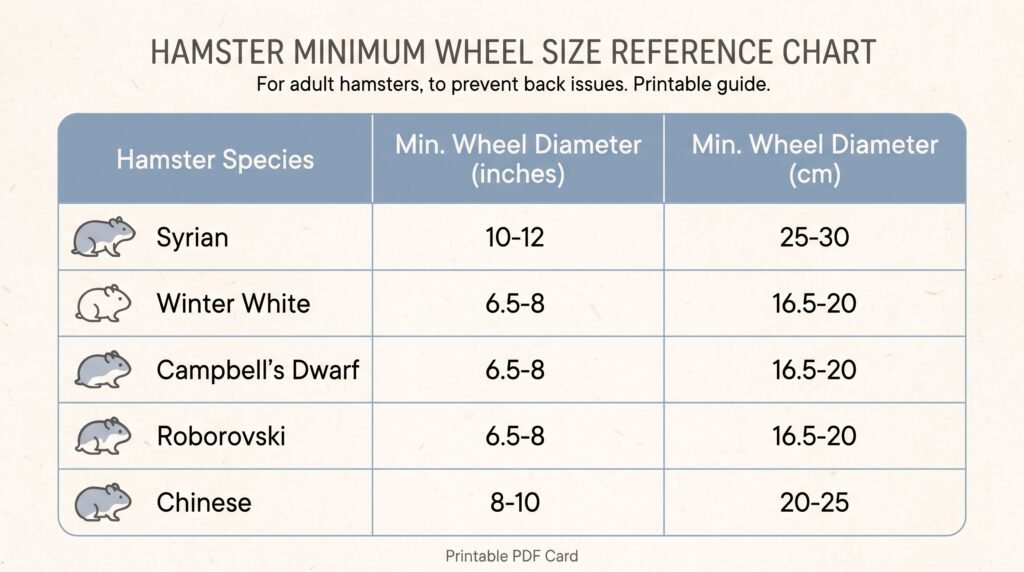
Eleven inches. That’s the wheel diameter I now recommend as a floor for any adult Syrian, no exceptions, no “it’s probably fine for now.”
Do the wheel check with the lights off, or as close to it as you can manage, since that’s when the real running pattern shows itself. Watching at noon tells you almost nothing about a nocturnal animal (nocturnal hamster activity). A cheap infrared camera solves this better than standing in the dark with a phone flashlight, which — take it from someone who’s done both — just startles the hamster and ruins the data.
Keep a simple log for those three nights: start time, roughly how long the bouts last, and anything unusual about posture or noise. It doesn’t need to be scientific. It needs to exist, because memory alone is a bad tool for spotting a slow change over weeks.
Diet plays a smaller but real role too. A hamster on a poor, nutritionally imbalanced diet can show restless, erratic wheel patterns that look behavioral but resolve within days of correcting the food itself — something worth ruling out before assuming the wheel or cage is entirely to blame.
When to Actually Call a Vet
Stopping suddenly and staying stopped for days is the pattern that should move you from “watch and log” to “book an appointment,” not raw hours of running. Pair that with reduced eating, and it stops being a wheel question altogether and becomes a health question that a log alone won’t answer.
The Part I Notice Now That I Didn’t Used To
I check wheel diameter before almost anything else in a new setup now, and it’s become such a reflex that I sometimes forget not everyone does this.
The moment that actually changed how I look at this topic wasn’t a study. It was watching a rescued Syrian, finally given a properly sized solid wheel after months on a cracked mesh one, run for six straight hours the first night and then sleep through most of the next day without a single sign of stress. That’s not obsession. That’s relief with legs.
I still measure every wheel that comes through my door before I let a hamster near it, even the ones marketed specifically for adult Syrians, because “made for Syrians” and “correctly sized for Syrians” have turned out to be two very different claims on more packaging than I’d like to admit.
Fix the wheel first. Everything else about “why won’t my hamster stop running” tends to answer itself after that.
FAQs
Is it normal for my hamster to run on its wheel all night?
Yes — nocturnal wheel use through most of the dark phase is standard hamster behavior, not a red flag on its own.
How many miles does a hamster run every night?
Estimates vary widely by species, age, and setup, but wild golden hamsters are thought to cover somewhere around 9 kilometers foraging in a single night, and a pet hamster on a properly sized wheel can rack up a meaningful fraction of that without it being abnormal. The number that actually matters more than distance is consistency — a sudden jump or drop against your own hamster’s baseline. A hamster logging four hours nightly on a well-fitted 12-inch wheel and eating and drinking normally is not a hamster in crisis, even if that sounds like a lot to a first-time owner. Small dwarf species, gram for gram, often log more relative activity than Syrians do. Room temperature, wheel size, and even the time of year can all shift the total up or down without anything being wrong. Take any single “safe” number with a grain of salt.
Should I remove my hamster’s wheel if it seems obsessive?
No — removing the wheel tends to push the behavior somewhere worse, like bar-chewing or pacing. Fix the wheel and the environment before you ever consider taking the outlet away entirely.
What size wheel does my hamster actually need?
Syrians need a minimum of 11 inches, and dwarf species need at least 8 inches, measured to keep the spine flat rather than arched during a full stride. Undersized wheels are one of the most common causes of what looks like “excessive” running, since a hamster straining against a bad fit often runs longer, not shorter, as if compensating for a stride it can’t fully complete. The one exception is very young or very small-bodied dwarfs, where a slightly smaller wheel may still be appropriate short-term, before sizing up as they grow.
Why does my hamster squeak or click while running?
Usually a dry or damaged axle bearing, and it’s worth checking before assuming it’s the hamster making the noise at all.
Sources referenced:
- Vet Help Direct — Hamster space and welfare standards
- HamsterWelfare.com — Wheel size evidence, TVT guidance, bumblefoot risk
- HamsterWelfare.com — Wild running distance, wheel banning campaign
- ScienceDirect — Running-wheel activity and bedding depth in golden hamsters
- ScienceDirect — Running wheel effects on behaviour and reproduction in pet hamsters
- ResearchGate — Companion data on wheel running and chronic stress in small cages
- BMC Neuroscience — Wheel access and circadian rhythm splitting in hamsters
- PMC — Rhythmic properties of the hamster suprachiasmatic nucleus
- PMC — Circadian rhythms and wheel-running monitoring in Siberian hamsters
- PMC — Stereotypic wheel running and cortical activity
- PMC — Exercise and stress-hormone regulation
- PMC — Photoperiod and ultradian activity rhythms in hamsters
The point about wheel size forcing the spine into a curve is the part I’d focus on first, since it’s easy to overlook when the running looks energetic rather than painful. A practical check: measure your hamster’s body length from nose to base of tail, then confirm the wheel’s running surface diameter is large enough that the back stays flat while running. If the back arches upward at all, size up before assuming the behavior is obsessive.