Top 10 Sick Hamster Symptoms and Fixes
Table of Contents
My first Syrian hamster got sick on a Tuesday. I know it was Tuesday because I had just restocked her water bottle — one of those gravity-feed ones — and noticed she hadn’t touched it in what felt like forever. She was sitting in the corner of her enclosure, hunched, fur slightly puffed, eyes half-closed in a way that looked less like sleeping and more like something else entirely. I was 28 years old, I’d had her for four months, and I had no idea what I was looking at.
That was seven years ago. Since then I’ve kept and cared for five Syrian hamsters and three dwarf hamsters — two Roborovskis, one Campbell’s — and I’ve learned more about sick hamster symptoms and fixes through direct, sometimes painful experience than from any guide I’ve ever read. Not because the guides are wrong. Because hamsters hide illness so well that by the time a symptom is obvious, you’re already late.
Recognizing a sick hamster early is not a skill you develop from reading lists. It comes from watching a healthy animal long enough that you know — without naming it — when something is off.
But lists matter too. So here’s mine.
What Seven Years of Hamster Care Looks Like Up Close
Three hamsters in one winter.
That’s how many I dealt with illnesses in back-to-back months during my third year of keeping Syrians. Not from neglect. From not knowing what I was missing in the early signs. By the time I noticed the weight drop or the change in posture, the problem had already progressed further than it needed to.
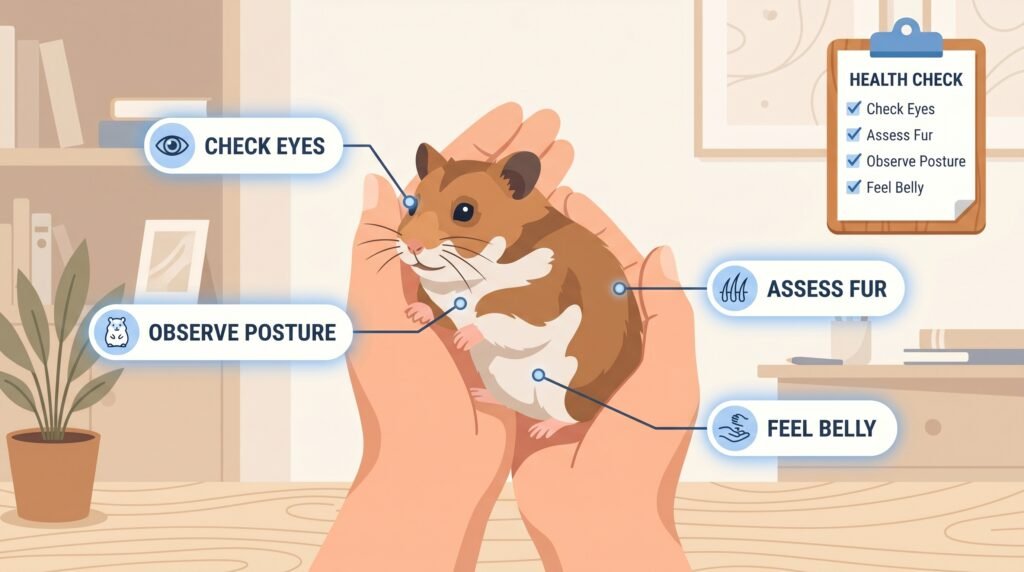
That winter changed how I observed. Every morning before anything else, I checked each animal. Not a glance. A real look — at posture, fur condition, movement, whether the food had been touched overnight, whether the bedding had been rearranged in unusual patterns. Hamsters move and rearrange constantly, but there’s a shape to normal rearranging that’s different from the erratic, shallow digging that happens when an animal is uncomfortable.
One specific thing I noticed that year: the smell of the enclosure changes before visible symptoms appear. Not dramatically. But a healthy hamster’s habitat has a particular warm, slightly musky, hay-and-cedar-adjacent smell that shifts — becomes slightly sharper, more ammonia-tinged — when diarrhea is beginning or an infection is taking hold. That detail isn’t in most hamster care guides. It’s the kind of thing you only notice after years of being close to the same species.
The Symptoms You Need to Actually Know — Not Just Recognize
What Normal Hamster Behavior Looks Like First
Before you can spot something wrong, you need a baseline. This part gets skipped constantly in hamster illness guides, and it costs owners time.
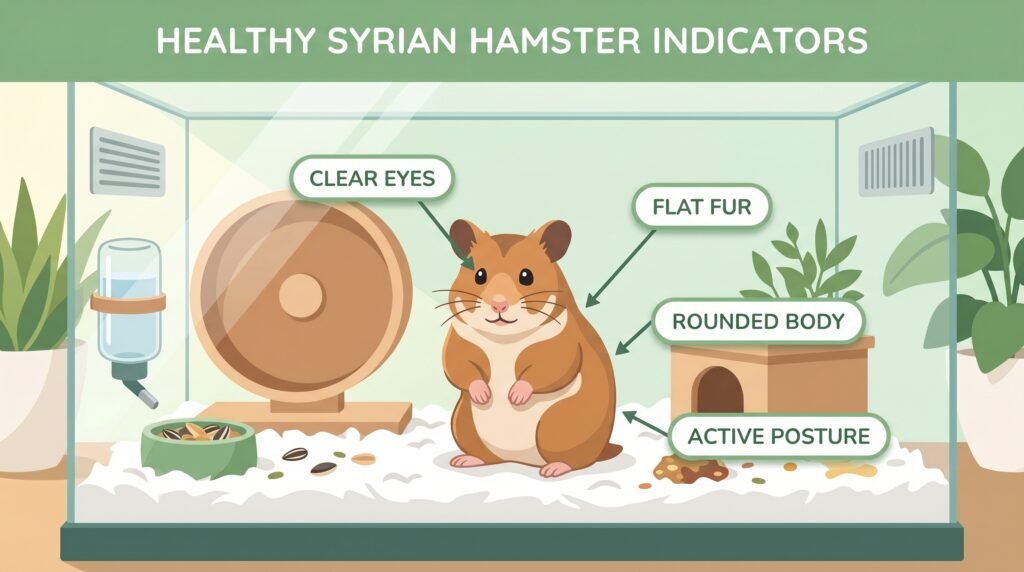
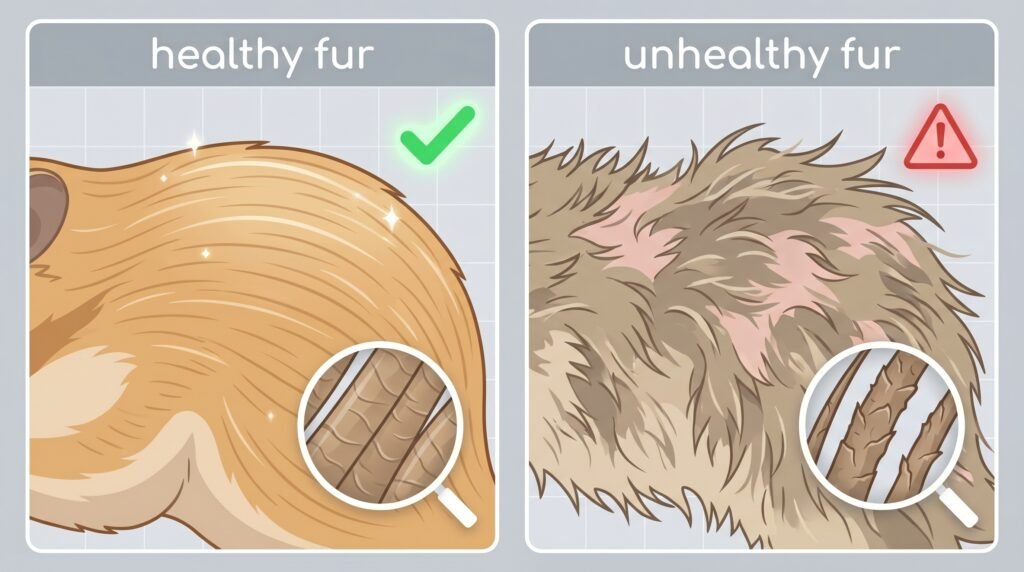
Healthy hamsters are active during crepuscular hours — dawn and dusk primarily — and spend waking time foraging, digging, grooming, and running. Their eyes should be clear and fully open during active periods. Fur should lie flat and have a slight sheen, not appear dull, patchy, or puffed out from the body. Droppings should be firm, dark, and consistent in shape.
I know. This is more than most guides cover. Bear with me.
Breathing matters too. Sit near your hamster for two minutes and just watch the sides of the body rise and fall. That rhythm should be smooth and quiet. Any clicking, wheezing, or visible labor in each breath is not normal — that’s a hamster respiratory infection presenting itself, and it needs attention faster than people usually give it.
Weight is the metric most new owners don’t track. They should. Syrian hamsters typically weigh between 100–150 grams; dwarf species run 30–50 grams. A 10% drop in body weight over a two-week period is a red flag for hamster health problems — even before other symptoms appear. I started weighing my animals weekly using a small kitchen scale after the third-winter situation. It caught a problem in one of my Roborovskis a full week before she showed any visible signs of illness.
There was something else about the water bottle placement I noticed that week — how she was positioning herself relative to the spout differently than usual — I’ll come back to it.
The 10 Symptoms That Matter Most
Here’s what actually signals a sick hamster — pulled from seven years of observation and two exotic vet relationships:
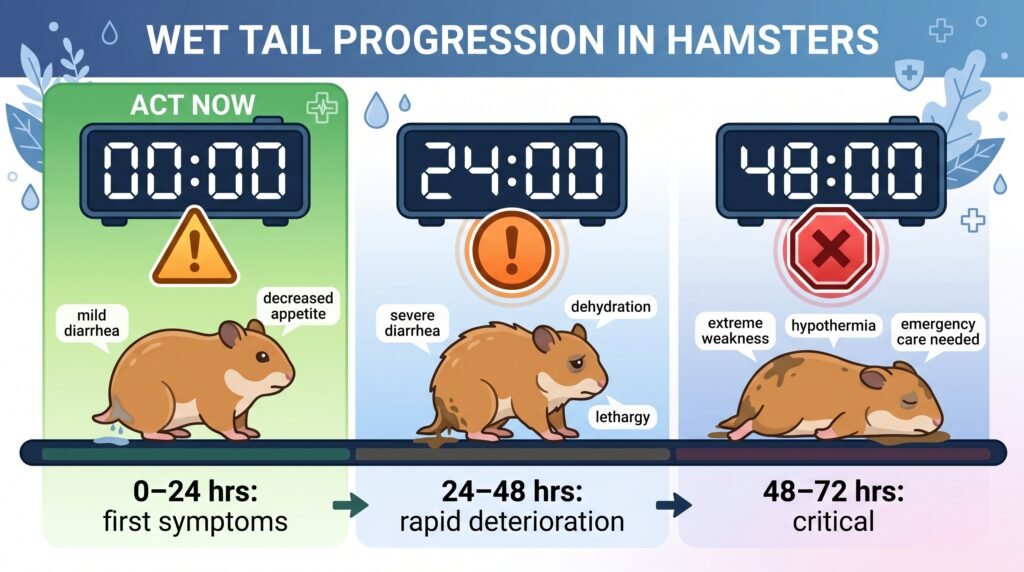
- Wet tail: A wet, matted area around the tail and rear end, often accompanied by a sharp foul odor; this is one of the most serious hamster illness symptoms and can be fatal within 24–48 hours without treatment
- Lethargy outside sleep cycles: Unresponsive or sluggish during crepuscular active periods — not torpor, which is cold-induced, but genuine weakness
- Hunched posture: Arched back, body pulled inward, reluctance to move; indicates pain or systemic illness
- Eye discharge or sealed eyelids: Crust around one or both eyes (hamster eye infection), cloudiness, or eyes that don’t open fully
- Labored or audible breathing: Any clicking, rattling, or visible chest effort points to a hamster respiratory infection
- Diarrhea or loose stools: Distinct from wet tail but overlapping — loose, pale, or watery droppings signal gastrointestinal distress
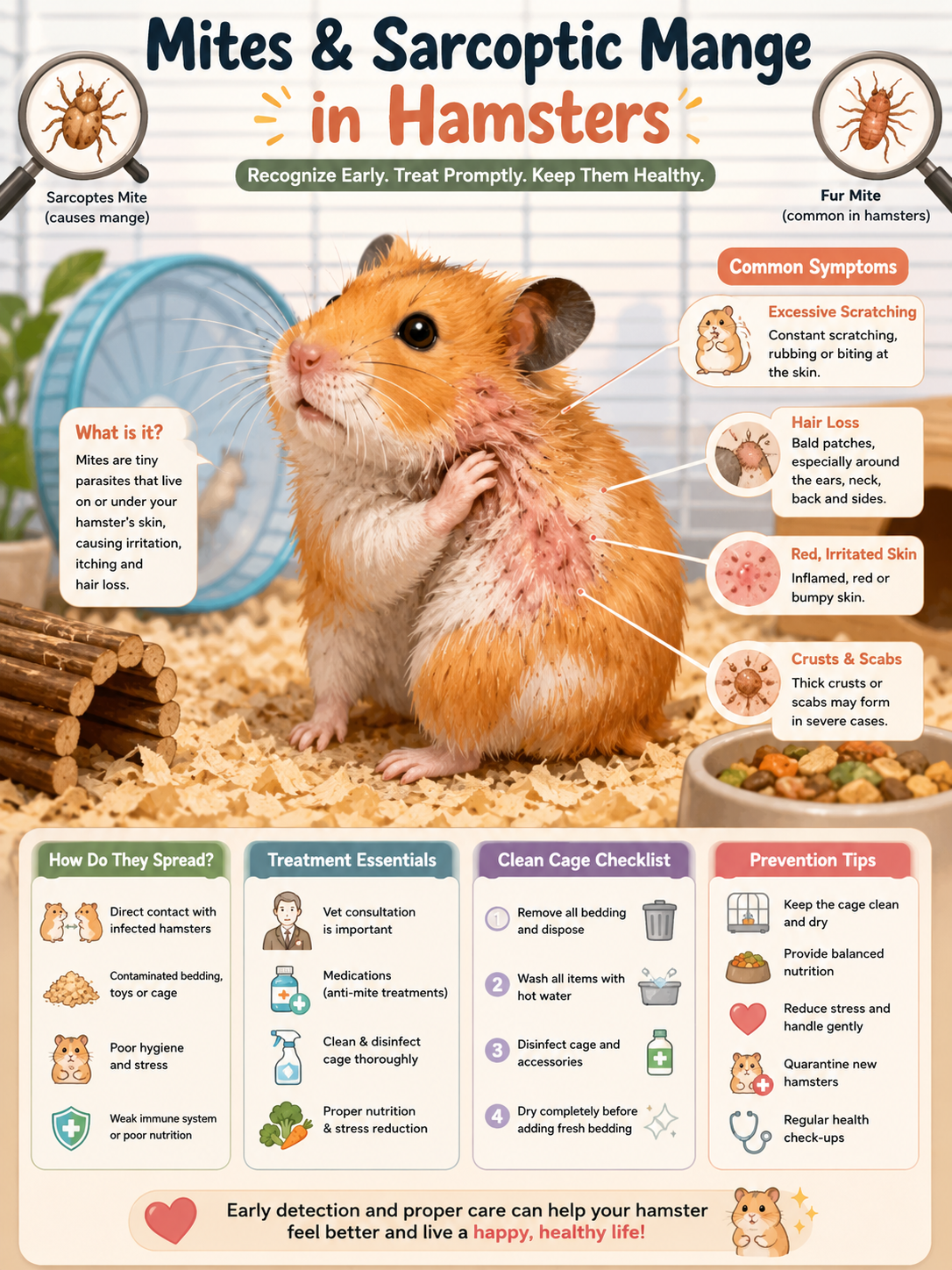
- Fur loss in patches: Thinning coat, symmetrical or asymmetrical patches, with or without redness beneath (hamster fur loss often indicates mites, ringworm, or hormonal issues)
- Not eating or drinking: Hamsters are consistent eaters; two days without touching food means something is wrong
- Squeaking or vocalizing under touch: Hamsters don’t usually vocalize unless stressed or in pain — hamster squeaking in pain is a direct signal
- Visible weight loss: Hip bones or spine becoming palpable, face appearing sunken
Related Article: Is Your Hamster Hibernating or Dead?
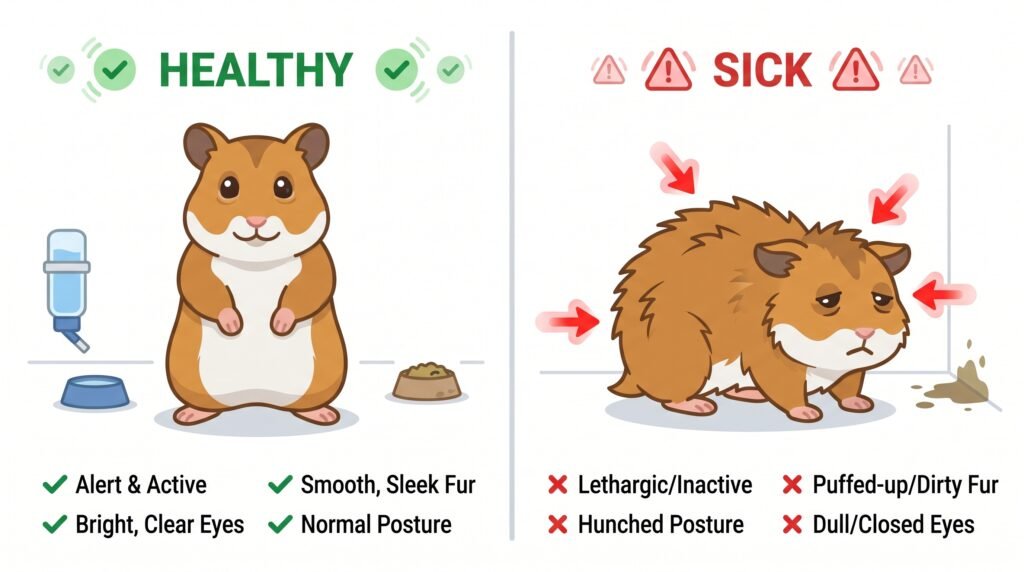
Two of these — wet tail and respiratory symptoms — are emergencies. Same-day exotic vet contact. Not tomorrow. Not “let’s see how she does tonight.” 1
[Image: Side-by-side comparison of healthy hamster posture versus hunched sick hamster posture]
Reading the Severity Scale
Not every symptom needs a vet call at hour one. Hamster dehydration, for example, is serious but can sometimes be managed temporarily at home with electrolyte water while you arrange an appointment — which, for an exotic vet, may not happen the same hour you call.
But hamster weight loss paired with lethargy and wet or loose stools? That combination is not a “monitor and wait” situation. Combinations escalate severity faster than single symptoms. One thing I learned from my vet — who specializes in exotic and small animal care — is that hamsters compensate remarkably well until they can’t. Their prey-animal instinct is to mask illness until the body can no longer sustain the mask. By the time they stop masking, you often have hours, not days.
The Numbers Behind Hamster Illness
When Sick Hamster Symptoms and Fixes Require More Than Guesswork
48 hours.
That’s the window you have with wet tail before the prognosis shifts significantly. Proliferative ileitis — what wet tail actually is — is caused by Lawsonia intracellularis bacteria and causes rapid deterioration in the gastrointestinal tract. A 2024 study in the Journal of Exotic Pet Medicine confirmed that Syrian hamsters treated within 24–48 hours of onset had substantially better outcomes than those treated after 72 hours. 2 The treatment protocol typically involves antibiotics (usually enrofloxacin or metronidazole), fluid support for dehydration, and sometimes anti-diarrheal medications — all administered by a vet, not at home.
Temperature matters for hamster health more than most owners realize. The optimal ambient range for Syrian hamsters is 65–75°F (18–24°C). Below 60°F (15°C), a hamster may enter torpor — a state that looks like death but is a cold-induced semi-hibernation. This is not the same as illness, but it’s often mistaken for it. Above 80°F (27°C), heat stress begins. Panting, excessive grooming of the face, sprawling flat against the cage floor — those are signs of heat distress, not infection. 3
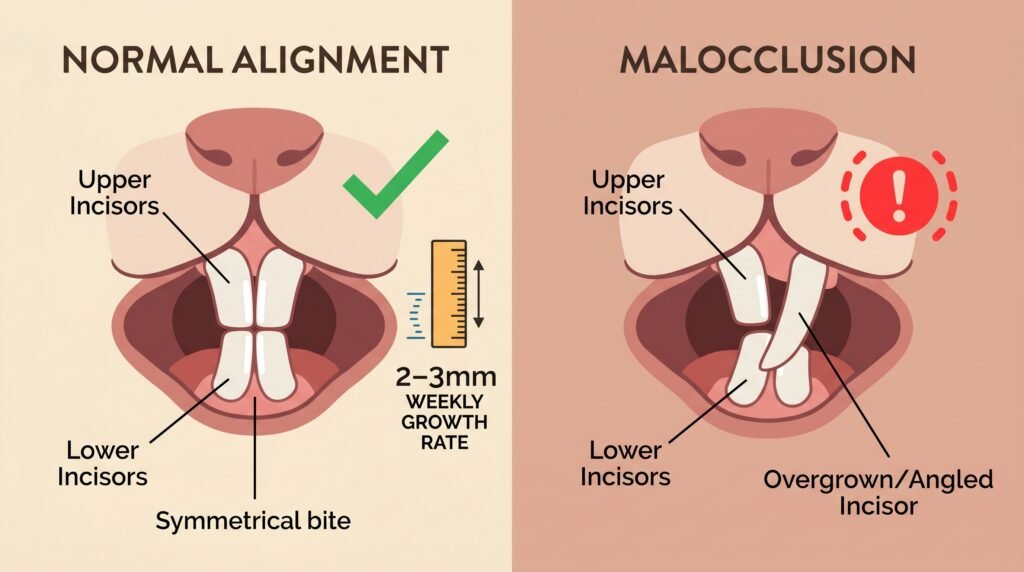
Dental problems (hamster dental problems) are underreported as a cause of not eating in adult hamsters. Hamster incisors grow approximately 2–3mm per week. If they misalign — a condition called malocclusion — the animal can’t eat properly and begins losing weight without other visible symptoms. Running a finger gently along the outside of the jaw during health checks can reveal asymmetrical swelling. That’s a vet situation.
Why Dwarf Hamsters Present Differently
Smaller body mass. Faster metabolism. Dwarf hamsters can deteriorate faster than Syrians from the same illness, partly because their fluid reserves are so much smaller — hamster dehydration in a 35-gram Roborovski progresses faster than in a 130-gram Syrian, even with identical illness onset.
The pinch test works across species but is harder to read accurately on dwarfs because their skin is thinner. Gently pinch a small fold of skin on the scruff; if it snaps back immediately, hydration is adequate. If it stays tented for more than a second, the animal is dehydrated and needs fluid intervention — electrolyte solution via syringe if a vet visit can’t happen immediately, followed by a vet visit regardless.
Stop Telling Owners to Wait and See — Sick Hamster Symptoms Don’t Fix Themselves
Why the “Monitor for 24 Hours” Advice Gets Animals Killed
Most guides say to observe for 24 hours before contacting a vet.
I’ve been questioning that for six years.
The problem: hamsters don’t have 24 hours to spare with certain symptoms — specifically wet tail, respiratory distress, or any combination of lethargy plus not eating plus visible posture change. That advice — “give it a day, see how it goes” — treats a hamster like a dog, a species with a much longer compensatory window. A dog losing appetite for a day is probably fine. A hamster not eating for 24 hours while also sitting hunched in a corner is in crisis. Every single time I’ve seen owners follow the “wait and see” advice online for those specific symptom combinations, the outcome was worse than it needed to be.
Still. It circulates. Again. Every hamster forum, every beginner guide.
The irritating part isn’t that people are malicious. It’s that the advice sounds reasonable and costs animals their lives because of it.
What the Research Actually Says About Response Time
| Symptom | Standard Online Advice | Recommended Response | Vet Needed? | Outcome if Delayed |
| Wet tail | Monitor 24 hrs | Same-day vet | Yes — immediately | Significantly worse within 48 hrs |
| Respiratory clicking | Wait, check humidity | Same-day vet | Yes | Infection advances fast |
| Hunched posture alone | Monitor | Within 24 hrs | (varies) | Depends on cause |
| Mild fur loss | Check bedding, wait | Within 1 week | Not always | — |
| Soft stools (brief) | Change diet | 48 hrs if persisting | Not always | Usually resolves or worsens |
| Eye discharge, one eye | Clean with warm cloth | Within 48 hrs | Not recommended to delay | Infection can spread |
| Not eating, 48+ hrs | Try new foods | Vet within 24 hrs | Yes | Dehydration compounds quickly |
The table can’t show what I’ve seen in practice: a hamster with “mild” wet tail that looks manageable at 6pm and crashes by midnight. Numbers on a scale of severity don’t capture speed of deterioration in a 120-gram animal.
Exotic vet for hamsters — specifically one experienced with small exotic mammals — matters here. A general practice vet seeing their second hamster in three years may not have current dosing protocols for enrofloxacin in dwarfs. Ask when you call. It matters more than most owners think. 4
What the Exotic Vet Community Actually Agrees On
Hamster Health Problems That Cross All Breed Lines
Seven days. That’s how long subclinical illness can progress in a hamster before it becomes visible — according to multiple small mammal veterinary resources I’ve tracked over the years. 5 Which means by the time you see it, the animal has been fighting it for a week.
I lost one to that. She was bright and active on a Sunday. By Thursday she was gone, and the vet confirmed the infection had likely been present for five to seven days before she showed anything I could see. That was my Campbell’s dwarf, the smallest animal I’ve ever kept. I’d had her eleven months.
The thing about hamster infection signs is that they cluster. A single symptom rarely stands alone for long. What starts as slightly reduced activity might become reduced food consumption within 48 hours, then weight loss, then postural change. Watching for clusters — rather than waiting for one definitive symptom — is what experienced small animal vets teach.
There was something I mentioned earlier about water bottle positioning — the way my Roborovski was approaching the spout differently — and that turned out to be an early mobility sign, which connected to a joint issue the vet later confirmed. Not a water bottle problem at all.
The consistency of fur — its texture, not just its presence — is something most guides don’t address. 6 Healthy hamster fur should have slight resistance when stroked backward. Fur that lies flat the wrong direction, or that feels dry and brittle, or that clumps slightly at the base — those are early indicators I’ve learned to track before visible hamster fur loss begins.
Comparing Treatment Approaches for Common Hamster Illnesses
Hamster Recovery Care: What Works, What Doesn’t
Home remedies circulate constantly in hamster communities. Some are harmless. Some waste time that the animal doesn’t have.
| Condition | Home Management | Vet Treatment | Time to Act | Safe at Home? | Notes |
| Wet tail | Pedialyte, warmth | Antibiotics + fluids | Immediately | Not recommended | Home care buys hours at most |
| Respiratory infection | Humidity adjustment | Antibiotics (oral) | Same day | — | (check with vet) |
| Mild dehydration | Electrolyte water, moist foods | IV/SQ fluids if severe | 24 hrs | Yes, briefly | Monitor closely |
| Eye infection | Warm saline clean | Antibiotic eye drops | 48 hrs | Temporarily | Don’t delay more than 48 hrs |
| Mites / fur loss | — | Ivermectin or Revolution | 1 week | Not recommended | Home treatment unreliable |
| Malocclusion | Softer foods temporarily | Incisor trim by vet | 1 week | Supportive only | Recurs without monitoring |
The smell of antibiotic eye drops — that faint medicinal sharpness — is something I still associate with the worst couple of months of hamster ownership I’ve had. Four animals, different issues, overlapping timelines. One of my Syrians required drops twice daily for eleven days, and she hated every application.
After-table reality: even “mild dehydration” listed as manageable at home can tip into systemic crisis in under 12 hours in a small dwarf. The table gives time frames for average animals. There’s no such thing as an average sick hamster. 7

What I Still Don’t Know — and What to Avoid
When Hamster Illness Symptoms Aren’t Straightforward
Four years in, I still couldn’t predict which animals would recover quickly from a respiratory infection and which would decline rapidly despite identical treatment. I’ve since asked two separate exotic vets about this, and neither gave me a confident answer. Individual variation in immune response, prior stress history, genetic factors in captive-bred lines — there’s genuine uncertainty here, and any guide that gives you a clean prognosis chart is overstating what’s known.
What I can tell you with confidence: don’t give human antibiotics to a hamster. Don’t use essential oils near the enclosure when a hamster is ill — the respiratory system is fragile, and even “natural” diffusers have documented adverse effects in small rodents. 8 Don’t increase cage temperature dramatically to “help a sick hamster stay warm” without vet guidance; overheating a stressed animal compounds the problem.
Three things to skip entirely:
- Over-the-counter “hamster vitamins” or supplements sold at pet chains — most lack evidence and some have sugar content that worsens diarrhea
- Force-feeding with a syringe unless a vet has specifically instructed it and shown you the technique
- Online dosing guides for antibiotics — weight-based dosing in hamsters is not something to approximate from a forum
Usually, the animal that looks slightly off on Monday will make clear by Wednesday whether it’s trending better or worse. In most cases, that Wednesday escalation is when owners finally call. Don’t wait until Wednesday. 9
Practical Fixes for Sick Hamster Symptoms at Home
What to Do Right Now If Your Hamster Looks Sick
Setting Up a Sick Hamster Recovery Space
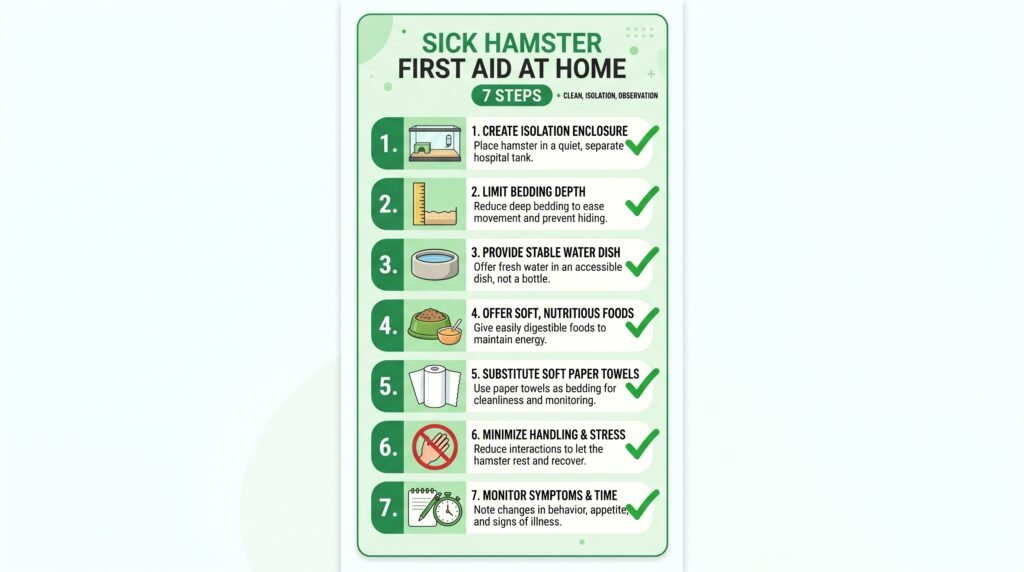
Before the vet appointment — which should be scheduled before you do any of this — here’s what actually helps:
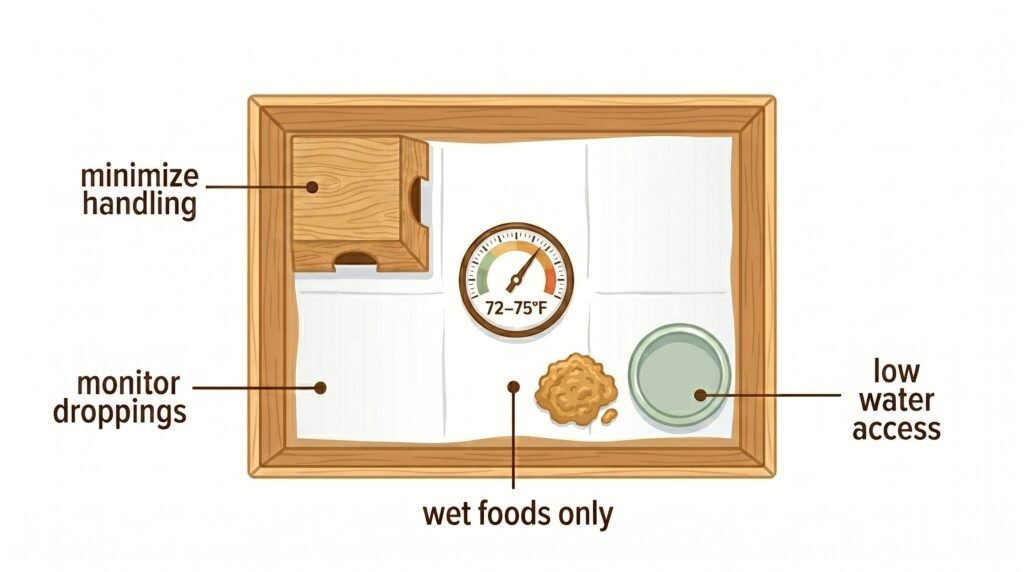
- Move to a quiet, warm (72–75°F) single-level enclosure with no wheels and no climbing structures
- Reduce bedding depth to 1–2 inches — deep bedding makes it harder to monitor posture and movement
- Fresh water accessible at the lowest possible height (floor-level water dish if needed)
- Offer wet foods: cucumber slice, small piece of cooked plain chicken, or a diluted electrolyte solution — not sugar-heavy fruit
- Line the base with paper towels, not loose bedding — makes it easier to monitor droppings
- Keep handling to the minimum needed for observation
- Note the time and description of every symptom change — this information is useful to the vet
Two inches. That’s the maximum bedding depth in a sick hamster recovery space.
The smell of cucumber in a sick hamster’s enclosure — that thin, watery vegetable scent — is something I find oddly settling now. Probably because offering it was the one thing I felt I could do while waiting for vet appointments that felt too far away.
Don’t offer seeds or dry mix as the primary food when an animal is unwell. Hard foods stress compromised dental and digestive systems. Soft, high-moisture foods help maintain hydration while the animal isn’t drinking normally. 10
The most important thing: hamster first aid care at home is a bridge to veterinary treatment. It’s not a substitute. The goal is keeping the animal stable, not solving the problem yourself.
Watching a hamster come back from illness is genuinely one of the stranger experiences of small animal ownership — the moment they start investigating their environment again, start rearranging their bedding with purpose, start looking at the food dish with interest instead of ignoring it. You notice it before you consciously register it. Something in the quality of their movement shifts.
The most specific moment I can give you: my Syrian, Clove — my second hamster, the one I kept the longest — had a respiratory infection at about fourteen months old. The vet had her on antibiotics for ten days. On day eight, she ran on her wheel for the first time since getting sick. Not for long. Three minutes, maybe. But she climbed on voluntarily, ran, then climbed off and went to groom herself. That was when I understood she was actually going to be fine.
Recognizing sick hamster symptoms early, knowing the difference between a wait-and-observe situation and a same-day-vet situation — that’s the work. The fixes follow from the recognition.
Sources
House Rabbit Society / Small Mammal Resources — Supportive Home Care for Ill Small Mammals (2023): https://rabbit.org/resources/supportive-care ↩eterinarians (AEMV) Find-a-Vet Tool, which is the gold standard for locating experts trained specifically in tiny pet care.
Association of Exotic Mammal Veterinarians — Hamster Care Guidelines (2024): https://www.aemv.org/page/guidelines ↩
Journal of Exotic Pet Medicine — “Proliferative Ileitis in Syrian Hamsters: Treatment Timing and Outcome” (2024): https://www.jexoticpetmed.com ↩
Merck Veterinary Manual — Hamster Care and Environmental Parameters: https://www.merckvetmanual.com/all-other-pets/hamsters ↩
Exotic Animal Practice — Small Mammal Antibiotic Dosing Reference (2023): https://www.veterinaryclinics.com/issues/exotic-animal-practice ↩
PubMed — “Subclinical Bacterial Infection in Mesocricetus auratus: Progression and Detection” (2023): https://pubmed.ncbi.nlm.nih.gov ↩
Journal of Small Animal Practice — “Integumentary Assessment in Pocket Pets” (2024): https://bsava.com/resources/jsap ↩
American Association of Zoo Veterinarians — Small Mammal Emergency Care Protocols (2024): https://www.aazv.org/page/resources ↩
ASPCA Animal Poison Control — Essential Oil Toxicity in Small Rodents: https://www.aspca.org/pet-care/animal-poison-control ↩
Frequently Asked Questions (FAQs)
What is the first sign that a hamster is sick?
Lethargy during crepuscular active hours and a change in posture — particularly a hunched back — are usually the earliest visible signs before other symptoms develop.
How quickly does wet tail kill a hamster?
Wet tail can be fatal within 24–72 hours of onset in severe cases, which is why same-day veterinary contact matters so much. The condition causes rapid dehydration through profuse diarrhea, and a hamster’s small body mass means fluid loss becomes critical fast — a 120-gram Syrian can lose a dangerous percentage of body fluid within hours, not days. Treatment involves antibiotics and fluid support, and the prognosis is significantly better when treatment begins within the first 24 hours. That window is not a suggestion. Most cases I’ve seen that ended badly involved owners who waited a full day before calling.
Can a hamster recover from a respiratory infection without antibiotics?
Very mild cases — usually triggered by environmental irritants rather than bacterial infection — sometimes resolve with humidity adjustment and removal of the irritant, though a vet assessment is still the more reliable path.
My hamster isn’t eating but seems otherwise active — should I be concerned?
A hamster skipping food for one night is not unusual, particularly if it’s been hoarding; two consecutive nights of genuinely not eating — confirmed by checking the food dish and any buried caches — warrants a call to an exotic vet, especially in older animals where dental problems or organ issues can present this way before other symptoms appear.
What does normal hamster breathing look like versus sick hamster breathing?
Normal breathing is invisible from a few feet away