
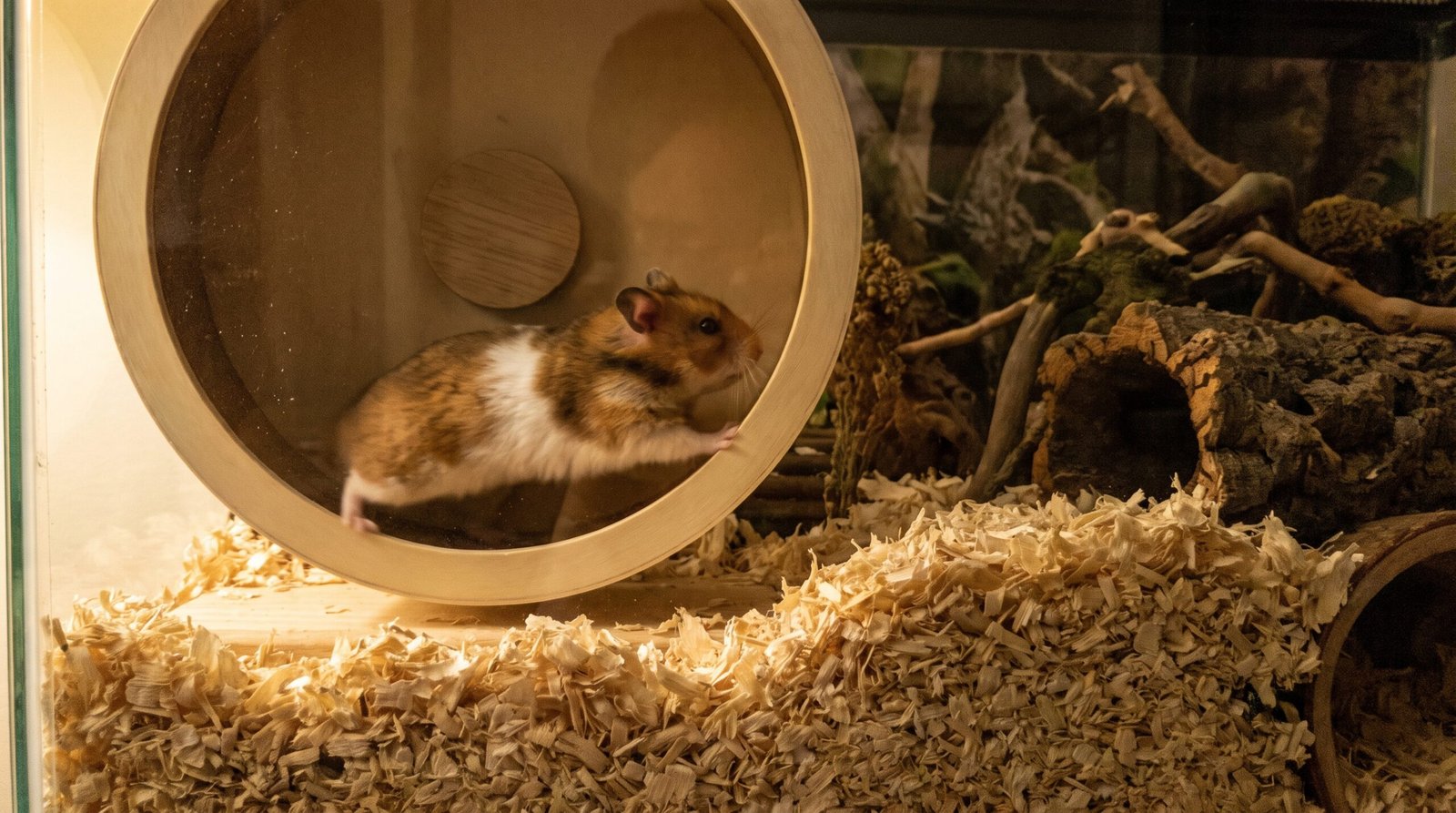
Preparing the Cage Setup for Pregnant Hamster
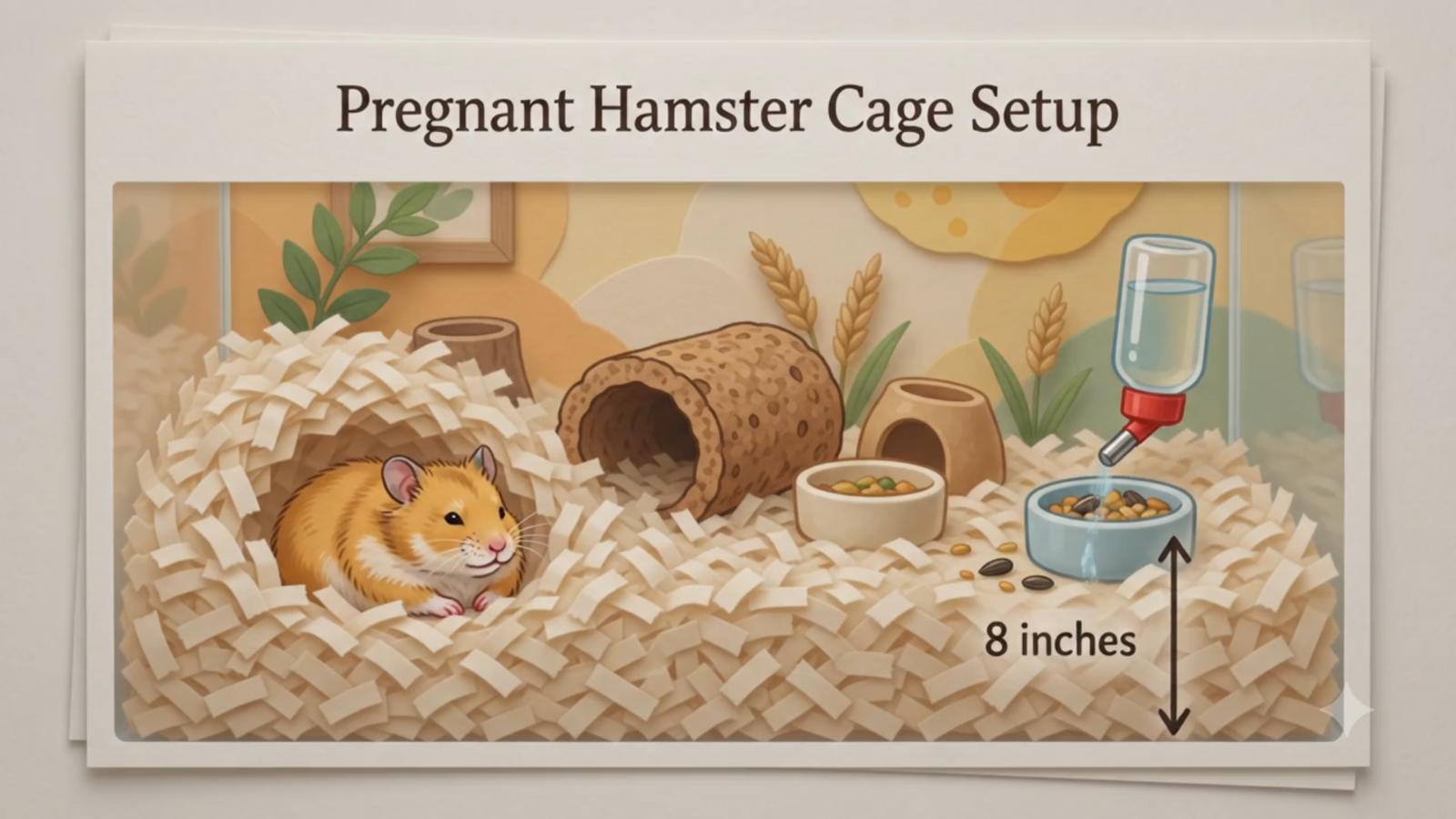
Table of Contents
Nobody told me you had to start three weeks early. That was the first mistake — mine, not the hamster’s. Preparing the cage setup for a pregnant hamster isn’t something you do when you notice the belly. By the time you notice the belly, you’re already behind. I learned that in the worst way possible, with a Syrian female named Oat, a tank that was frankly embarrassing in hindsight, and a litter I never saw take their first steps.
That was the one.
Twenty-two years of keeping hamsters — Syrian, Roborovski, Campbell’s, Chinese — and that single experience still shapes every recommendation I make. Not because it was uniquely tragic. Because it was preventable. Completely, easily, no-excuse preventable, and I didn’t prevent it because I was working from advice written in 1998 that hadn’t been meaningfully updated.
Three weeks. That’s the window. Start the full cage reconfiguration at least twenty-one days before you expect the birth, and if you’re not certain of your timeline, start earlier than that and don’t apologize for it.
The advice floating around in forums and low-traffic pet blogs is still recommending cages that would embarrass anyone paying attention to what current behaviorists and veterinary professionals have established. Bare setups. Removed enrichment. The idea that a pregnant hamster needs less stimulation. She doesn’t. She needs the right stimulation — and that difference, between less and right, is the entire article.
Here’s what I actually know.
What the Cage Looked Like Before I Understood Anything
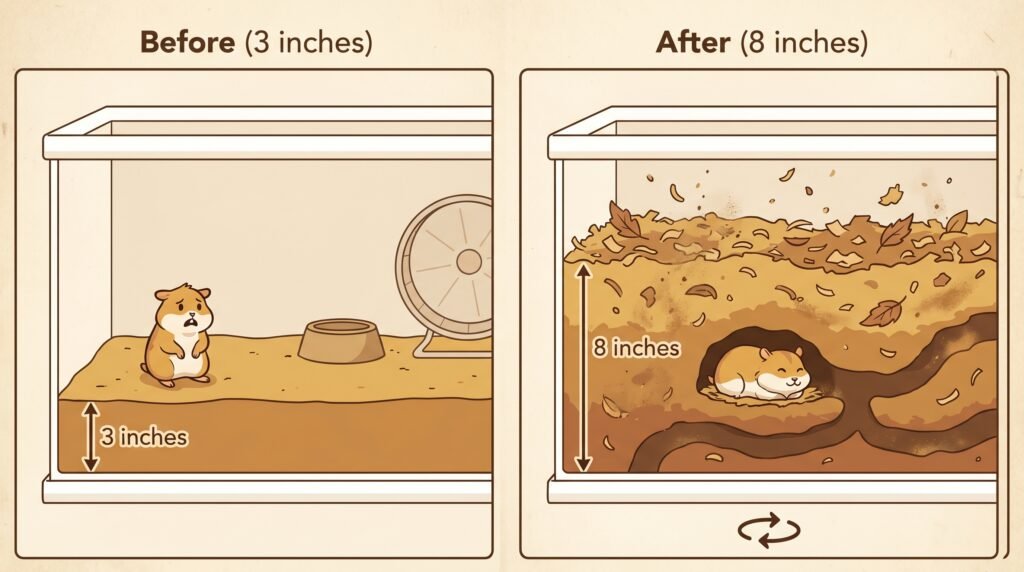
Six inches of bedding. That’s where every conversation about this should start — not because it’s the most complicated part, but because it’s the part that gets dismissed first.
I used to run four inches. I thought that was generous. Most of the advice I’d absorbed said two to three inches was fine. It wasn’t fine, and it still isn’t fine, and watching a pregnant hamster scratch compulsively at substrate that doesn’t give her enough depth to build a real nest chamber told me more than any article had.
She needs to burrow down and build a separate space.
The Part About Nesting Material That I Cannot Seem to Stop Explaining
Paper bedding. I know I keep coming back to this. I know it sounds like the most boring possible thing to fixate on, but the gap between what most setups use and what actually works for a pregnant hamster during the nesting phase is wide enough to cost you a litter, and I’ve watched it happen too many times to pretend it’s a minor detail.
Eight inches.
That’s the substrate depth I use now — not for every hamster setup, but for any hamster who is pregnant or who I suspect might be. Eight inches of paper-based substrate, unscented, loose enough to compress when burrowed into but dense enough to hold a tunnel. The hamster nesting behavior in the final week before birth is not decorative. She’s building a microhabitat. She needs material that cooperates.
Paper bedding has a faint chalky smell the first day — not bad, but noticeable enough that I always air new bags for an hour before use.
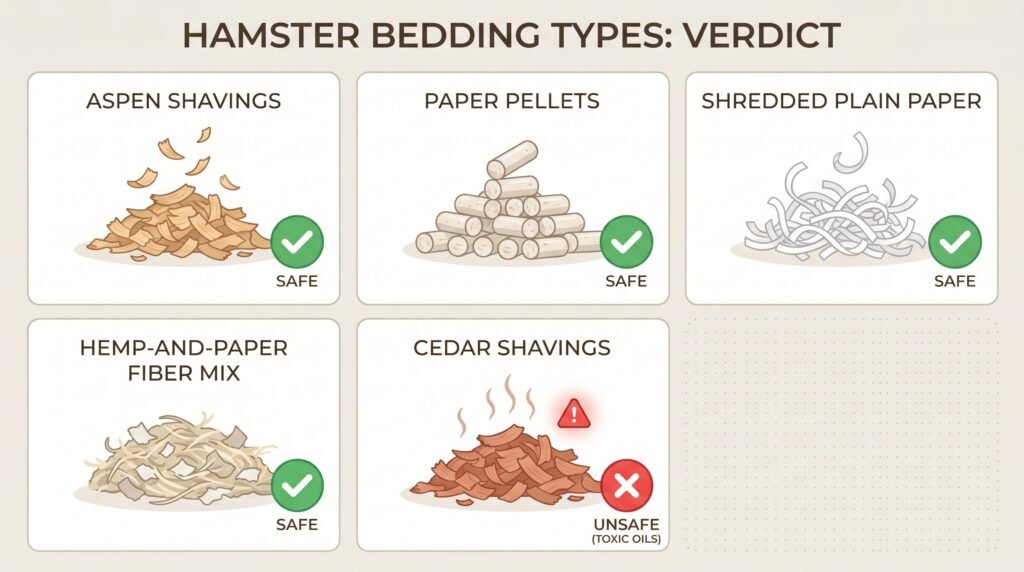
I’ve tried the following:
- Aspen shavings: okay for general housing, genuinely problematic for birth prep because the texture doesn’t compress into stable tunnel walls, and a nest that collapses under a nursing mother is a disaster.
- Paper pellets: good odor control, but too rigid — this is what most vets refer to as inadequate for maternal nesting, though the pellet manufacturers would rather you didn’t know that.
- Shredded paper (plain, unbleached): the best secondary layer I’ve found, layered over paper fiber base substrate; she’ll redistribute it herself.
- Hemp bedding mixed with paper fiber: excellent, though the hemp can be coarser than you expect — check the specific brand before committing to a pregnant setup.
- Cedar or pine shavings: no.
The smell thing matters more than people acknowledge. Cedar has aromatic oils that are genuinely hazardous for small animals, particularly newborns whose respiratory systems are not equipped for that kind of assault [Quesenberry & Carpenter, Ferrets, Rabbits, and Rodents, 4th ed., 2021]. Pine is slightly less severe but still in the avoid category. Neither belongs anywhere near a maternity cage (this is what experienced rescuers call it, though the clinical term is more prosaic).
Quantity also matters in a way nobody explains clearly. A standard 40-gallon tank with eight inches of paper substrate is going to require somewhere around a full large bag — more than feels necessary. That’s correct. Use more than feels necessary. The first time I bought what seemed like enough, it wasn’t, and I spent a frantic evening trying to layer in supplements while the female watched me with, I choose to believe, mild judgment.
I know. I know. But this part actually matters. The substrate volume is the foundation of everything else — the nest structure, the burrow system, the pup safety zone, the mother’s ability to thermoregulate a small space without your help. Get it right once and you stop thinking about it.
The Problem With “Comfortable Nesting Material”
Every guide I’ve read says “provide comfortable nesting material.” That phrase does almost no work. Comfortable for whom? Under what conditions? “Comfortable” in a cage with three inches of substrate means something different than in a cage with eight, and the nesting material behaves differently in each context because depth changes how the hamster can use it.
What She’s Actually Building
She’s not just piling things up. She’s constructing a multi-chamber burrow system — entrance tunnel, nest chamber, sometimes a separate latrine area — and in captivity, the depth and quality of the substrate determines whether she can do this fully or has to compromise. A compromised nest is a stressed mother. A stressed mother during late pregnancy and early nursing is a significant risk factor for litter loss, including pup cannibalism, which no one likes to say out loud but is a real thing that happens in poorly prepared setups [Harkness et al., Biology and Medicine of Rabbits and Rodents, 5th ed., 2022].
How Long Do You Actually Have? The Timeline for Cage Setup for Pregnant Hamster
Sixteen days.
Syrian hamster gestation is fifteen to sixteen days. That is not a typo. If you’re not watching for signs of pregnancy from the moment of any potential mating event, you can genuinely miss the window for a proper pregnant hamster cage setup entirely. Dwarf species — Campbell’s, Winter White, Roborovski — run slightly longer at eighteen to twenty-two days, but the point stands.
The implication is that you have almost no time. Once a Syrian hamster is visibly pregnant — belly noticeably rounded, nipples visible — you may have less than a week before birth. You cannot do the full cage setup in less than a week and also let the hamster acclimate to the changes. She needs time to explore the new configuration without the stress of impending labor layered on top.
According to a 2023 veterinary care update from the American Association of Exotic Mammal Veterinarians (AEMV), hamsters experiencing environmental disruption within seventy-two hours of parturition show measurably elevated cortisol indicators and increased likelihood of disturbed maternal behavior [AEMV Small Mammal Care Guidelines, 2023].
The lesson is: set up the cage before she’s visibly pregnant if possible. If you’ve had a male and female in contact at any point, assume pregnancy and prepare accordingly.
Also Read: Pregnancy Signs in Hamsters
Cage Setup for Pregnant Hamster — The Timeline That Actually Works
Start three weeks before expected birth. Not two. Not one. Three.
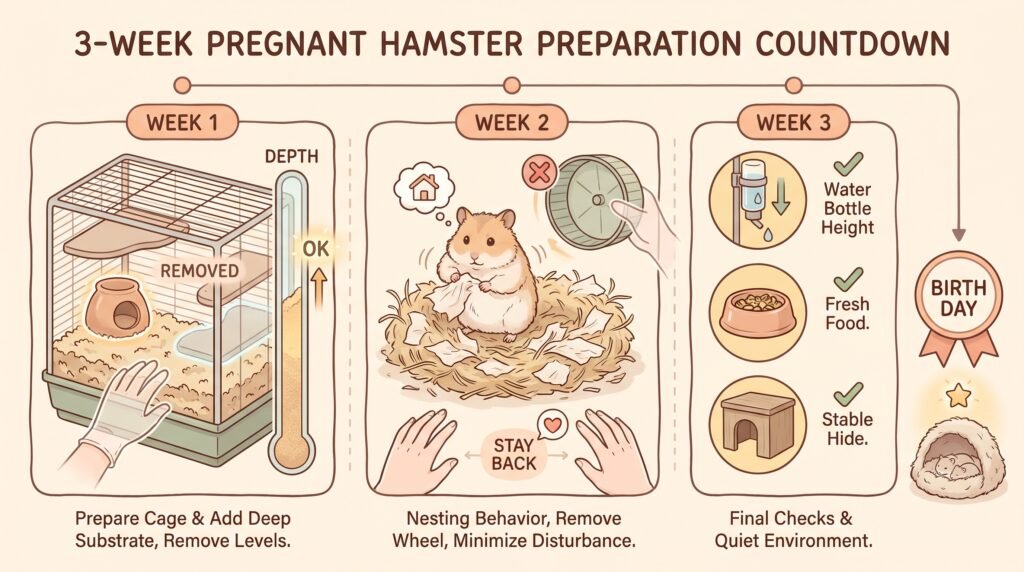
Week one: complete substrate change, depth calibration, placement of hides and nesting areas, removal of any multi-level platforms that require climbing.
Week two: let her settle. Watch. Don’t rearrange anything. If she’s moving items, that’s maternal nesting behavior beginning — let her. Your job is to provide material, not to decide where it goes.
Week three: final checks only. Water bottle accessibility, food supply, removal of wheel if applicable.
Wheel Removal Timing
The wheel question is contested. I’ll say clearly what I do: the wheel comes out at the start of week two, or earlier if she’s showing nesting behavior. The concern isn’t exercise in the abstract — pregnant hamsters can and do exercise safely in early pregnancy. The concern is a running wheel near a nest structure, in a cage where a female is increasingly oriented toward that nest, is a fall risk and a stress contributor in the late stage. A hamster wheel that vibrates the entire cage frame at 3am is not a low-stress hamster habitat.
The Advice I’ve Been Disagreeing With for Twelve Years
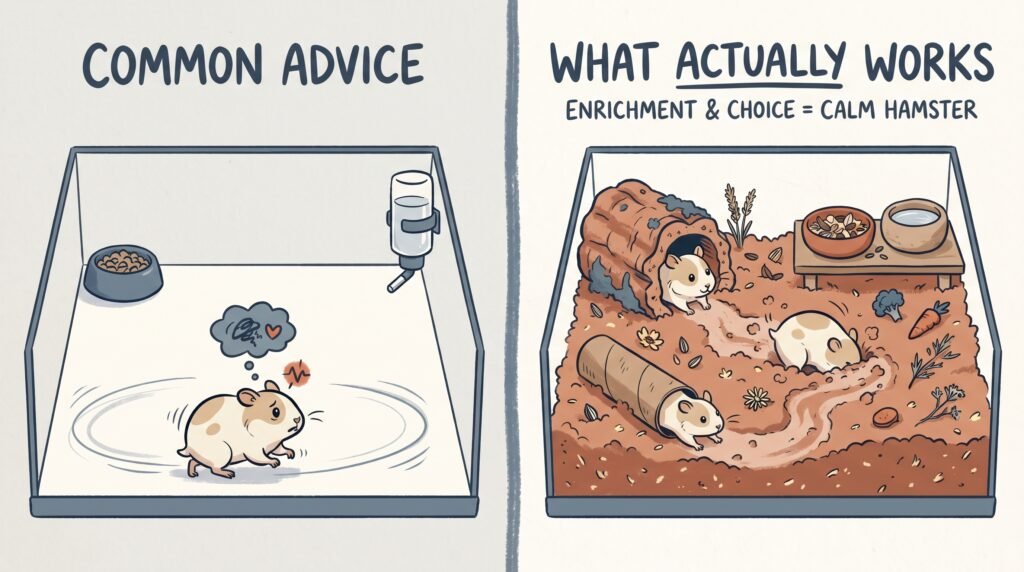
Most guides — and I mean most, including some published by otherwise reputable small animal resources — recommend stripping enrichment from the cage when a hamster is pregnant or nursing.
Muhammad Shahzad has been questioning that recommendation for twelve years.
The problem: enrichment removal assumes the hamster’s stress comes from stimulation. It doesn’t. In most cases, the stress comes from inadequate space, inadequate substrate, and the specific kind of disruption that comes from human interference — not from having things to investigate, chew, or interact with. A hamster in a bare cage with no enrichment isn’t calmer. She’s bored, under-stimulated, and often redirects that energy into repetitive behaviors that are far more stressful than whatever the enrichment would have caused.
The thing that gets me — every time — is that this advice persists because nobody has updated it.
The source for “remove enrichment during pregnancy” is old husbandry culture that predates modern understanding of rodent behavioral needs. It’s not from a study. It’s not from a veterinary recommendation. It got passed down from keeper to keeper, from forum to forum, and it’s still out there in articles that were last updated in 2017 but rank well because they’re old.
| Enrichment Item | Safe During Pregnancy? | Safe During Nursing? | Notes |
|---|---|---|---|
| Wooden chew toys | Yes | Yes (check placement) | Avoid if scented or treated |
| Cork hides | Yes | Yes | Best hide type for stability |
| Fabric hammocks | Avoid | Not recommended | Fall risk, suffocation concern |
| Cardboard tubes | Yes | Yes | Pups can enter; check diameter |
| Running wheel | Early pregnancy only | — | Remove by week 2 pre-birth |
| Sand bath | Yes | Yes (small, stable dish) | Keep away from nest area |
| Foraging scatter | Yes | Yes | Slows down eating, reduces stress |
| Rope toys (bird-safe) | Not recommended | Not recommended | Entanglement risk |
The table can’t show you the way a pregnant hamster interacts with a cork hide at 2am — the sound of her rearranging it, the way she’ll move it twice in a night before settling — which tells you more about her comfort level than any metric.
Research on environmental enrichment in captive small mammals consistently shows that appropriate enrichment reduces stereotypic behavior and cortisol levels — findings that apply directly to pregnant rodents who are also navigating elevated hormonal stress [Meehan & Mench, Applied Animal Behaviour Science, 2007, cited in recent reviews through 2024].
How the Pregnant Hamster Cage Setup Fails Most Often
Two ways. Not one, not five. Two.
First: substrate depth. Already discussed. Not going to apologize for repeating it.
Second: hide placement that creates a navigational stress route. If the primary hide is positioned such that the hamster has to cross open ground to reach it from the food area, she will be stressed every time she eats. Put the hide near the food. Let her feel covered.
The Water Bottle Height Problem
Every single guide about this skips the water bottle. Every one. A pregnant hamster in the final stage, with a significantly enlarged abdomen, may struggle to reach a water bottle placed at the height appropriate for a non-pregnant adult. Lower it. Check that the spout functions smoothly. Dehydration in late pregnancy is a complication you do not need.
The Part I Don’t Talk About Enough — What Vets Are Actually Saying Now
Most veterinary guidance on perinatal hamster care has shifted significantly in the last five years toward a model that prioritizes low-stress consistency over intervention. The recommendation — and this comes from small mammal specialist publications, not general pet care guides — is to establish the environment and then genuinely leave it alone [Journal of Exotic Pet Medicine, 2024].
I lost a litter to that mistake. Took me three days to understand why.
She had a perfect setup. The bedding was right, the depth was right, the hides were stable, the wheel was gone. But I kept checking. Not intrusively — I thought. Just brief looks. Just making sure. And those looks happened in the first twelve hours after birth, which is the period of maximum vulnerability, and the repeated disturbance to her nest entrance was enough to trigger abandonment behavior.
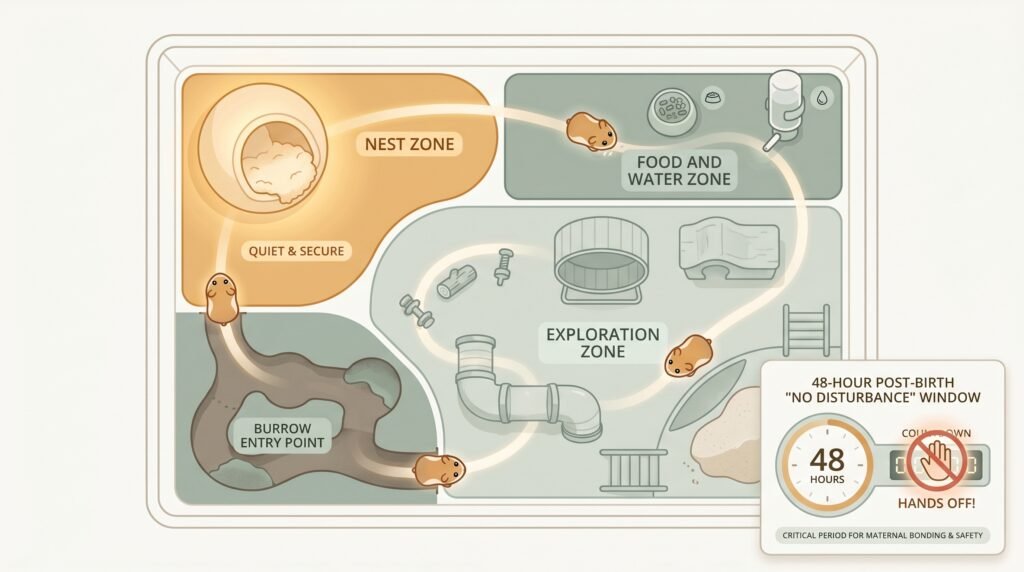
The rule now, for me, is: no visual checks for the first forty-eight hours after confirmed birth.
You can hear if something is wrong. The absence of sound — no squeaking, no movement — is a better check than any visual. A quiet cage is usually a functioning cage. A suddenly very quiet cage after days of activity might be worth a careful look. But routine checking in that window does harm.
Quiet Hamster Habitat — What That Phrase Actually Means
It means low interference from you.
It does not mean a bare cage in a silent room. It means placing the cage away from high-traffic areas, away from other pets who might nose at the enclosure, away from speakers, and away from direct vibration sources like washing machines or bass-heavy audio equipment. The hamster herself generates plenty of sound and activity. The quiet you’re creating is human quiet, not environmental sterility.
Comparing Setup Approaches — What the Options Actually Look Like
The setup philosophy split in hamster keeping is real and has been building for about a decade. On one side: minimalist setups with easy-clean surfaces and stripped-down enrichment. On the other: enrichment-based habitats that prioritize behavioral expression over keeper convenience.
Watch the water intake.
For a pregnant hamster, this isn’t even close.
| Setup Type | Substrate Depth | Enrichment Level | Birth Safety | Cleaning Frequency | Keeper Effort |
|---|---|---|---|---|---|
| Traditional minimal | 2–3 inches | Low / stripped | Moderate risk | Weekly | Low |
| Intermediate | 4–5 inches | Partial | Acceptable | Every 10–14 days | Moderate |
| Enrichment-based | 6–8 inches | Full appropriate | Best outcomes | Spot-clean only pre-birth | Higher |
| Bioactive attempt | 6–8 inches + live substrate | Variable | — (varies by setup) | Minimal (varies) | High |
| Bare/emergency setup | Under 2 inches | None | Not recommended | — | — |
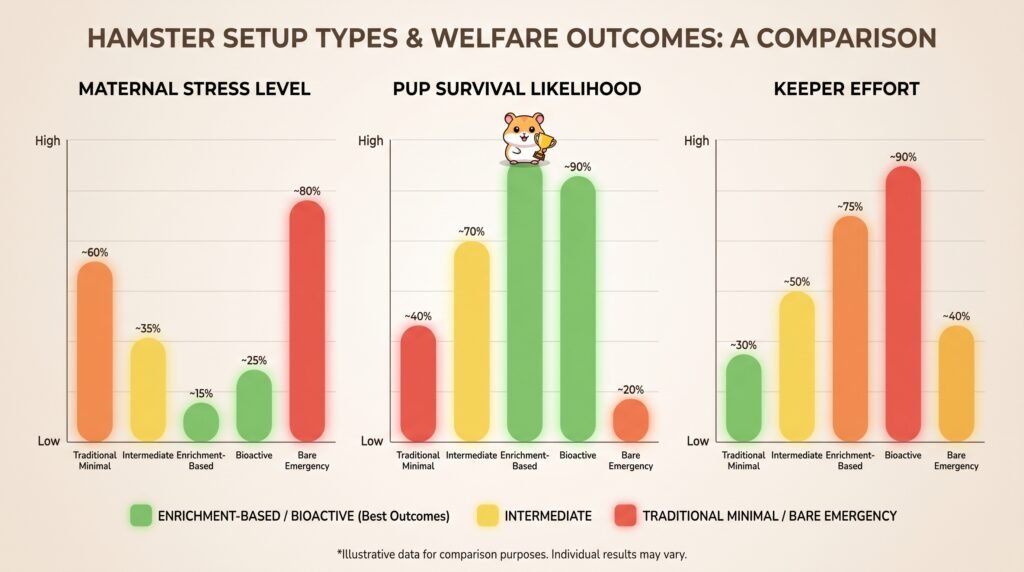
The table misses something that only experience gives you: a hamster in an enrichment-based setup during late pregnancy will show you clearly what she needs through her behavior. In a minimal setup, there’s nothing to modify. You’ve already removed everything. You’re flying blind.
A 2024 review of captive small mammal welfare indicators published through the Universities Federation for Animal Welfare (UFAW) specifically flagged substrate insufficiency as one of the top three preventable welfare failures in hamster keeping, alongside social housing errors and inadequate thermal regulation [UFAW Hamster Welfare Guidelines, 2024].
Nursing Hamster Care After Birth
The transition from birth preparation to nursing support is a continuation, not a reset. Same cage. Same substrate. Same hides. The only additions: slightly increased food availability — protein sources in particular, as lactation dramatically increases caloric demand — and a water bottle check every twenty-four hours without opening or disturbing the cage.
Hamster Pup Safety in the Nest Zone
Pups are essentially defenseless for the first two weeks. Blind, hairless, entirely dependent on a nest that is warm and structurally sound. A collapse in the nest structure — from inadequate substrate, from a hide that shifts, from a water bottle that drips into the bedding corner — can kill pups through chilling in under an hour at room temperature. The setup you build before birth is the setup they live in. Build it like lives depend on it.
The substrate depth is not aesthetic. It’s thermal.
What You Should Not Do — With Real Reasons
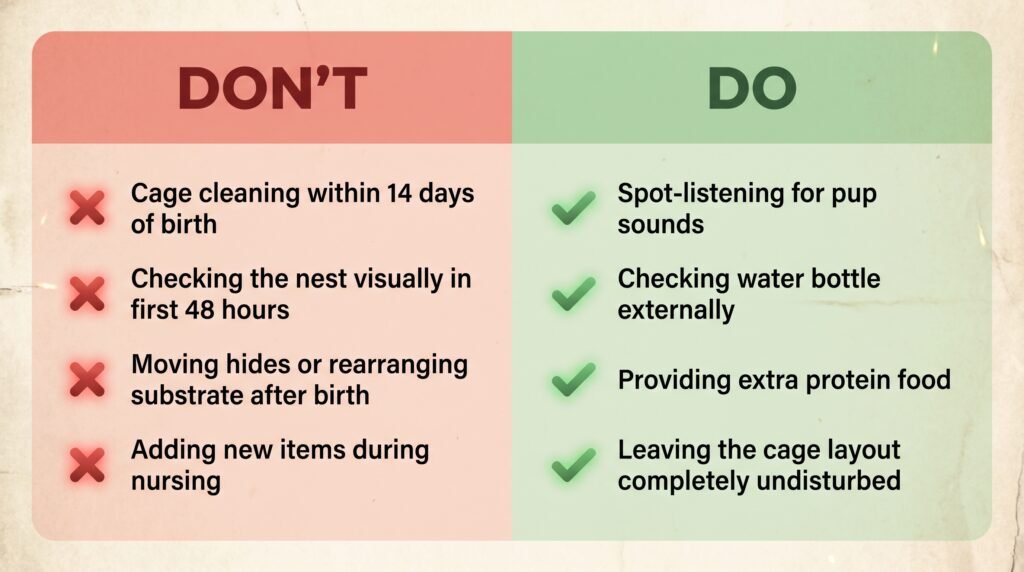
Don’t clean the cage in the two weeks after birth.
Not spot-clean. Not a “quick refresh.” Not “just the corner.” Nothing.
I’ve heard the counter-argument: the cage will smell, the hygiene risk will build, you’re worried about the pups. Understand what you’re trading. The hamster mother has built a nest structure that she knows by smell, by texture, by position. She’s oriented her entire behavioral world around it. Every time you disturb it — even to remove a piece of soiled bedding — you’re introducing your scent into the nest space, changing the structural landmarks she uses, and potentially triggering a stress response that, in the worst cases, ends with the pups being cannibalized or abandoned.
Usually, if you leave the cage entirely alone for fourteen days, the hamster manages the hygiene herself far better than you’d expect.
In most cases, the smell that keepers panic about is not actually a health risk. It’s just unfamiliar.
What Hamster Stress Reduction Actually Requires
Ninety-six hours.
That’s how long it takes, roughly, for a hamster to acclimate to a significantly changed environment — new cage, new substrate, new hide placement. If you move things around during the final week of pregnancy, you’re forcing her to navigate that acclimation window during the most hormonally chaotic period of her life.
According to published veterinary behavioral guidelines for small mammals (BSAVA Small Animal Practice, 2023), environmental changes during the periparturient period should be avoided within five days of expected parturition unless welfare requires immediate intervention.
Make your changes early and then stop. Leave the cage alone and let her settle in.
The sound of her rearranging things — the low scraping of substrate moving, the occasional thump of a hide being repositioned — is good. It means she’s building. Don’t interrupt that process by adding or removing things.
The Practical Checklist — What Needs to Happen Before She Gives Birth
Exact measurements. Real numbers. Not ranges designed to make you feel like anything is fine.
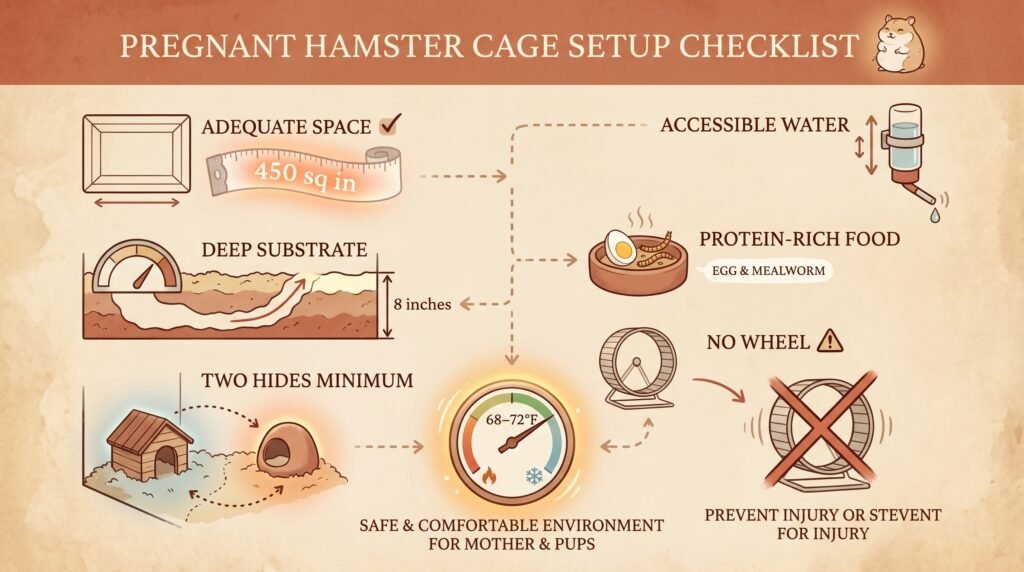
Start here:
- Minimum cage footprint: 450 square inches of unobstructed floor space — this is the standard now recognized by most European welfare bodies, and it matters more during pregnancy because she needs genuine ranging space as well as nest space. Less than this is a welfare compromise regardless of enrichment.
- Substrate depth at 8 inches in the main burrowing area; can taper to 5 inches at the periphery.
- At least two hides: one primary nest site (enclosed, opaque, stable — cork rounds or wooden huts, not plastic igloos that retain heat), one secondary retreat.
- Water bottle at a height she can reach comfortably without straining — this means testing it yourself by observing her posture when drinking, not by measuring from the floor.
- Food: high-quality hamster mix supplemented with small amounts of cooked egg or mealworms in the week before birth and throughout nursing. Protein is not optional for a nursing mother.
- No running wheel from week two onward.
- No cage mates. Ever. This should not need saying, but it does. The advice that dwarf hamsters can be kept in pairs during pregnancy is conditionally true and absolutely not a beginner decision.
- Cage placement: stable temperature between 68–72°F, away from windows (draft risk), away from other animals’ sight lines.
Getting the Pregnant Hamster Cage Setup Right Before Day One
Check the water bottle spout.
Not the bottle. The spout. Run your finger across it, confirm it releases a drop easily, confirm it isn’t dripping. A dripping bottle will wet the substrate near the bottle placement and create a cold, damp zone in the cage that is particularly dangerous if the nest is positioned nearby — which it often is, because hamsters tend to nest near their food and water.
Check the hide stability.
Push it gently. If it shifts, she’ll spend energy trying to anchor it. Use a heavier option or press it slightly into the substrate.
Hamster Food During Pregnancy — The Protein Question
Standard hamster mixes are maintenance nutrition, not gestational nutrition. In the final week before birth and throughout the nursing period, add a small amount of boiled egg (unseasoned, cooled) or commercially dried mealworms every other day. The protein demand during lactation is significantly higher than during normal adult maintenance, and a mother running on a maintenance diet will metabolize her own tissue to compensate.
That’s not a metaphor. That’s physiology.
What I Know Now That I Didn’t Know Then
Oat — the Syrian I mentioned at the start — had a setup that would have been considered acceptable by the standards most online resources were recommending at the time.
Preparing the cage setup for a pregnant hamster was something I thought I understood. Four-inch substrate. One hide. A wheel I didn’t remove because nobody told me to. A cage I checked twice daily because nobody told me not to. A litter that didn’t survive, for reasons I pieced together slowly over the following week.
She was fine one day.
The next, the nest was quiet in the wrong way, and I understood for the first time what the gap between acceptable and actually right looks like up close.
Depth. Stability. Hands off.
Those three things, applied three weeks early.
FAQs
How early should I set up a cage for a pregnant hamster?
At minimum, three weeks before expected birth. If you’re not certain of the conception date, set up as soon as you suspect pregnancy — the changes won’t harm a non-pregnant hamster, and the cost of being wrong about timing is high.
What bedding depth is safe for a pregnant Syrian hamster, and does it matter as much as people say?
Eight inches is the target for the main burrowing area. That number matters — for a pregnant Syrian, the ability to construct a real, multi-chamber burrow is not a comfort feature, it’s a behavioral necessity tied directly to her stress levels and, after birth, to pup survival through thermoregulation. Most setups run two to three inches, which is insufficient for this purpose. The hamster will show you the gap is a problem through persistent scratching behavior at the substrate floor — she’s trying to go deeper and can’t. Some keepers argue that four to five inches is a reasonable compromise for smaller enclosures; I’ve tested that and found it marginally better than three but still insufficient for a first-time mother who hasn’t developed workarounds. The one caveat worth noting: substrate that is too loosely packed at depth can collapse inward; a mix of paper fiber base with shredded paper on top gives the compression resistance a burrow system needs.
Do I need to remove all enrichment from a pregnant hamster’s cage?
Enrichment that creates fall risks — platforms, rope elements, hammocks — comes out. Everything else stays. The idea that pregnant hamsters are better off in stripped-down cages is outdated advice that was never based on behavioral research.
Can dwarf hamsters use the same setup as Syrian hamsters during pregnancy?
Broadly yes, scaled to size — but winter white and Campbell’s dwarf hamsters in particular have slightly different social tolerances during pregnancy that can make communal setups viable in very specific circumstances. An established bonded pair of dwarf hamsters does not always require separation during pregnancy, though I’ve seen this recommendation misapplied to hamsters who were never actually bonded and paid for it.
When should I clean the cage after the pups are born?
Not for fourteen days.