Never Touch Newborn Hamster Pups: The Mistake That Costs You the Litter
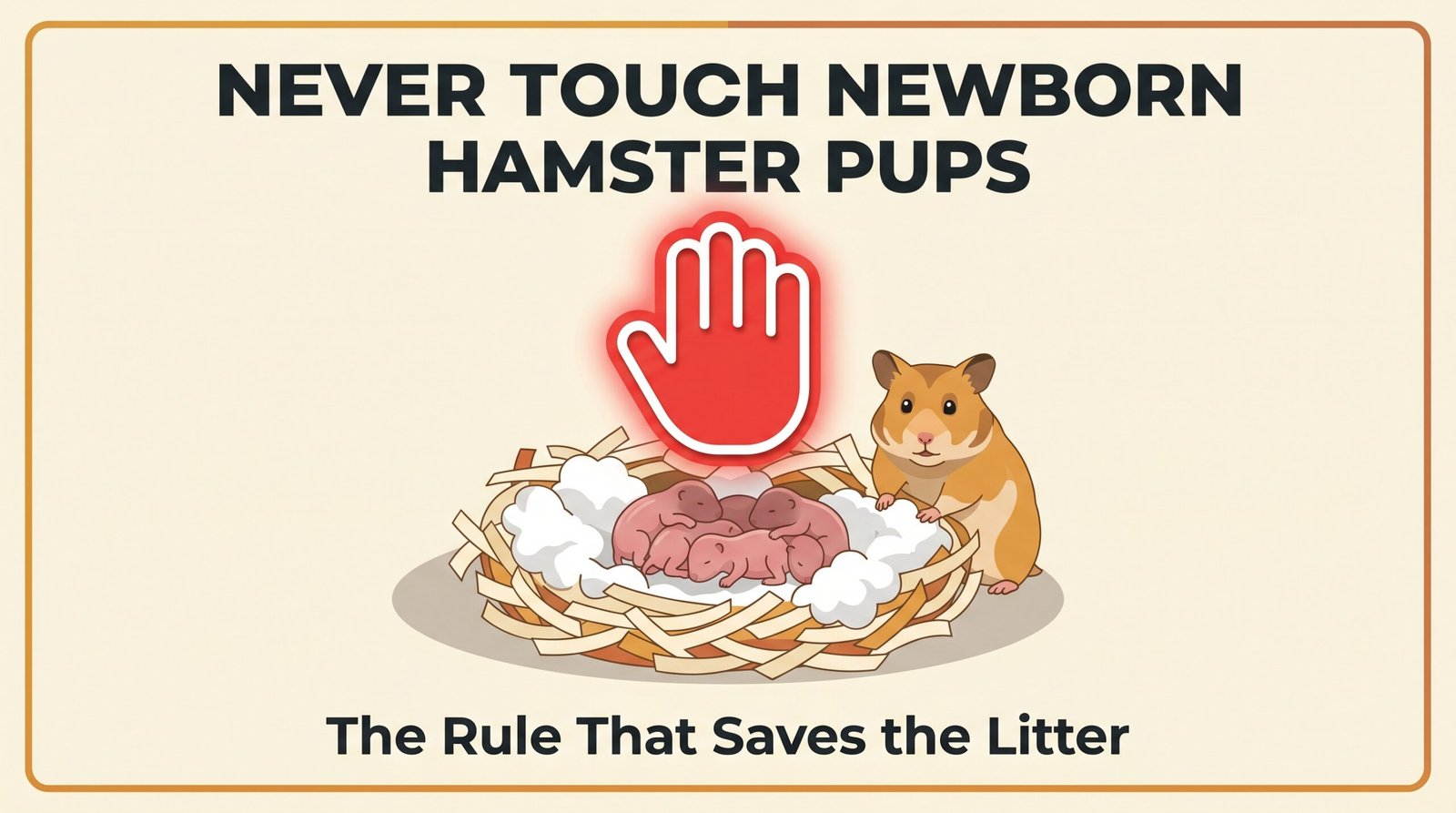
Table of Contents
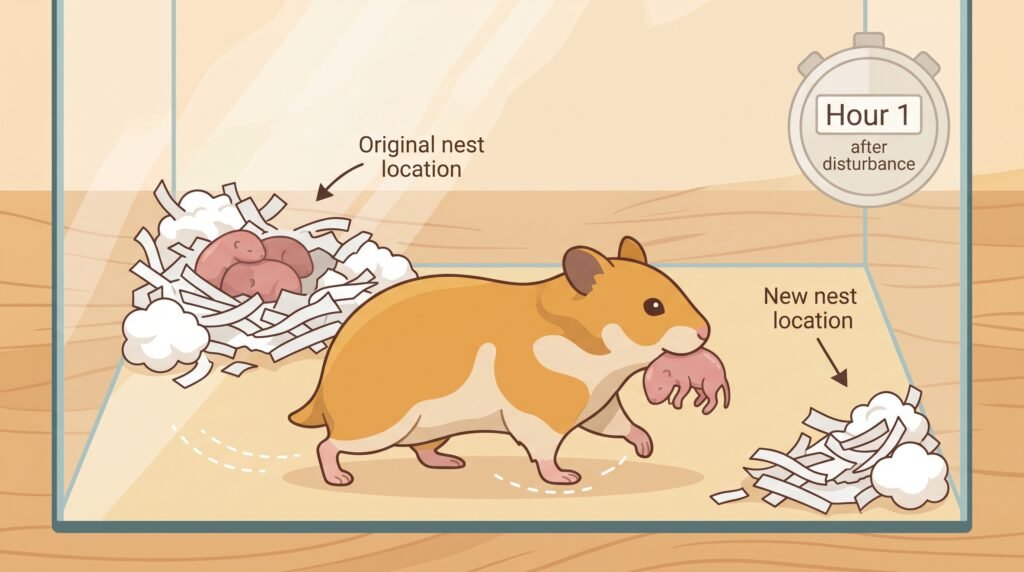
My first litter didn’t survive past day three. I had done everything by the book — clean cage, fresh bedding, extra protein for the mother — and then I reached in on day two to check on them. Just a peek. Just to count. The mother, a Syrian named Petra, had the whole nest moved within an hour. By the next morning, two of the five were gone. Not abandoned. Gone.
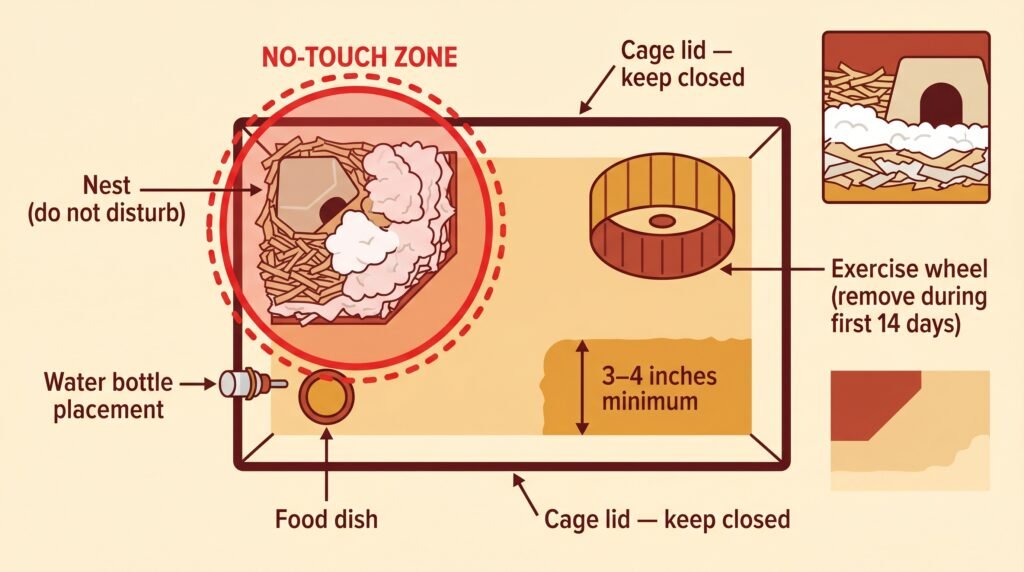
That’s how I learned what never touch newborn hamster pups actually means in practice — not as a guideline, but as a hard rule that has no exceptions for curiosity, concern, or good intentions. The instinct to look, to count, to make sure they’re breathing — it feels responsible. It isn’t.
Most people who lose early litters never find out why.
They read afterward that you shouldn’t disturb a nest and assume they did something else wrong. The cage placement, the temperature, the food. And maybe those things mattered too. But nine times out of ten, the thing that tipped the mother into rejection or worse was a human hand that entered the space before it should have.
I’ve bred Syrian and dwarf hamsters for over twelve years. I’ve made this mistake myself, watched others make it, and spent a long time figuring out why the instinct to intervene is so hard to override even when you know better.
Don’t touch. Not on day one. Not on day three. Not to check.
What Twelve Years Near a Nest Actually Teaches You
Forty-eight hours. That’s the window where almost every crisis I’ve witnessed — and caused — took place.
The first two days after birth are when a mother hamster’s stress response is sharpest and her tolerance for outside input is closest to zero. I didn’t understand that early on. I understood it the way you understand a rule before you’ve broken it: abstractly, without weight. After Petra’s litter, I understood it differently.
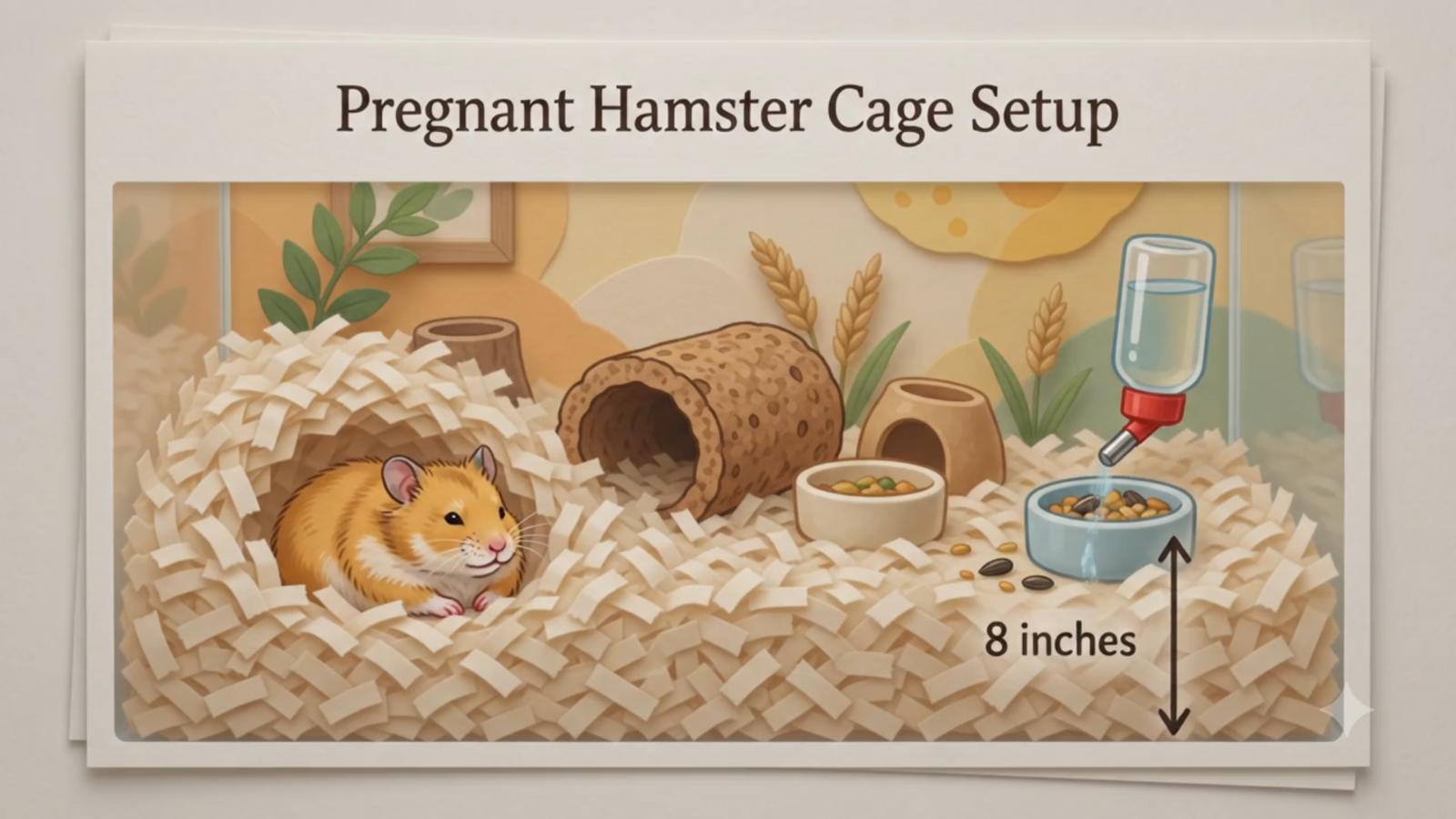
Also Read: Preparing the Cage Setup for Pregnant Hamster
She moved the nest to the far corner of the tank within an hour of my intrusion. I watched her carry each pup individually, that small pink weight in her mouth, and place it somewhere she had apparently decided was safer. One didn’t make the journey intact.
Why the Mother Hamster’s Response Is More Complex Than “She Smells You”
What’s Really Happening Inside the Nest
People hear “scent transfer” and think the explanation is simple. Touch the pup, leave your smell, mother rejects it. That’s the version that circulates online and it’s not wrong exactly — but it’s incomplete in ways that matter if you want to understand what’s actually at risk.
The olfactory bond between a mother hamster and her litter is built within hours of birth. She memorizes their individual scents during the first nursing sessions, and that internal catalog becomes the basis for every identification decision she makes over the next three weeks. When a foreign scent — yours, or another animal’s, or even the scent of a different part of the cage — overlays one of those pups, her identification system gets noise in it.
She doesn’t think “this pup smells wrong.” She experiences something closer to: the signal she expects isn’t there.
I know. This is more than most guides cover. Keep reading.
Stress Hormones and the Cascade Nobody Explains
The scent problem is real. But the bigger issue — the one that gets left out — is what physical handling does to the mother’s stress response, independent of where the pup ends up.
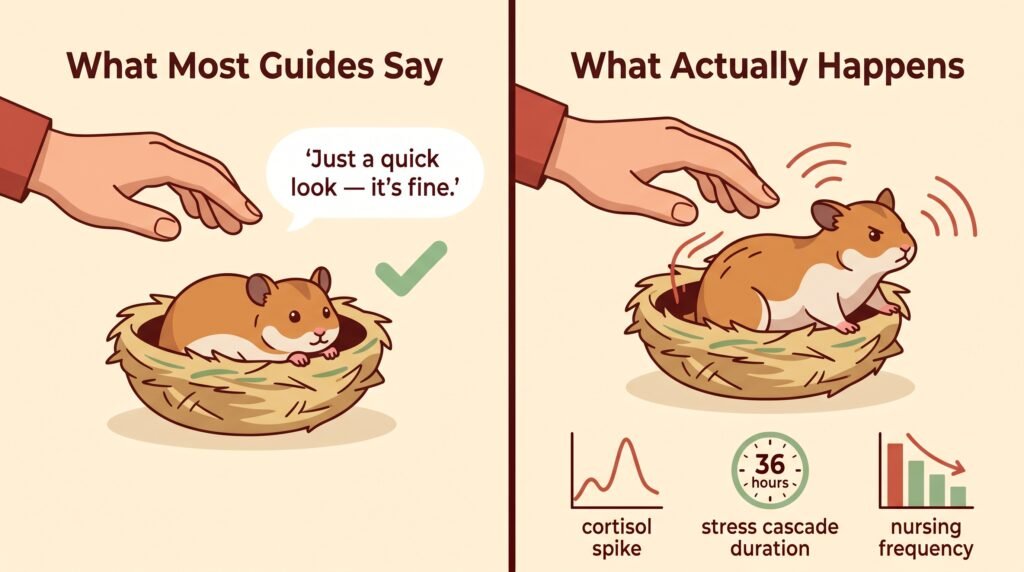
Cortisol and norepinephrine levels in a nursing hamster spike with any perceived intrusion during the first week. Not just the first day. The first week (mother hamster behavior research has documented this response in both Syrian and dwarf populations, with dwarf species showing faster recovery but higher acute peaks). When those stress hormones stay elevated, nursing frequency drops. Milk production follows.
So even if she accepts the pup back into the nest — even if the scent disruption doesn’t trigger rejection — the act of your hand entering that space may have already started a cascade that plays out over the next 36 hours.
Three things happen when a mother hamster is stressed in the first week:
- Nursing sessions get shorter, sometimes cut by half or more in the 12-hour period following a disturbance
- Pup vocalization increases — baby hamsters produce ultrasonic calls when cold or underfed, and a stressed mother may not respond to those calls at normal rates
- Nest rebuilding behavior activates, which burns energy the mother needs for milk production
That last one is the part that trips people up. She looks busy. She’s moving things, rearranging, adjusting. From outside the cage it can look like normal nesting behavior. It isn’t. It’s a stress response that costs her calories she doesn’t have to spare.
The Water Bottle Problem I Haven’t Fully Sorted
There was something I noticed in my third year of breeding — something about how water bottle placement interacted with nest disturbance recovery. I’ve seen it repeat enough times that I think it’s real. I’ll come back to it.
How Hamster Pup Development Changes the Equation
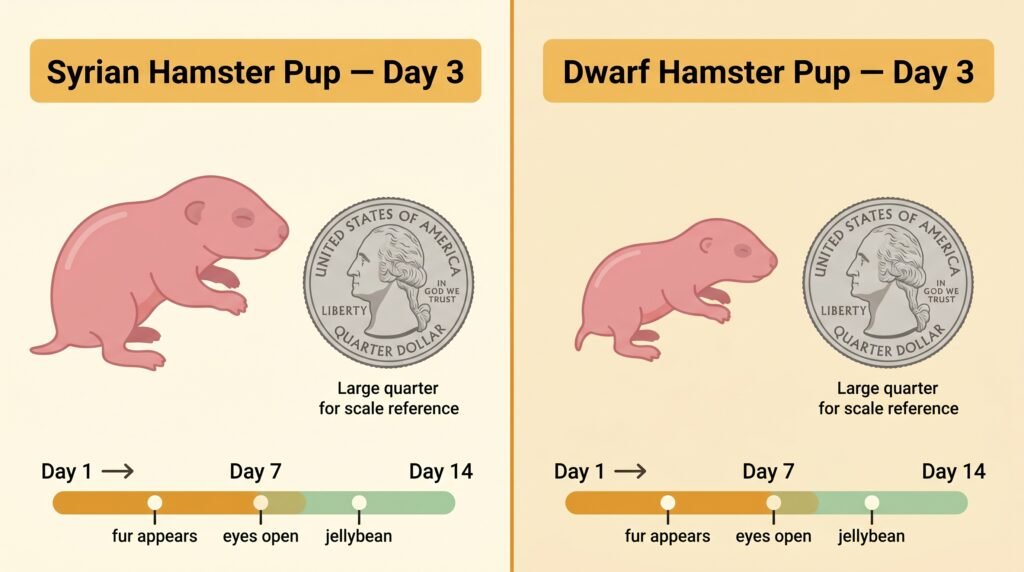
Hamster pup development doesn’t proceed the same way across breeds, and the early no-touch window isn’t identical for all of them. Syrians are generally considered to have a stricter maternal stress response in the first ten days. Roborovski hamsters — the smallest of the common dwarf breeds — show some of the most intense maternal guarding behavior I’ve encountered, though their litters are usually smaller and the individual pup survival rate seems higher when the nest is left undisturbed (a parenthetical I’ll qualify: my sample size with Robos is smaller than with Syrians, so I hold that observation loosely).
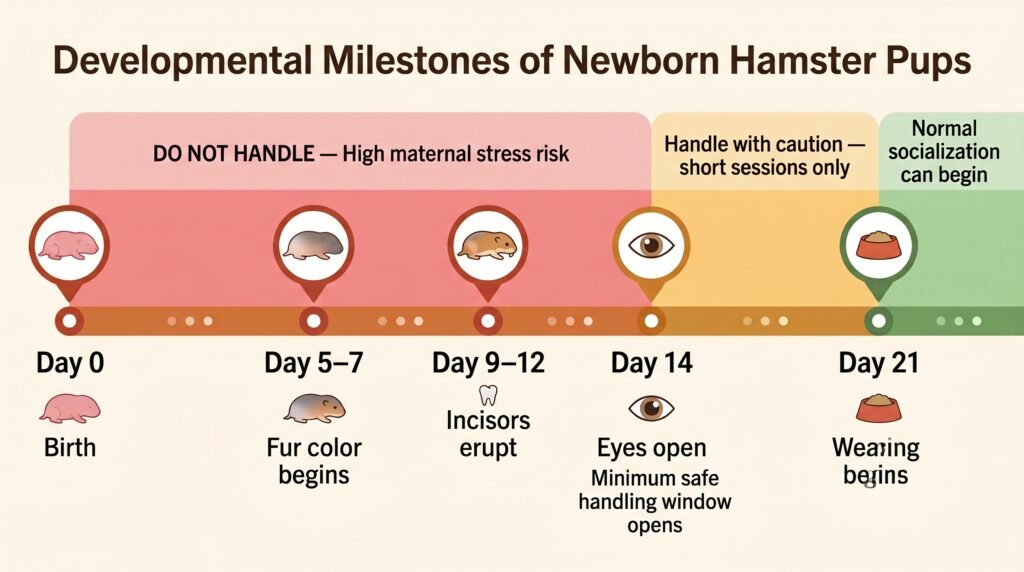
Campbell dwarf hamster pups and Russian dwarf hamster pups develop fur coverage noticeably faster than Syrians — you’ll see the color coming in around day five to seven in many Campbell litters, versus closer to day nine or ten in Syrians. That faster development doesn’t mean the mother is less stressed by intrusion, though. The developmental timeline and the maternal stress response are separate variables.
The Biology Behind Why You Must Never Touch Newborn Hamster Pups
What Research Says About Hamster Maternal Rejection
Seventy-two hours. That’s roughly the window during which olfactory imprinting between a mother hamster and her litter is most active and most vulnerable to disruption.
Studies of Mesocricetus auratus — the Syrian hamster — have documented that maternal rejection following human handling of pups occurs at meaningfully higher rates when the handling happens in the first three days versus days five through ten.[^3] The difference isn’t small. In one set of observations, pup mortality rates in handled-early groups ran nearly double those in control groups where nests were left completely undisturbed.
Short.
That’s how fast her decision can happen.
The mechanism involves both the main olfactory system and the vomeronasal organ (VNO), which processes pheromone-level chemical signals below the threshold of what we’d normally call “smell.” Human skin leaves compounds on newborn hamster pups that are detectable through the VNO even when you’ve washed your hands — which is one reason the “wash your hands first” advice circulating online is not as protective as people assume.
Why “Just Checking” Is Never Just Checking
Hamster cannibalization risk — and I know that word stops people — is real in stressed mothers, and it’s consistently underdiscussed in basic care guides. Cannibalism in rodent litters isn’t random. It follows a predictable pattern tied to maternal stress, perceived threat, and resource scarcity. A mother under severe stress may cull a litter she cannot, in whatever her nervous system calculates, adequately support.
Stop. Read that again.
She isn’t malfunctioning. She’s making a decision — one shaped entirely by conditions in her environment. One of those conditions is whether a human hand has entered her space.
Newborn rodent care frameworks used by wildlife rehabilitators and exotic animal vets consistently include a “minimal interference” protocol during the first week for exactly this reason (the language varies — some call it “hands-off,” some call it “observational only” — but the instruction is the same). What they don’t always explain is why. The why is this: the mother’s threat assessment runs constantly, and every intrusion resets her stress baseline upward.
Stop Believing the “Quick Check Is Fine” Advice About Newborn Hamsters
The Specific Claim That Gets Repeated Without Evidence
Most care guides say a quick visual check in the first 48 hours is acceptable. Dr. Muhammad Shahzad has been questioning that for nine years.
The problem: “visual check” doesn’t stay visual. Not for most owners. You look, you see a pup that’s separated from the nest, and your instinct says do something. The guide that told you a quick look was fine didn’t prepare you for that moment. And so you reach in. And now you’ve done the thing the guide was supposed to prevent.
The framing is the failure. Again, every single time, the advice presents looking and touching as two separate decisions when they’re almost always one continuous behavior. You don’t open the cage to check and then close it. You open the cage to check, and if anything looks wrong — or even ambiguous — you intervene. That’s human. It’s also how litters get lost.
What Guides Get Wrong About Hamster Maternal Instincts
| Advice Type | What It Claims | What's Missing | Risk Level | Recommended |
|---|---|---|---|---|
| "Quick visual checks are fine" | Visual inspection doesn't disturb the mother | Doesn't account for cage-opening stress response | High | Not recommended |
| "Handle after 7 days" | One week is the safe window | Varies by species; dwarf breeds may need 14 days | Moderate | (varies) |
| "Use a spoon to move pups" | Avoids human scent | Spoons still carry environmental odors; movement still stresses mother | Moderate | — |
| "Wash hands before touching" | Reduces scent transfer | VNO-detectable compounds persist after handwashing | High | Not recommended |
| "Leave completely undisturbed for 14 days" | Minimizes all interference | May not address temperature monitoring in cold environments | Low | Yes, with caveats |
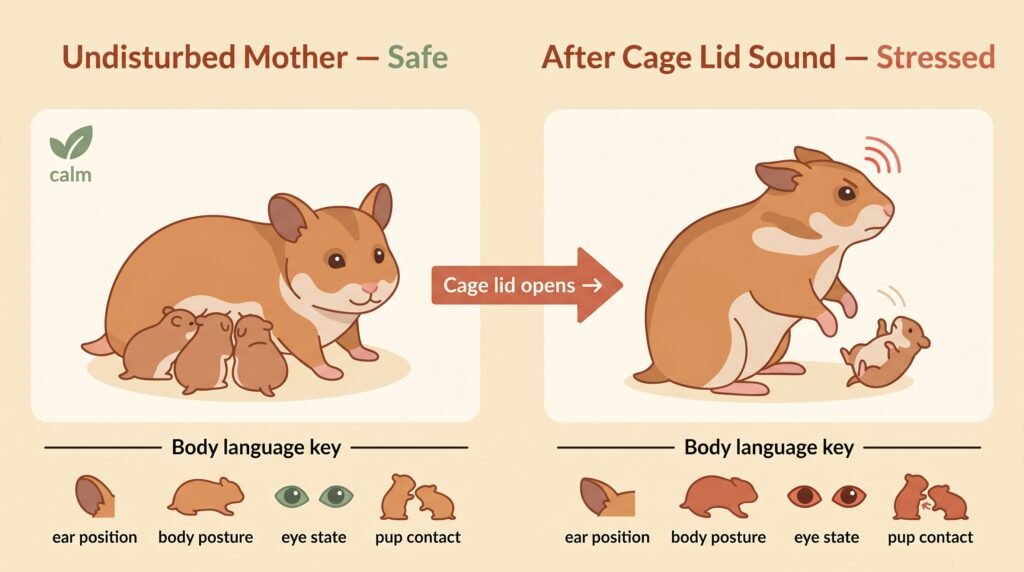
What the table can’t capture: the look on a mother hamster’s face when she hears the cage lid. Twelve years in, I still notice it. Her ears flatten slightly. There’s a pause before she goes back to nursing. That pause is the stress response. It’s not visible in any chart.
The framing that still drives me to some frustration — the “bonding with pups early helps socialization” argument that somehow still circulates — is the one that does the most damage. Bonding. With three-day-old hamsters. Hamster pup survival in the first two weeks has nothing to do with early human contact and everything to do with whether the mother is allowed to do her job without interruption.
Somehow, every single time, this advice finds its way into beginner forums without the context that makes it dangerous.
What the Expert Community Says and One Thing They Keep Getting Wrong
The Fourteen-Day Standard and Why It’s the Floor, Not the Ceiling
Fourteen days. That’s the minimum no-touch window recommended by most exotic animal veterinarians and small mammal breeders with serious track records.
The American Association of Exotic Pet Practitioners includes guidelines for hamster litter management that emphasize non-interference through at minimum day ten, with day fourteen as the preferred benchmark for first handling. The Merck Veterinary Manual’s small mammal section notes that maternal stress-induced litter abandonment is among the leading causes of early litter mortality in captive hamsters — ranking above temperature and nutrition as a risk factor in the post-birth period.
I lost a litter to that. Five pups, healthy birth, good maternal weight, everything set up correctly — and a single unnecessary intrusion on day four led to what I can only describe as a cascade I couldn’t stop.
The expert community is right about the fourteen-day window. Where I think they’re slightly off is in treating it as a universal number rather than a floor that varies by breed, by individual mother temperament, and — this is the part I’m still not fully certain about — by litter size. Larger litters may increase maternal stress independently of human contact, and in those cases the no-touch window may need to extend beyond fourteen days.
The water bottle placement issue I mentioned earlier connects to this, actually. Not to the fourteen-day rule directly, but to how mothers in larger litters manage hydration and stress in that third week. I haven’t reached a clean conclusion yet.
A stressed mother hamster produces less milk. You can hear it — not literally, but indirectly — in the ultrasonic pup calls that increase when pups are cold or underfed. Most owners can’t hear those calls without equipment. What they can observe is pups that look smaller than expected, or less round, or clustered far into the nest. Those are the signals that the hamster litter isn’t getting what it needs.
Hamster Species and the No-Touch Window: Not One Rule for All
Comparing Breed Differences in Maternal Sensitivity
Fourteen days isn’t the same fourteen days across every species.
| Species | Recommended No-Touch Window | Maternal Stress Sensitivity | Litter Size (avg) | Cannibalism Risk | Notes |
|---|---|---|---|---|---|
| Syrian Hamster | 14 days minimum | High | 6–12 pups | Moderate-High | Most commonly kept; well-documented |
| Campbell Dwarf | 14–16 days | High | 4–6 pups | Moderate | (check with vet) |
| Russian Dwarf (Winter White) | 14–16 days | Moderate-High | 4–6 pups | Moderate | Less studied than Syrian |
| Roborovski Hamster | 16–21 days | Very High | 3–5 pups | — | Smallest breed; longest recommended window |
| Chinese Hamster | 14 days | Moderate | 4–5 pups | Low | Less common; some individual variation |
The sentence the table can’t write: I’ve had individual Syrian mothers who were comfortable at twelve days and individual Campbells who were still clearly stressed at eighteen. Breed averages are starting points, not guarantees.
That interaction between individual temperament and litter size is the thread I keep coming back to and haven’t fully resolved — there’s something there about how the mother’s prior breeding history affects her baseline stress response, but my observations aren’t systematic enough to say anything definitive.
One detail that took me a long time to notice: the smell of the nest on day sixteen is distinct from the smell on day five. Warmer. Muskier. A specific kind of animal-dense smell that means things are working. When that smell isn’t developing the way it should, something is usually off.
Dwarf hamster pups — particularly Campbells and Winter Whites — are sometimes described as less fragile in the early post-birth period, and there’s some truth to that relative to Robos. But “less fragile” doesn’t mean “fine to handle earlier.” The maternal stress response is what drives the no-touch rule, not pup fragility alone.
What I Still Don’t Know — and Why That Matters
Honest Uncertainty About Orphaned Hamster Pups
Seven days. That’s when most interventions I’ve seen for orphaned hamster pups actually have a reasonable survival chance without the mother — and even then, “reasonable” is doing a lot of work in that sentence.
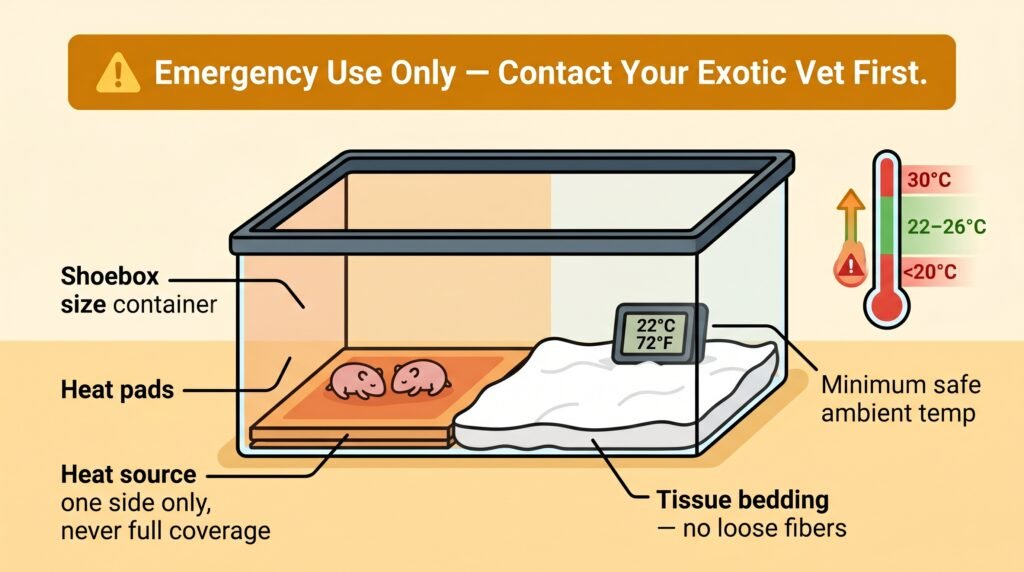
If the mother dies before day seven, survival without specialized intervention is very low. Hamster pups are altricial — born in an undeveloped state that requires continuous warmth and nursing at a frequency that’s difficult to replicate. Commercial milk replacers designed for small rodents exist, but in most cases the outcomes I’ve witnessed or read about have been mixed at best.
Don’t attempt tube feeding without veterinary guidance.
That’s not a hedge. That’s a hard limit. Hamster pups are small enough that improper tube placement — even in experienced hands — causes aspiration. Usually, in most cases, the correct response to a litter without a mother in the first week is to contact an exotic animal veterinarian immediately rather than attempting home intervention.
What I genuinely don’t know: whether there’s a reliable window during which partial foster care — placing orphaned pups with another nursing mother — has meaningful success rates in hamsters. The data I’ve seen is inconsistent. Some breeders report it working. My own attempts have been unsuccessful. I’m not sure whether that’s technique, timing, or individual variation.
Twenty-two degrees Celsius. That’s roughly the minimum ambient temperature where pup hypothermia risk starts to decrease when the mother is not present — but that’s an approximation, not a prescription, and it doesn’t account for drafts, humidity, or individual pup health.
Hamster pup death causes in the first week are usually one of three things: maternal rejection triggered by stress, inadequate nursing due to maternal stress or health problems, and congenital issues that were present at birth. Human handling is the only one of those three that’s entirely preventable.
When You Can Handle Pups — and Exactly How to Do It Right
The Actual First-Touch Protocol for Baby Hamster Care
Fourteen days minimum. Not thirteen. Fourteen.
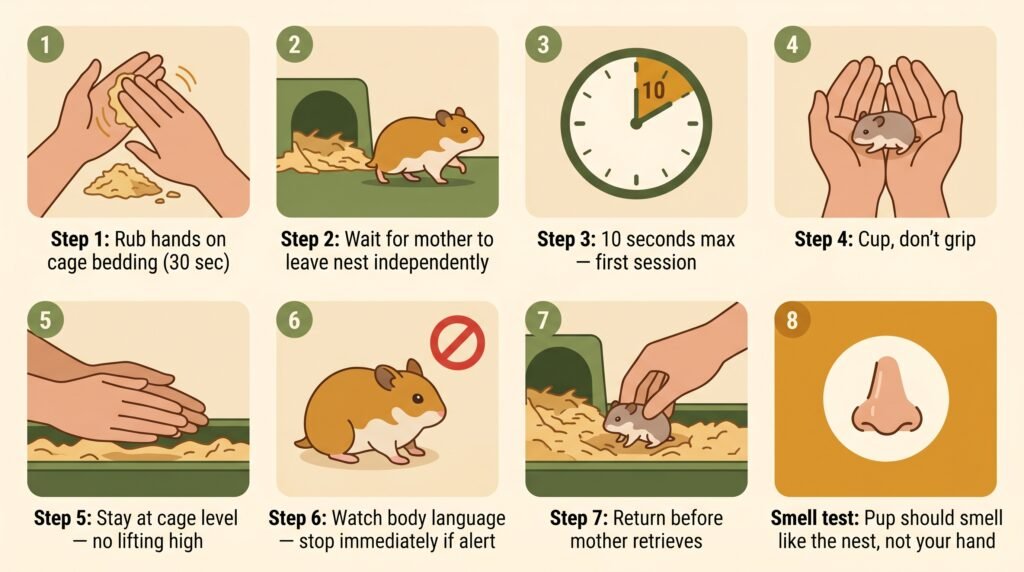
Here’s what that protocol looks like in practice, once you’ve passed the window:
- Rub your hands on the cage bedding first — not wash them, rub them on used bedding from the hamster’s own habitat for thirty seconds before any contact
- Let the mother leave the nest on her own before attempting to look at or touch pups — never move her manually
- Ten seconds maximum for the first handling session; extend slowly over subsequent days
- Cup, don’t grip — pups this age can be injured by even gentle squeezing; support the whole body with a cupped palm
- Keep at cage level — drops from even low heights are dangerous; baby hamster care at this stage means never holding pups more than a few inches above a soft surface
- Watch the mother’s body language throughout — ears back, freeze posture, or movement toward you means stop immediately
- Return pups to the nest before the mother shows interest in retrieving them — anticipate, don’t react
The smell test. This is the one thing I wish someone had told me in my first year: the pup should smell like the nest when you put it back. If it smells like your hand, you held it too long.
When to handle baby hamsters is the question most new owners ask too early and too optimistically. The honest answer is: later than you want, shorter than you planned, and always with one eye on the mother.
Fifteen days. That’s the minimum I’d recommend for first-touch with any dwarf breed, and twenty-one for Roborovskis specifically.
Most people who get this right don’t talk about it much. There’s no story in the litter that survived because you left it alone. The story is always the one that didn’t, and usually by the time someone tells it, they’ve already figured out what they did wrong.
My worst loss was a litter of eight. Syrian. The mother was a first-time breeder named Saffron, calm and well-socialized, and I’d convinced myself that meant she’d be more tolerant. She wasn’t. Day three, I reached in to remove a piece of bedding I thought looked wrong. She had the nest relocated within two hours. By morning, six of the eight were gone. I didn’t understand what I was seeing until I reviewed everything I’d read and accepted that I’d been the variable.
Never touch newborn hamster pups means never. It means not this time, not just for a second, not because you’re worried about that one that’s separated from the group. Leave them. Leave her. The intervention that feels like care is usually the one that does the damage.
Six pups lost in a single night.
FAQs
Can I touch newborn hamster pups if I wear gloves?
Gloves reduce but don’t eliminate scent transfer, and they don’t address the maternal stress response triggered by cage intrusion — the problem isn’t just scent.
How many pups can a hamster have, and does litter size affect the no-touch rule?
Syrian hamsters typically deliver between six and twelve pups per litter, with some litters reaching fourteen or more. Dwarf breeds like Campbells average four to six. Larger litters appear — in my observations, though not yet confirmed by controlled research — to correlate with higher baseline maternal stress, which may argue for extending the no-touch window rather than shortening it. One caveat: unusually small litters may also produce atypical maternal behavior, so litter size alone isn’t a reliable predictor of how any individual mother will respond.
What happens if a hamster pup is squealing and separated from the nest?
A separated pup producing ultrasonic distress calls is in genuine trouble — the mother should retrieve it on her own if she’s functioning normally, and that retrieval behavior usually happens within minutes.
What should I do if hamster pups are running out of the nest before their eyes are open?
Pups that leave the nest before day fourteen are usually doing so because they’re cold or underfed — the nest may not be warm enough, or nursing frequency has dropped; check ambient temperature before assuming anything about the mother.
Is it true hamster pups are born with teeth?
They’re not — incisors erupt around day nine to twelve depending on the breed, well after birth.