The Complete Hamster Nutrition Pyramid: What They Actually Need
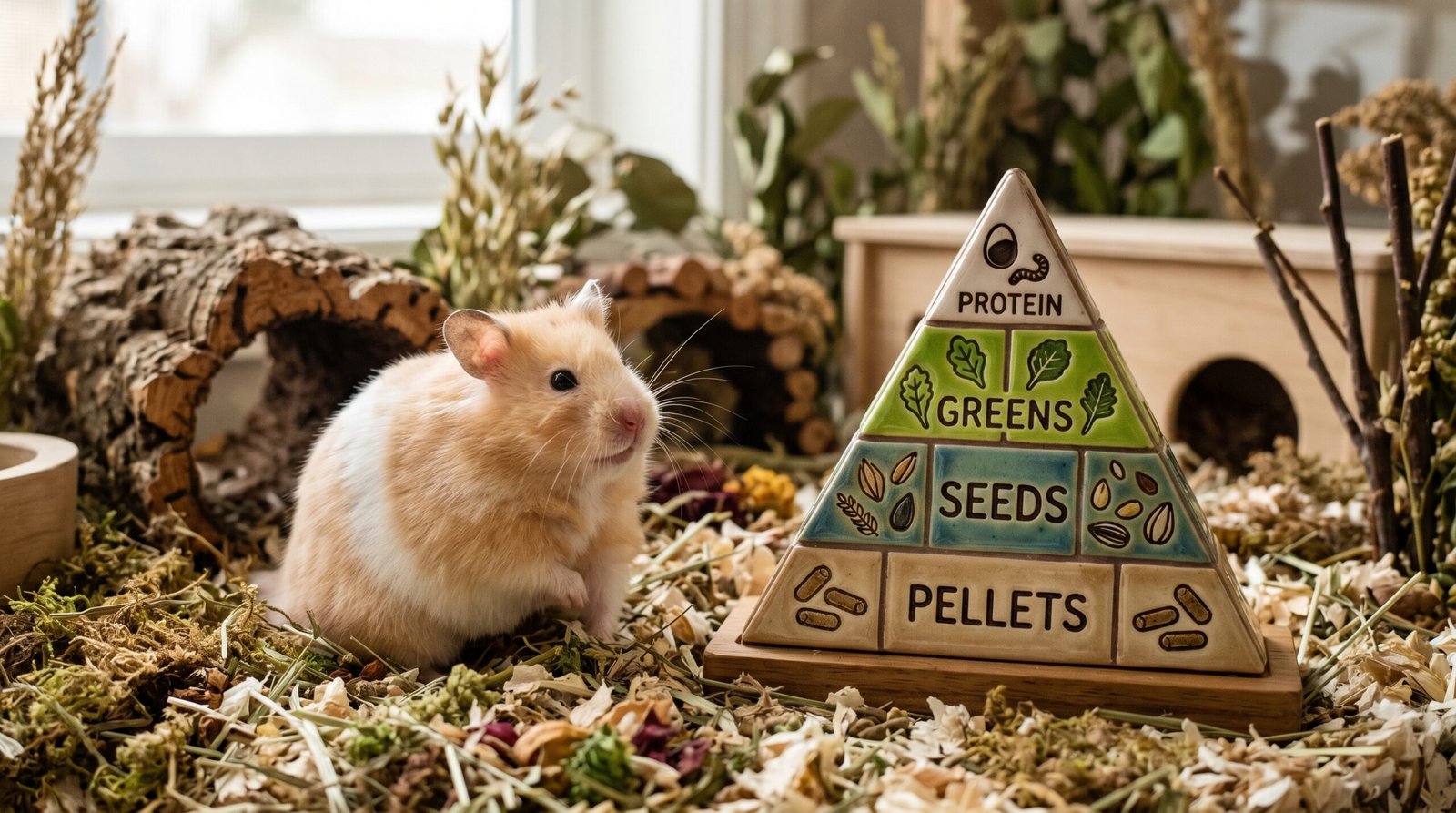
Table of Contents
To understand the complete hamster nutrition pyramid, Just imagine it’s 2 AM. You’re lying in bed, and instead of the peaceful silence of the night, you hear the rhythmic scritch-scratch of a tiny creature rearranging their life story in a pile of aspen shavings. We’ve all been there—the “hamster parent” life is a unique blend of sleep deprivation and absolute adoration for a ball of fluff that weighs less than a smartphone. But as you watch them stuff an entire broccoli floret into their cheek pouch like they’re preparing for a tiny apocalypse, have you ever stopped to wonder if they are actually getting the fuel they need?
Real talk: most of what we’ve been told about hamster nutrition is dangerously outdated. For decades, the industry standard was a dusty bag of “seed mix” from the local big-box store, filled with colorful dyed bits that look more like cereal than actual food. If you’ve ever felt that twinge of guilt wondering if those sunflower seeds are the hamster equivalent of a double cheeseburger, you aren’t alone. I’ve spent two decades dissecting lab reports, consulting with exotic vets, and—most importantly—watching my own rescues thrive or struggle based on their bowls.
The truth is, hamsters aren’t just “little mice.” From the sturdy Syrian to the tiny, high-metabolic Roborovski, their nutritional requirements are as complex as any dog or cat. To get them to that elusive three-year mark (and beyond), we have to stop feeding them like toys and start feeding them like the desert-dwelling omnivores they are. This guide is the result of years of trial, error, and breakthrough science. We are going to build a nutrition pyramid that ensures your pet isn’t just surviving, but truly vibrating with health. Let’s dive into the ultimate breakdown of what actually belongs in that ceramic bowl.
Why High-Protein Pellets Are Your Base Layer
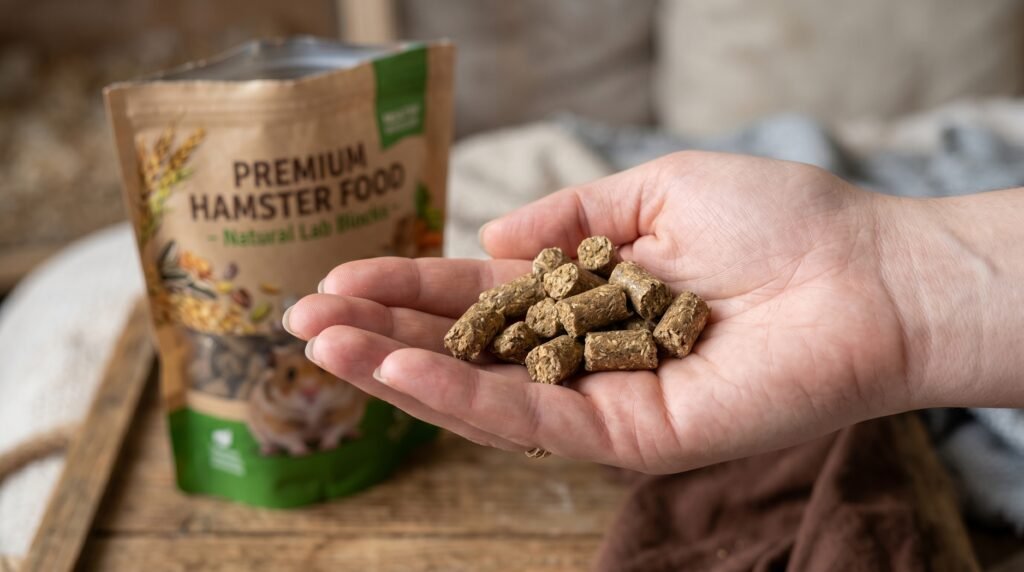
When we talk about a nutrition pyramid, the widest part—the foundation—must be consistency. In the world of hamsters, this means a high-quality, lab-blocked pellet. I know, I know. Pellets look boring. They don’t have the visual “pizzazz” of a gourmet seed mix. But here is the twist: hamsters are notorious selective eaters. If you give them a mix first, they will pick out the fatty sunflower seeds and leave the protein-rich lentils behind. It’s like giving a child a plate of broccoli and brownies; we know which one disappears first.
Also Read: 20 Toxic Foods Never Feed Hamster
How to Identify a “Gold Standard” Pellet
A quality foundation should make up about 50-60% of their daily intake. You’re looking for a block that isn’t held together by molasses or corn syrup. Look for a crude protein content of at least 17% to 19%. As hamsters age, their kidneys can become taxed, so we might scale back to 15% for seniors, but for a growing or active adult, protein is king.
The Problem with “Muesli” Style Diets
Research from the University of Veterinary Medicine in Vienna has shown that selective feeding in hamsters leads to massive calcium-phosphorus imbalances. This can result in metabolic bone disease—yes, even in tiny rodents. By using a pellet as the base, you ensure that every single bite contains the exact ratio of vitamins A, D3, and E they need.
3 Steps to Transition a Picky Eater
- The 75/25 Rule: Mix 75% old food with 25% new pellets for three days.
- The Scent Trick: Rub a piece of cucumber on the pellet to make it more enticing.
- The “Tough Love” Window: Only refill the bowl once the pellets are gone (within reason—don’t let them starve!).
Choosing the Right Seed Mix
While pellets provide the science, seed mixes provide the “soul.” In the wild, a Syrian hamster might forage for miles, gathering dozens of different types of seeds, grains, and grasses. Foraging is a vital psychological need. If they don’t have things to crack, peel, and pouch, they get bored. And a bored hamster is a hamster that starts chewing on their cage bars at 3 AM.
7 Proven Ingredients for a Healthy Seed Mix
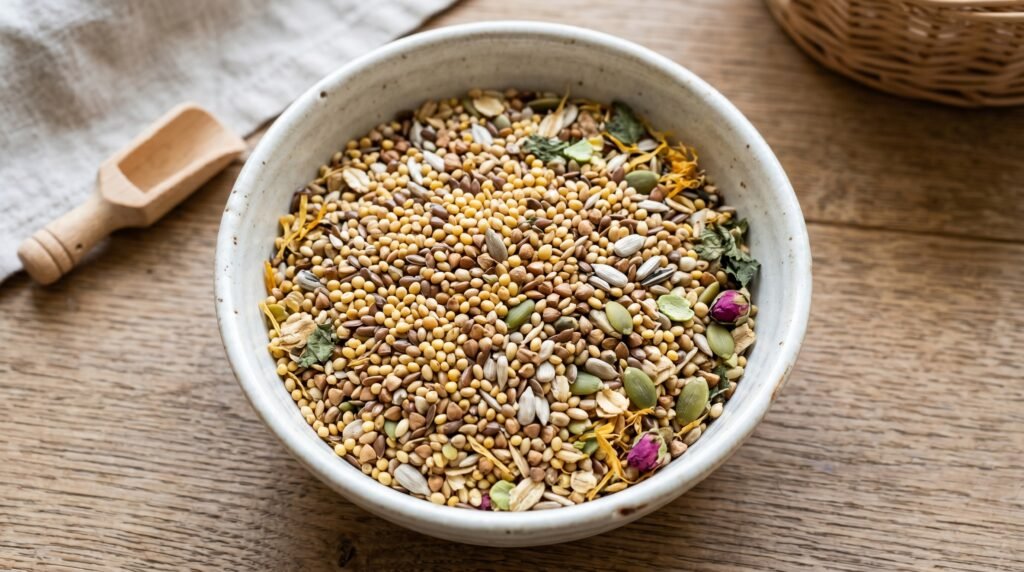
- Canary Seed & Millets: High in fiber and low in fat.
- Buckwheat: A fantastic “pseudo-grain” that provides complex carbs.
- Flaxseeds: Excellent for coat shine and Omega-3 fatty acids.
- Hemp Seeds: A complete protein source.
- Milo (Sorghum): Provides a satisfying “crunch” for dental wear.
- Oat Groats: Great for slow-release energy.
- Pumpkin Seeds: Use these sparingly as “high-value” finders.
Understanding the Macro Breakdown
A perfect mix should maintain a balance of 17% Protein, 4-6% Fat, and 8-10% Fiber. If you look at the back of your bag and see “Crude Fat: 12%,” put it back. That’s a recipe for obesity and hepatic lipidosis (fatty liver disease).
Case Study: The “Sunnie” Syndrome
I once consulted for a rescue where a dwarf hamster named “Nugget” was losing hair and lethargic. The owner was feeding a “premium” mix, but Nugget was only eating the sunflower seeds. By switching to a restricted-seed foraging method, Nugget regrew his coat in six weeks. Variety only works if they eat the whole variety.
Fresh Produce: The 15% “Vitamin Boost” Layer
Fresh vegetables are the “wet” component of the pyramid. Because hamsters evolved in arid climates, they are experts at extracting hydration from their food. However, there is a fine line between “hydrated” and “diarrhea,” and in a creature as small as a hamster, the latter can be fatal within 24 hours (a condition often confused with Wet Tail).
Safe Veggies vs. The “No-Go” Zone
You should aim for a “thimble-sized” portion of fresh greens every other day.
| Category | Best Options | Why? |
| Leafy Greens | Kale, Romaine, Dandelion Greens | High in Vitamin K and Calcium. |
| Crunchy Veg | Broccoli, Cauliflower, Carrots | Great for dental health and Beta-carotene. |
| Avoid Entirely | Onions, Garlic, Raw Beans | Contains compounds toxic to rodent blood cells. |
| Limit Strictly | Fruit (Apples, Berries) | High sugar content can trigger Type 2 Diabetes (especially in Dwarfs). |
The “Dwarf Hamster” Sugar Warning
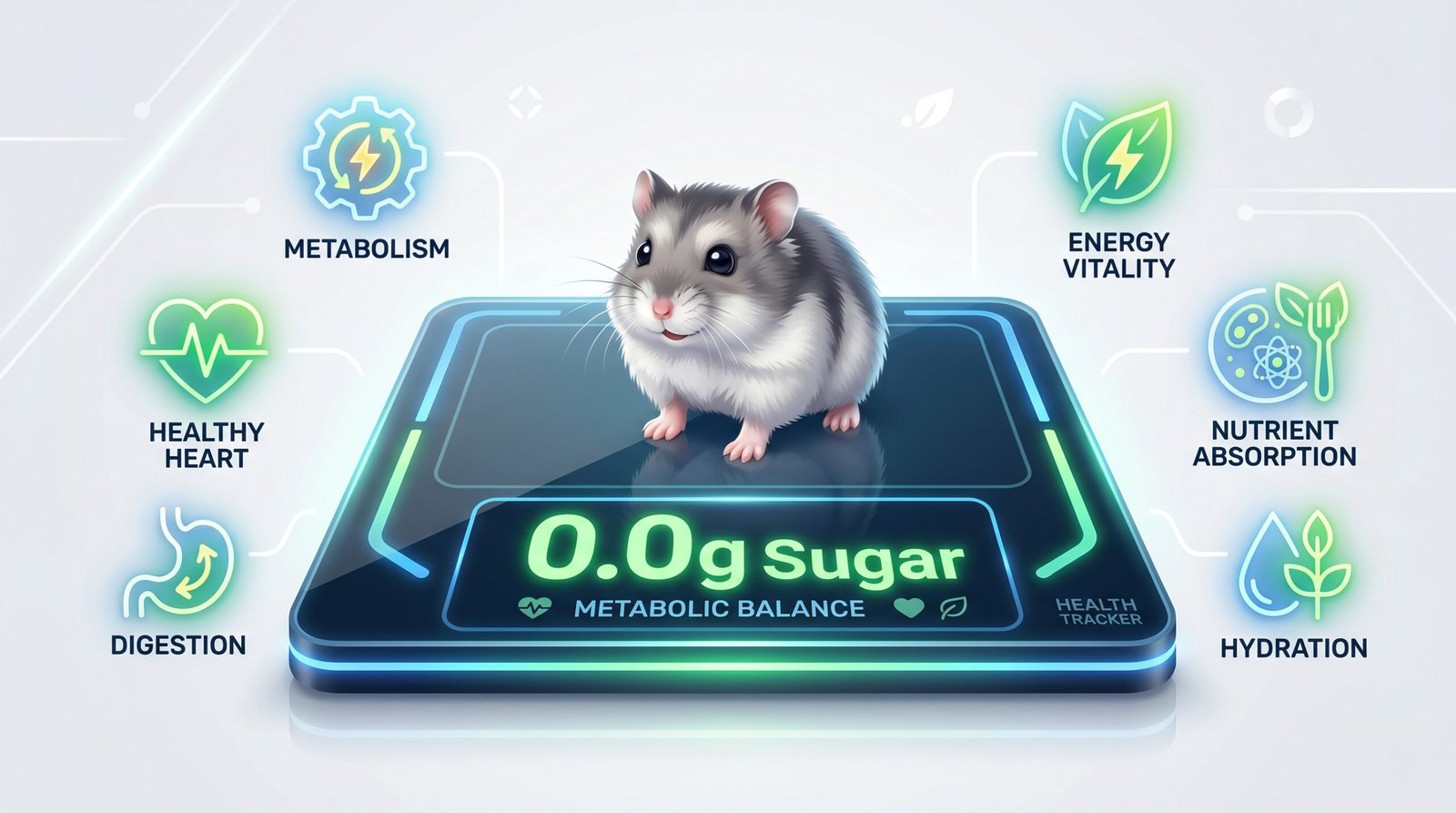
Real talk: if you own a Campbell’s, Winter White, or Chinese hamster, you need to treat sugar like poison. These species are genetically predisposed to diabetes. A single grape is like a human eating five chocolate cakes. Stick to fibrous greens like bell peppers (minus the seeds) and zucchini.
The “Wild Factor” often Forgotten
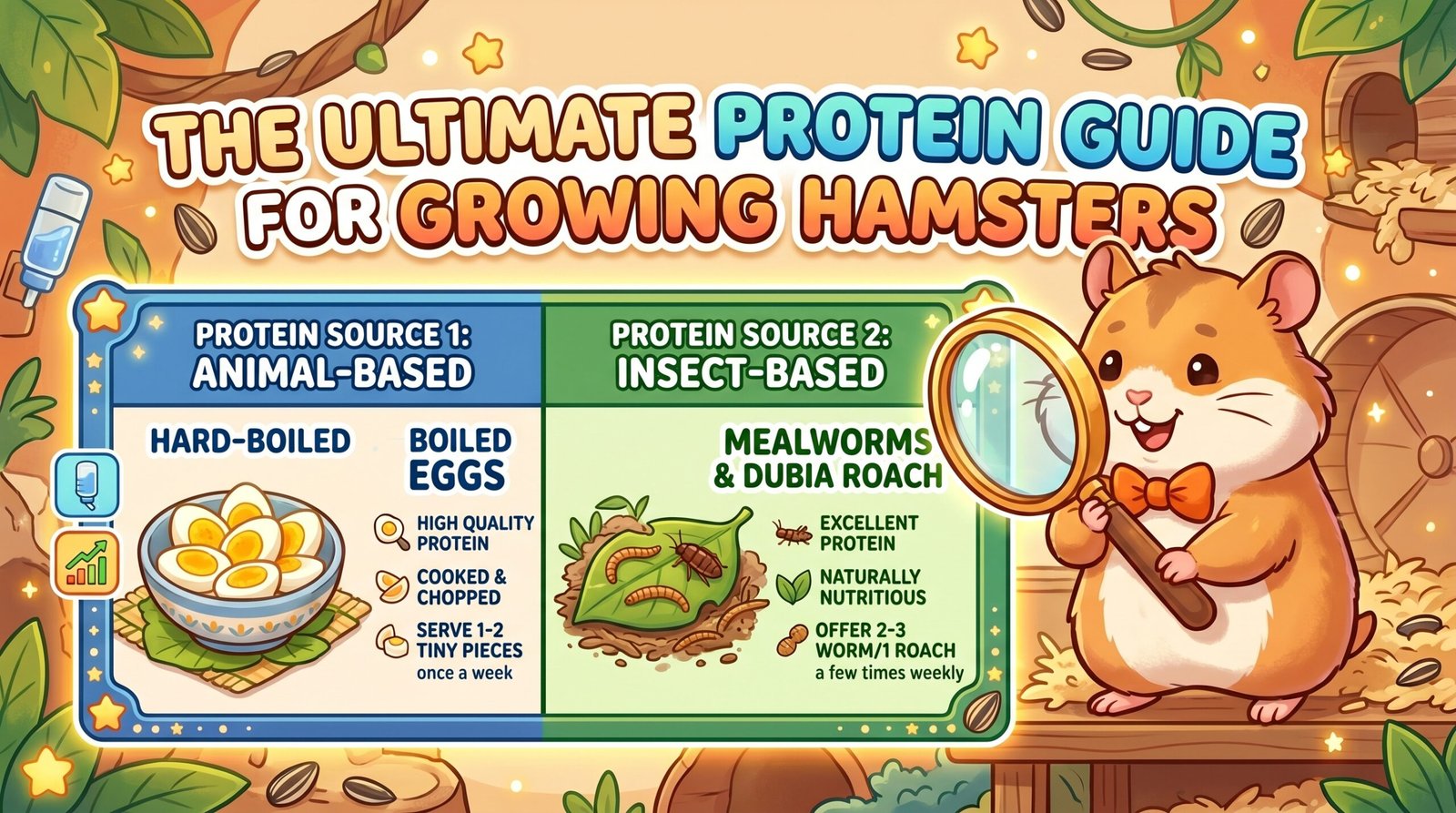
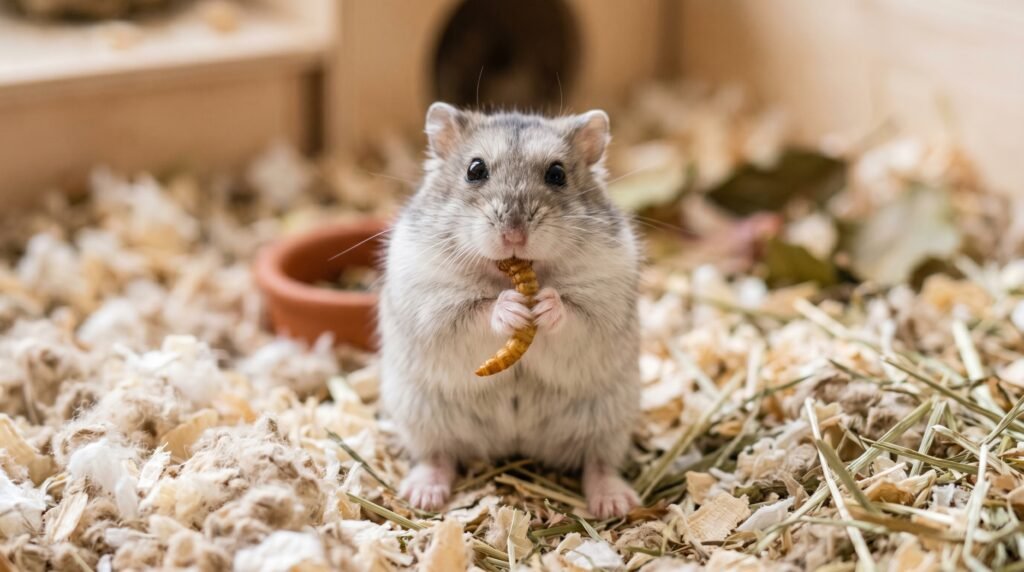
One of the biggest myths in pet care is that hamsters are vegetarians. They are absolutely not. In the wild, they are opportunistic hunters. If a beetle, a mealworm, or even a small lizard crosses their path, it’s dinner. To truly mimic a natural diet, you must include animal protein.
Why Insects Matter
Insects provide chitin, which is essential for digestive health, and specific amino acids like taurine.
- Dried Mealworms: The gold standard. Most hamsters go crazy for them.
- Crickets: Great for protein, though some hamsters find the legs a bit “pokey.”
- Silkworm Cocoons: A high-calcium treat for pregnant or nursing mothers.
Alternative Protein Sources
If the idea of touching dried bugs makes you squeamish, you can use:
- Plain Cooked Chicken: No oil, no salt, no seasoning. Just boiled.
- Hard-Boiled Egg: A tiny piece of the white and yolk once a week.
- Plain Tofu: A great option for senior hamsters who have trouble chewing.
Hydration Science: Beyond the Drippy Bottle
We’ve all dealt with the “leaky bottle” syndrome—the puddle on the floor that ruins the bedding and makes the cage smell like a swamp. But hydration is a critical part of the nutrition pyramid. Without enough water, a hamster cannot process the minerals in their pellets, leading to bladder stones.
Bowl vs. Bottle: The Great Debate
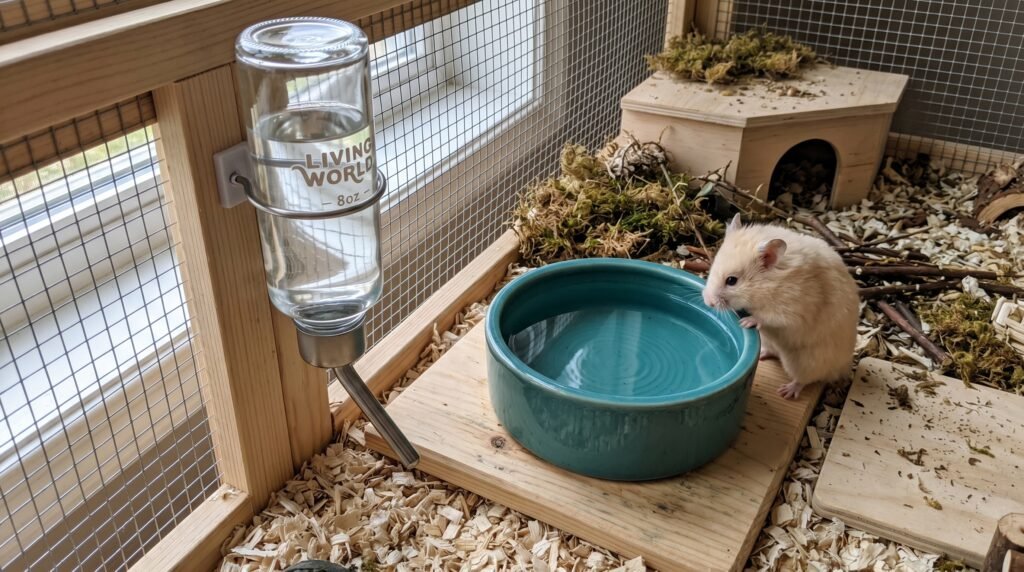
Recent studies in Applied Animal Behaviour Science suggest that hamsters prefer drinking from a shallow bowl over a vacuum-valve bottle. It allows them to lap water in a natural neck position.
- The Pro-Bowl Argument: Easier to clean, more natural, no mechanical failure.
- The Pro-Bottle Argument: Keeps water clean from bedding and debris.
- The Expert Solution: Provide both. Let your hamster choose. If you use a bowl, place it on a flat wooden platform so it doesn’t get buried.
Water Quality Matters
If you wouldn’t drink your tap water, don’t give it to your hamster. Chlorine and heavy metals can impact their sensitive gut flora. Filtered water is always the best bet for longevity.
Healthy Fats and Treats: The Tip of the Pyramid
At the very top of our pyramid—the smallest section—are fats and treats. These should make up no more than 5% of the diet. This is where most owners go wrong. We show love through food, and when those beady eyes look at us, it’s hard not to hand over a yogurt drop.
The “Yogurt Drop” Scam
Most commercial “hamster treats” found in aisles are essentially colored sugar and palm oil. They lead to obesity, tooth decay, and impacted cheek pouches (where the sticky sugar causes food to rot inside the pouch).
Better Alternatives
- Walnuts or Pecans: Give them a tiny piece (the size of a pea) once a week. The healthy fats support brain function.
- Millet Sprays: Usually sold for birds, these are great “working treats” that require the hamster to harvest the seeds themselves.
- Whimzees: Small dog chews (the toothbrush-shaped ones) are safe, vegetable-based, and fantastic for wearing down ever-growing teeth.
5 Steps to Prevent “Pouch Rot”
- Avoid sticky foods (honey-coated sticks).
- Never give soft bread or crackers that can turn into “glue” when wet.
- Check their hoard weekly. If you find “slimy” veggies, toss them.
- Provide plenty of dry forage to “scrub” the inside of the pouches.
- Watch for facial swelling—a sign of a stuck treat.
How You Feed is as Important as What You Feed
In the wild, no one puts a ceramic bowl in front of a hamster. They spend 70% of their waking hours searching for food. If you provide all their nutrition in one spot, you are stripping them of their primary job. This leads to lethargy and “cage craze.”
The “Scatter Feeding” Method
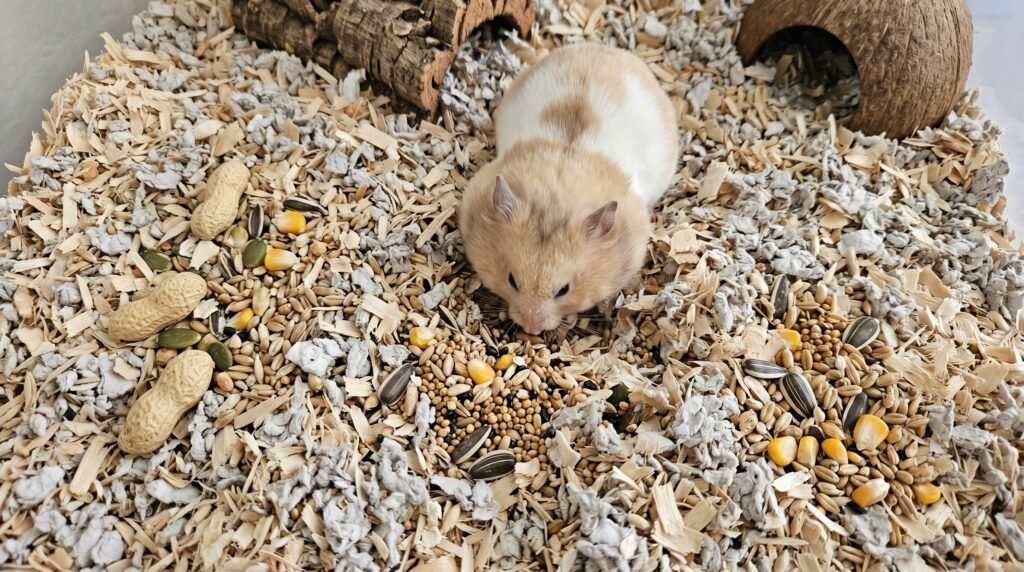
Instead of using a bowl, take their seed mix and literally throw it across the bedding. Hide some under handfuls of hay or inside cardboard tubes.
- Benefit 1: Exercise. They have to move to eat.
- Benefit 2: Mental Stimulation. It turns dinner into a game.
- Benefit 3: Reduced Aggression. Foraging calms the nervous system.
DIY Enrichment Ideas
- The Stuffed Toilet Roll: Put some pellets inside a toilet paper roll, fold the ends, and let them chew their way in.
- The Veggie Kabob: String safe veggies on a stainless steel wire (available at pet stores) and hang it so they have to reach for it.
- Seed Sprays: Stick flax or oat sprays into the bedding so they look like growing plants.
Life Stage Nutrition: Adjusting the Pyramid
A six-week-old pup has very different needs than a two-year-old senior. You cannot feed them the same “maintenance” diet and expect optimal results.
Related Article: Hamster Lifespan: How to Extend the Life of Your Small Friend
The Growth Phase (0-6 Months)
During this time, they need higher protein (20%) and slightly more calcium for bone development. This is the only time I recommend a “free-feeding” approach where the bowl is never empty.
The Senior Years (1.5+ Years)
As hamsters age, their activity levels drop. You’ll notice them sleeping more and perhaps losing a bit of weight.
- Soft Foods: If their teeth are weakening, soak their pellets in warm water to make a mash.
- Reduced Fat: Cut back on the nuts to prevent strain on the liver.
- Added Fiber: High-quality Timothy hay (though they don’t eat much of it) can help with digestion.
[Image: Table comparing Syrian vs. Dwarf nutritional needs]
| Nutrient | Syrian Hamster | Dwarf Hamster |
| Protein | 17-19% | 18-20% |
| Fat | 4-6% | 4-5% (Strict) |
| Fiber | 8-12% | 10-15% |
| Sugar/Fruit | Occasional (Small) | None |
The Path to a Three-Year Hamster
Building a nutrition pyramid isn’t about being “perfect” every single day. It’s about creating a consistent, science-backed framework that allows your pet to thrive. We’ve moved past the days of “just seeds.” By focusing on a strong pellet foundation, a diverse foraging mix, controlled fresh greens, and essential animal proteins, you are effectively doubling the quality of your hamster’s life.
Remember, you are the guardian of a very small, very fast metabolism. Every sunflower seed counts, and every piece of broccoli is a vitamin-packed win. Watch your hamster’s coat—it should be shiny and smooth. Watch their eyes—they should be bright and clear. And watch their energy—they should be eager to explore their world. When you get the nutrition right, the bond between you and your tiny friend only grows stronger. Now, go scatter some seeds and watch that natural foraging instinct kick in. Your hamster (and your 3 AM sleep schedule) will thank you.
FAQs
1. Can hamsters eat cheese as a protein source?
While they can technically digest small amounts of hard, low-lactose cheese, it is very high in fat and sodium. Stick to boiled egg or mealworms for safer, more natural protein. Too much salt can lead to rapid dehydration and kidney stress.
2. Why is my hamster hoarding all their food in one corner?
This is a completely natural “caching” behavior. In the wild, hoarding ensures survival during lean times. Don’t throw the hoard away during cleaning! Only remove fresh items that might mold; leave the dry seeds to keep your hamster feeling secure.
3. Is “Timothy Hay” necessary for hamsters?
Unlike guinea pigs or rabbits, hamsters are not “hindgut fermenters” and don’t need hay to live. However, it provides excellent nesting material and a tiny bit of supplemental fiber. It’s great for enrichment but shouldn’t be a primary food source.
4. How do I know if my hamster is obese?
If your hamster cannot easily groom their back or if you see “rolls” of fat behind their front legs when they sit up, they are likely overweight. Transition to a lower-fat seed mix and increase out-of-cage exercise time immediately.
5. Can I give my hamster “human” baby food?
Yes, but only specific types. Organic, pureed “Chicken and Gravy” or “Vegetable” baby food (with NO onion or garlic) is a lifesaver for sick or elderly hamsters who cannot chew. Always check the ingredient label for hidden additives.